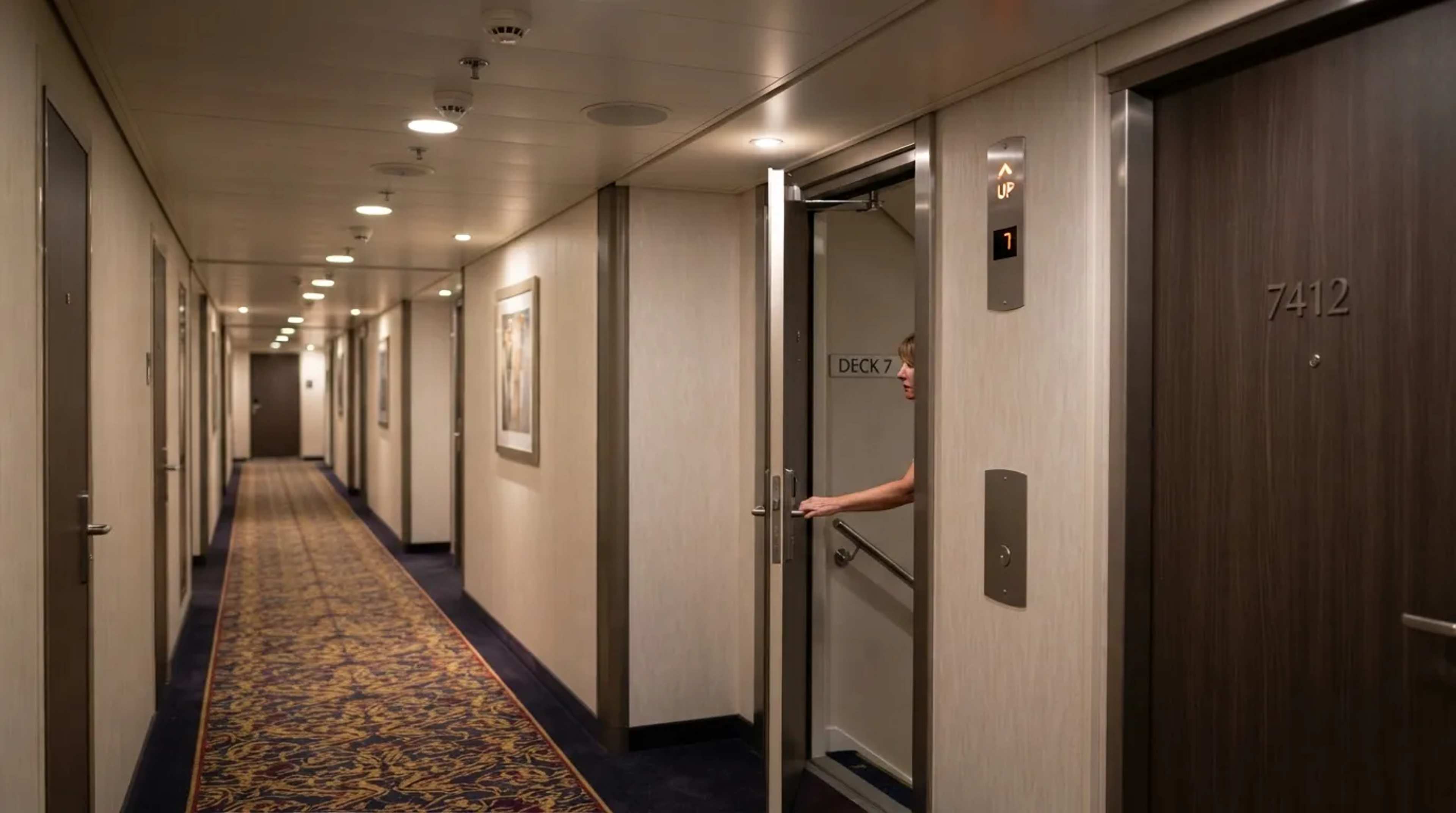
The cabin looks finished the second you swipe in: bed made, balcony light spilling across the carpet, everything in its place. It isn’t. A stateroom is set up for the average guest, and the average guest doesn’t need a CPAP cord, a cold place for insulin or a bed layout different from the one on the door.
Stay through to #1. It’s the one setup item a steward can’t fix at the cabin door, and a wrong guess there can cost you a prescription. Anything beyond the default has to be asked for through the right channel, and the best time to ask is before the ship leaves the dock. First, the smallest move on the list, which takes about ten seconds.
#14 – Lock the Door Behind Your First Bag
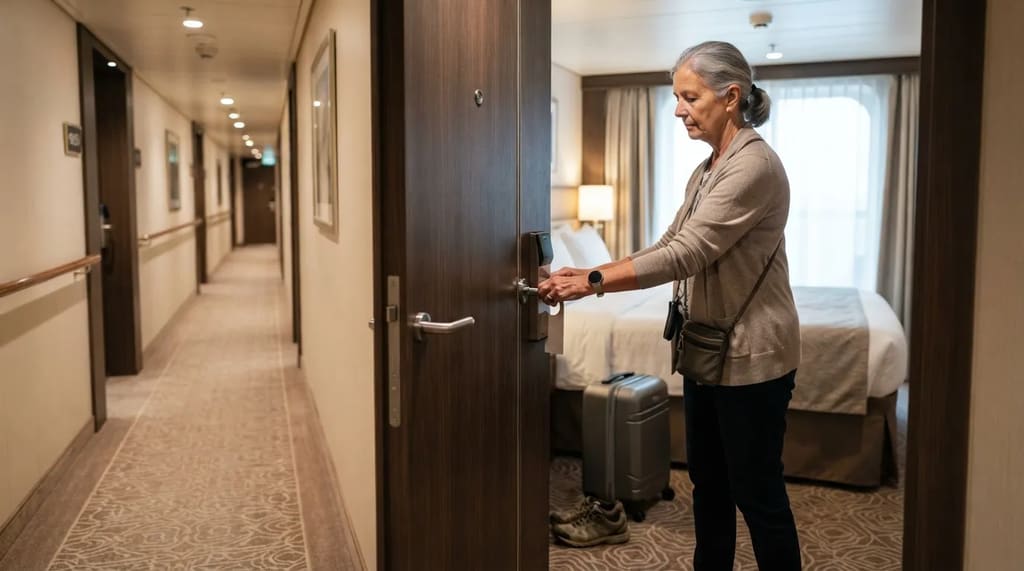
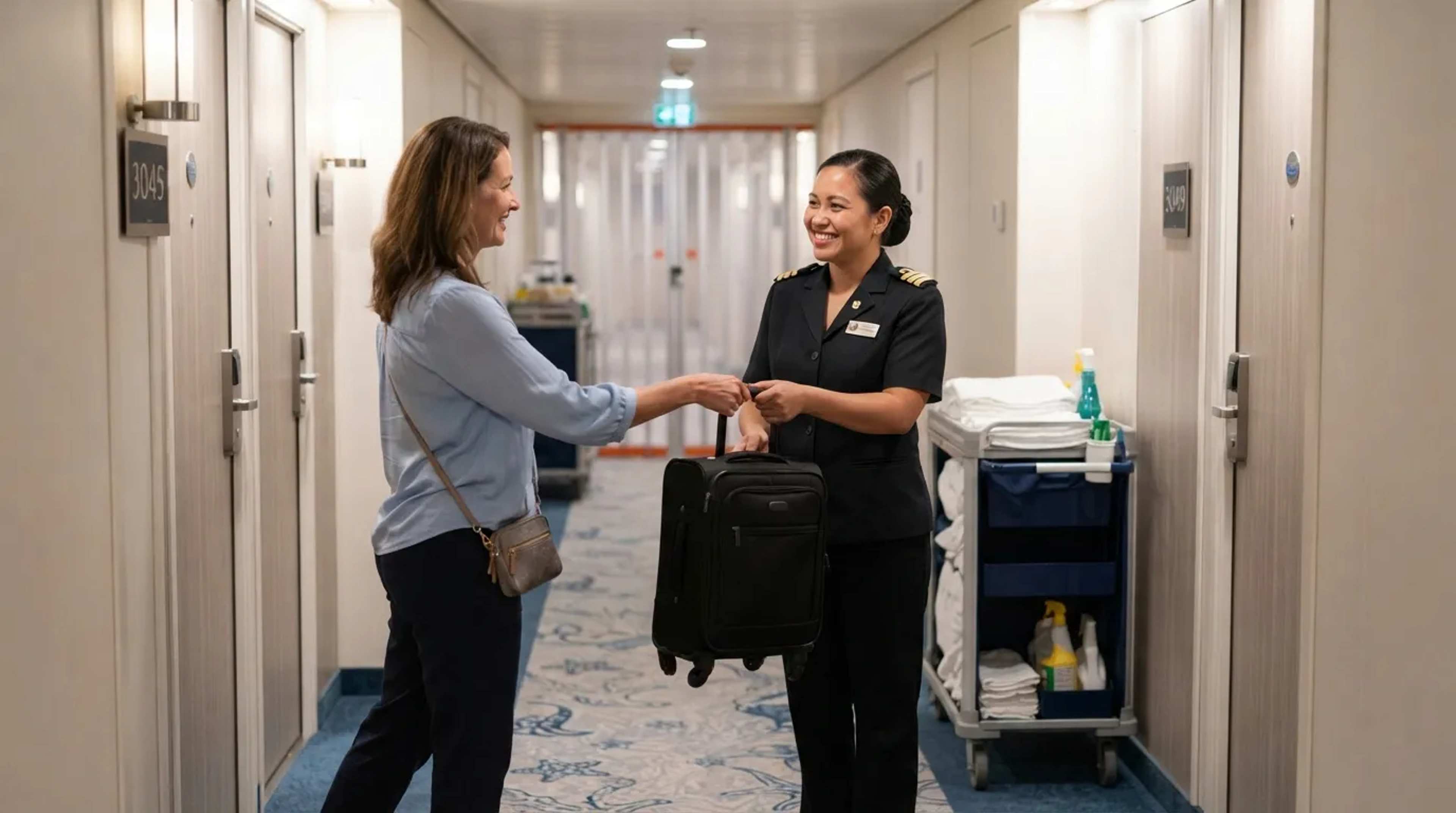
Your keycard opens the cabin, and on most lines you collect it at check-in, so the door is usually your first stop. Even when the stateroom isn’t fully ready, you can often leave roller bags inside.
Once the bags are down, lock the door behind you. Don’t leave it propped open even if that’s how you found it, because your steward has a key and can still get in to finish.
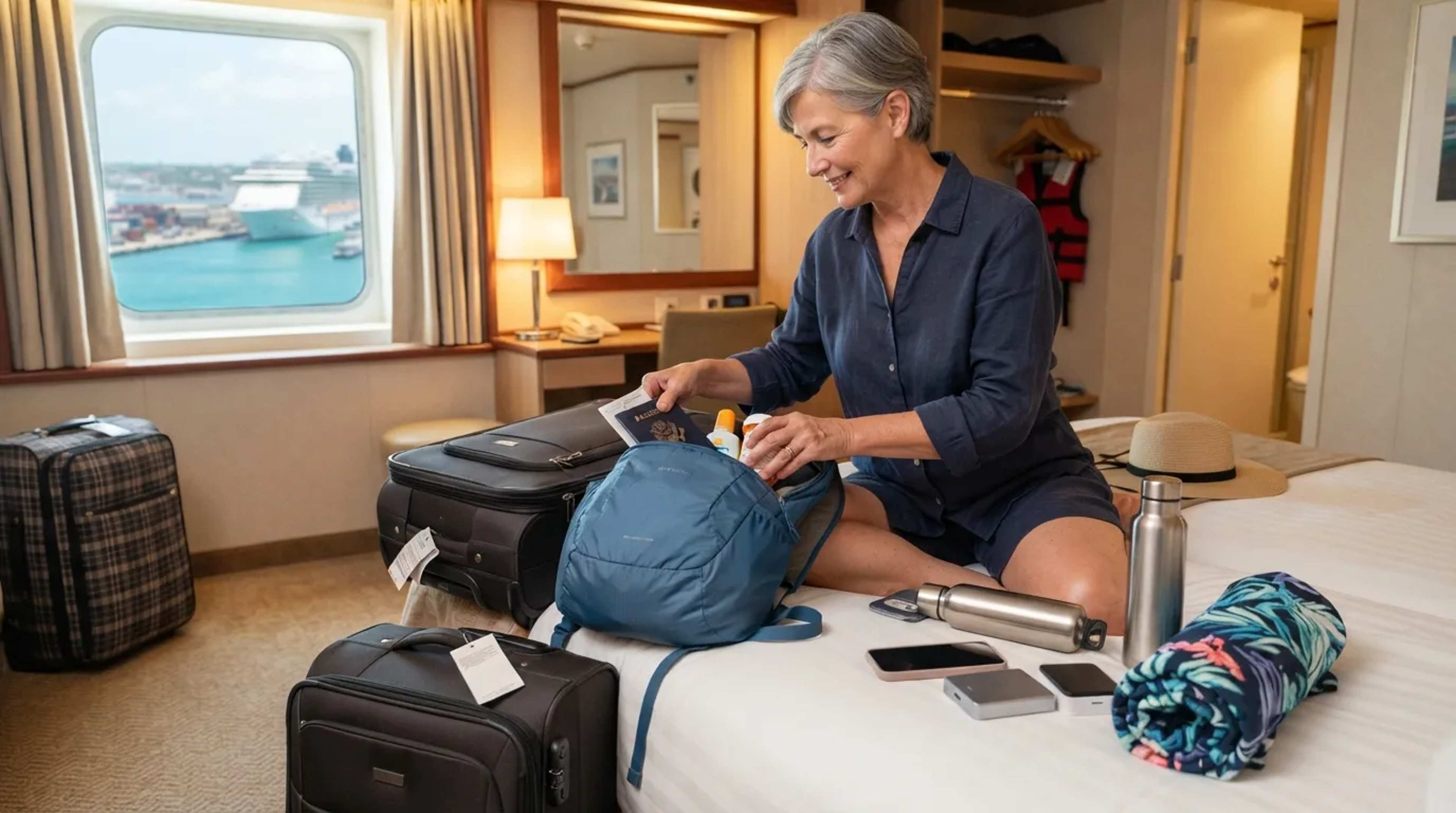
Keep your passport and important documents with you until the safe has been tested. Your luggage may not reach the cabin for hours, so pack medication and a charger in a carry-on that stays in your hand.
A cabin that’s ready on paper can still have a shower that won’t run or a door that won’t latch, and the first hour is when those get fixed fastest.
#13 – Five Minutes of Testing Before You Unpack
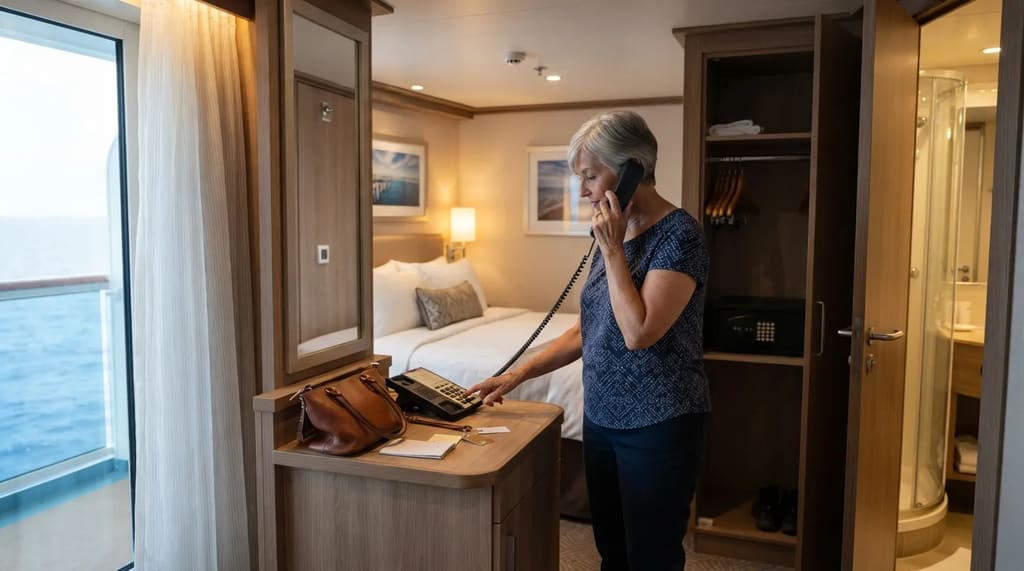
Five minutes inside the cabin catches most of what can go wrong. Start with the booking itself: make sure the cabin category matches what you reserved, especially if you chose a specific layout or location.
Then work through the room with your hands, not your eyes:
- Lights, outlets, shower, toilet and safe
- The cabin, bathroom, closet and balcony doors, each of which should shut and latch
- The TV and the cabin phone
Test every switch, tap and latch before you unpack. If anything is off, tell your stateroom attendant or Guest Services right away, because small problems caught early prevent bigger frustrations later.
One control on the cabin wall costs nothing to change, and it works better the earlier you touch it.
#12 – The Thermostat Comes Before the Suitcase
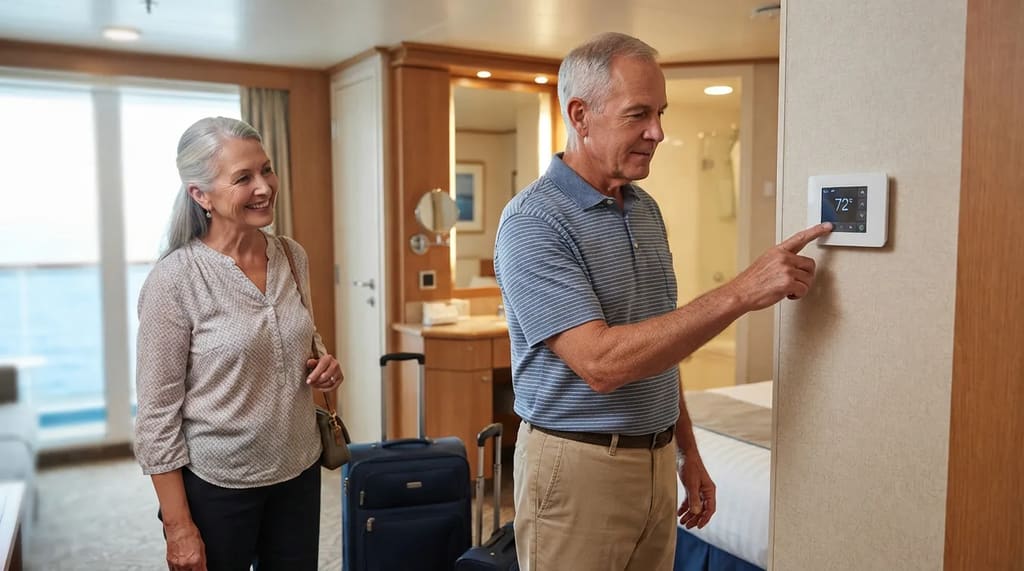
Touch the thermostat before you touch your luggage. Set the temperature the moment you walk in, so the cabin has time to adjust while you do everything else.
The control differs from ship to ship. On newer Royal Caribbean ships you can pick an actual temperature, while older ships have a slider. Set it before you unpack.
If you’re sharing the cabin, agree on a setting now so the first night doesn’t start with a negotiation in the dark. If the control seems to change nothing, add it to the list from your walk-through and tell your attendant.
#11 – Test the Safe Before Your Passport Goes In
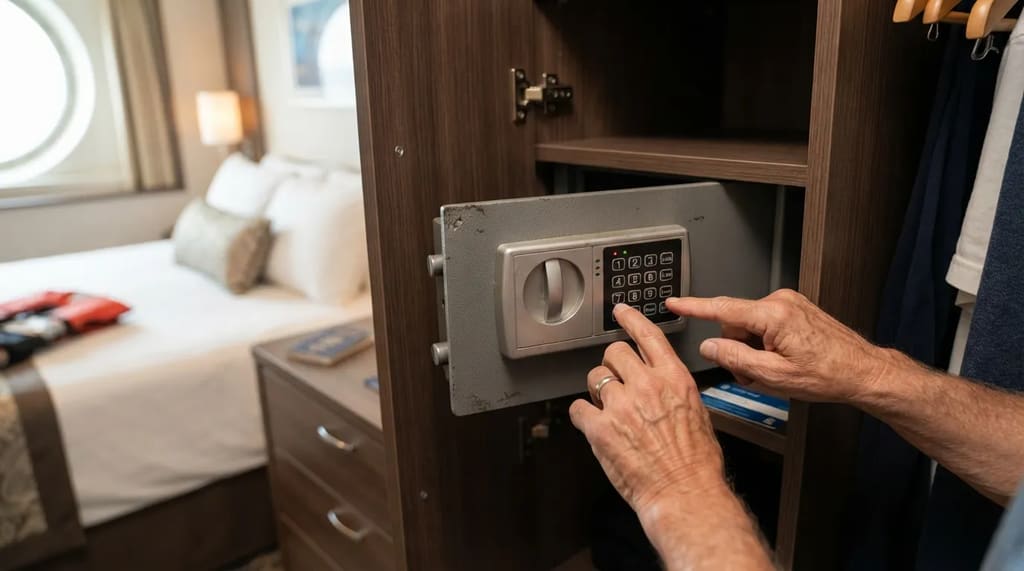
A safe that won’t reopen is a miserable way to start day two. There’s usually one in every cabin, though it may be hidden in a closet or drawer.
On many ships you set a four-digit code to open and close it, while some open with your cruise card instead. Pick four digits you’ll remember without writing them anywhere in the cabin.
Set your code, lock it, then reopen it with the door shut before anything goes inside. Only after that do your passport, spare cash and extra cards go in.
#10 – Finding Every Outlet and USB Port
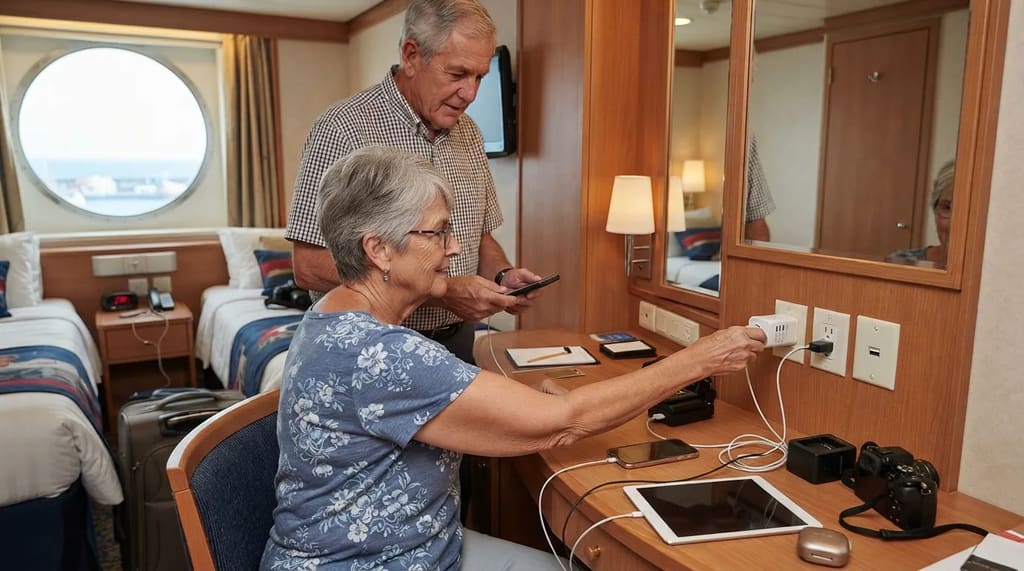
Carnival says each stateroom has one electrical outlet, near the desk or vanity. That’s the line’s own description, and other lines vary, but the lesson holds. Your phone, tablet, camera and hearing-aid charger will compete for very few sockets.
Find every outlet and USB port in the first minute. In a shared cabin, whoever finds them first usually claims the bedside spot.
A multi-port USB charger helps, provided it’s an approved one. Decide tonight which device charges where, and keep your phone cable beside the bed so you aren’t fumbling on a dark floor at 3 a.m.
Fast Facts
- Carnival describes one outlet per stateroom, near the desk or vanity.
- Phone, tablet, camera and hearing-aid charger all compete for the same few sockets.
- A multi-port USB charger is the usual workaround, once it’s confirmed as allowed.
- Cable beside the bed means no fumbling at 3 a.m.
Your home power strip is the obvious fix, and it’s also the item most likely to be taken from you before you reach the cabin.
#9 – Why Your Home Surge Protector Stays Home
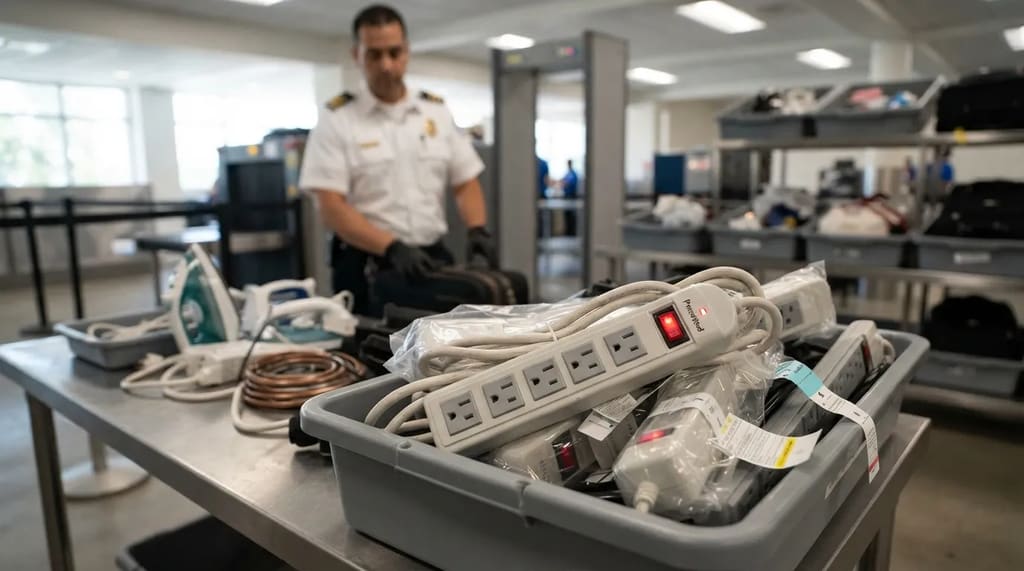
Security can take your power strip before you ever see your cabin. Surge protector strips are banned by Carnival, Royal Caribbean, Norwegian, Princess, MSC, Celebrity and Holland America. Items judged a hazard are confiscated at boarding and returned on the last day before you disembark.
The trap is that most strips sold for home use include surge protection by default. Packaging that mentions surge protection, a joule rating or a protected indicator light is a warning sign. A “cruise approved” label doesn’t change that if the product description says surge protector.
Check your own line’s prohibited list before you pack any strip. My verdict: if you’re sailing Royal Caribbean or Disney, leave the strip at home and plan around a USB charger, after confirming it’s on the allowed list. That fits the outlet count you worked out in the last item.
Fewer outlets means you’ll lean harder on the rest of the room, and the cheapest storage upgrade fits in an envelope.
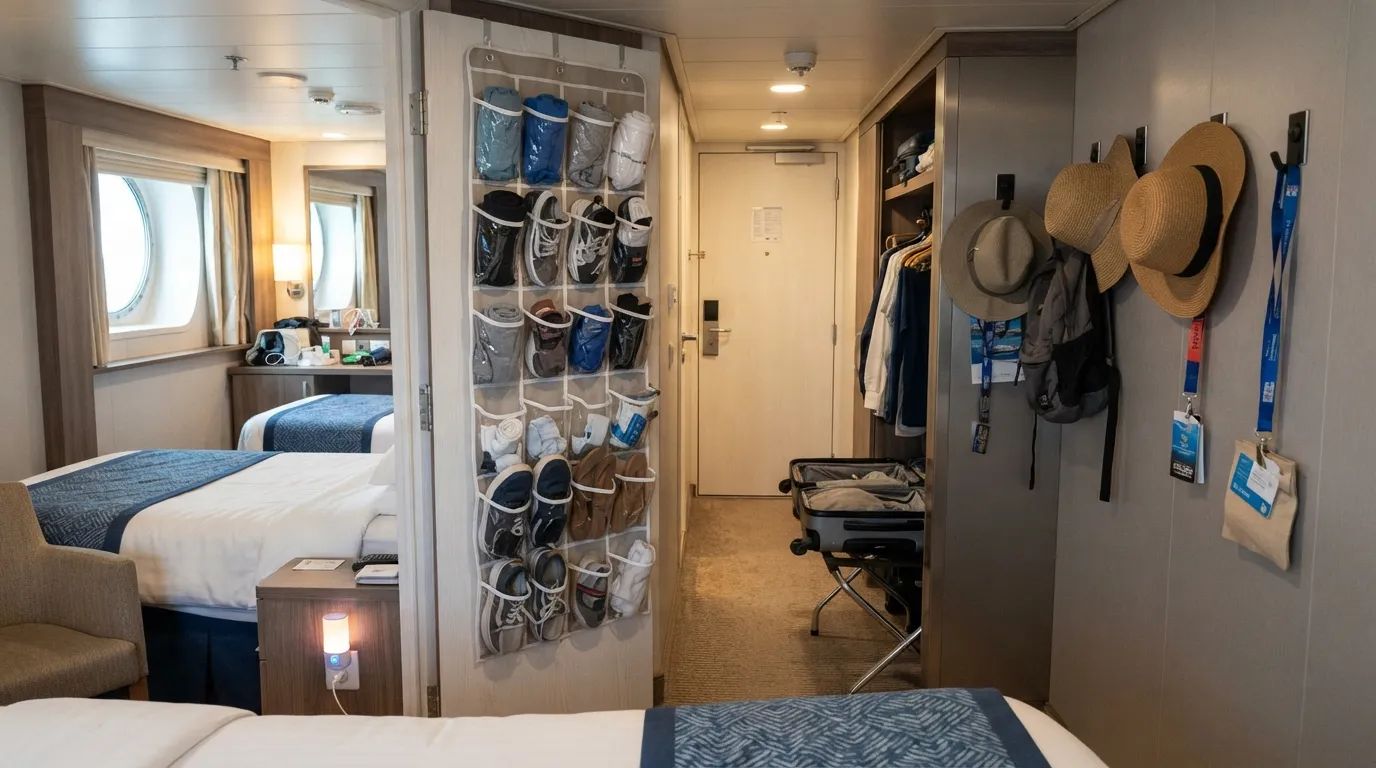
#8 – Hooks and a Shoe Organizer First
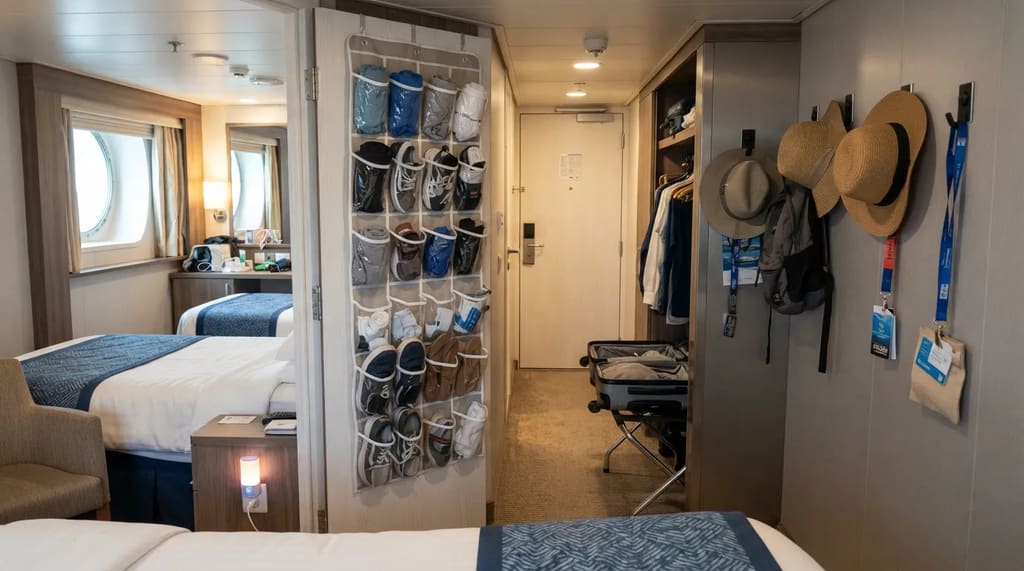
A common tip says to unpack everything within the first hour of boarding. I’d rank that below every item here that involves a drill or a form, because those have deadlines and a half-empty suitcase doesn’t.
Storage still makes the room easier to live in. Magnetic hooks hold hats and lanyards, and over-the-door shoe organizers add pockets where there were none. Once everything has a place, the cabin feels like a small hotel room instead of a packed closet.
If you’re in an inside cabin, plug in a nightlight. Those rooms sleep pitch dark, and a lit path to the bathroom matters at 2 a.m.
Hang the hooks and organizer first, then unpack in order of need. Medications and chargers go first, then tomorrow’s clothes, then everything else.
Whatever a hook can’t solve, one person aboard can, and you’ll see them every day.
#7 – Meet Your Steward and Keep the Card
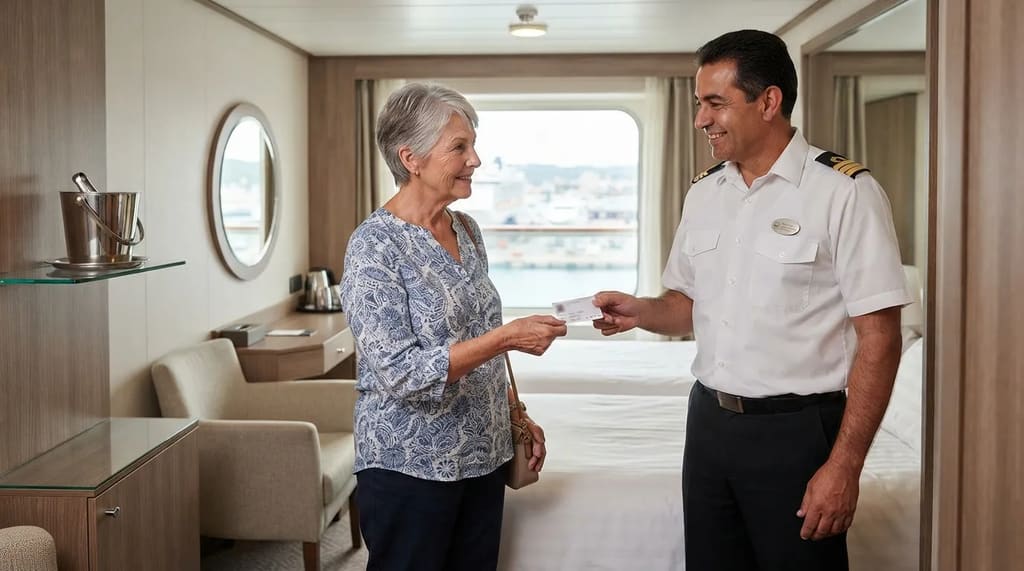
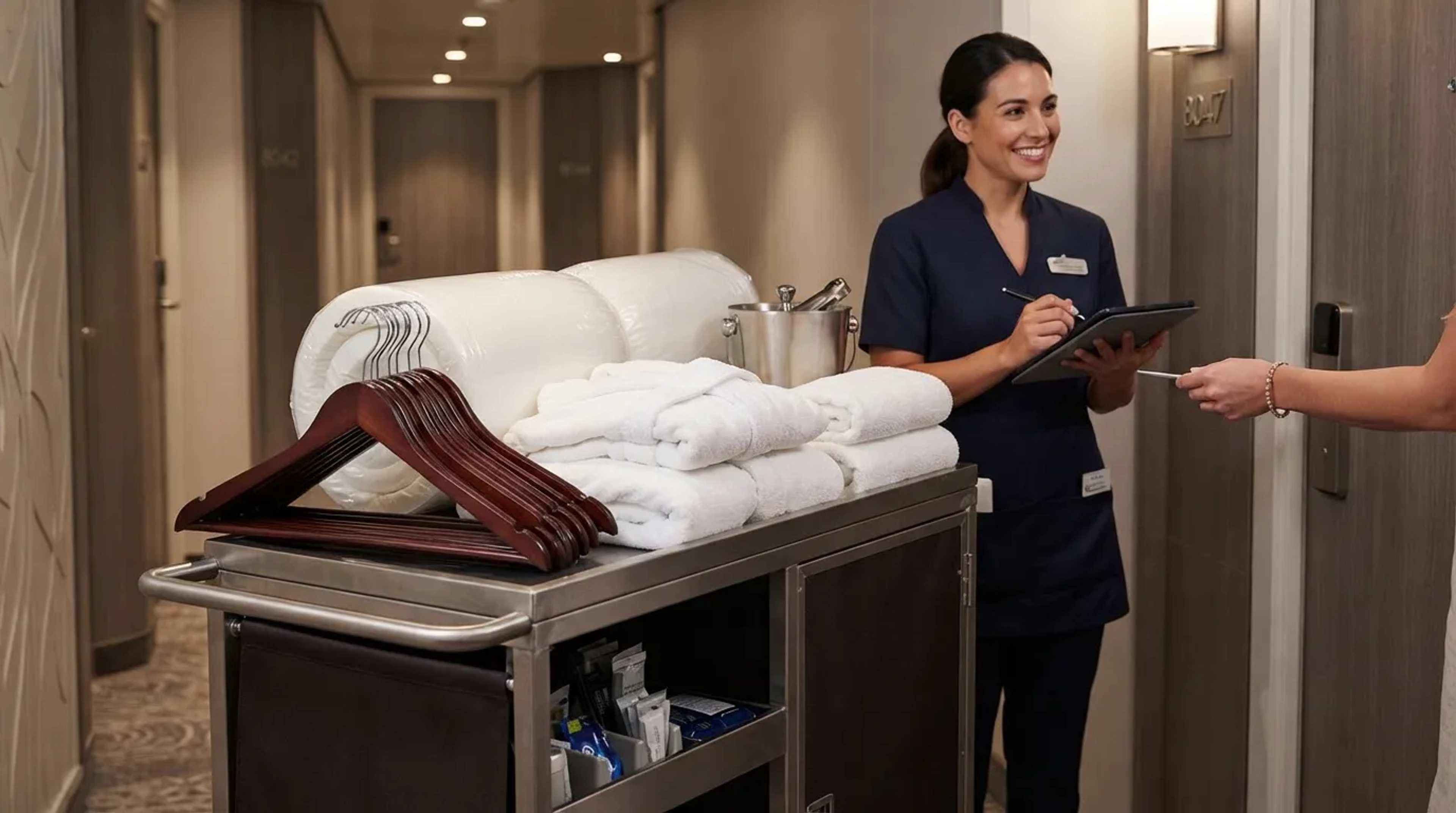
On embarkation day you’ll be asked about special requests, such as a bed configuration or fresh ice. Arrive with one list rather than three separate calls, because every cabin is asking for something at the same hour.
Reasonable items include extra pillows, more hangers and a regularly filled ice bucket. Say them once, clearly, and your steward can plan for them.
Your attendant usually gives you a card with a phone number. Put that card on the vanity mirror where you’ll see it. It has their name on it too, which helps when you want to thank them.
Know what a steward can’t do. Comfort and housekeeping go to the steward, while billing, account questions and medical equipment go to the desk. That split matters a great deal in the last two items.
Of everything you can ask a steward for, one request has a deadline of your first bedtime.
#6 – Fix the Bed Layout Before Your First Night
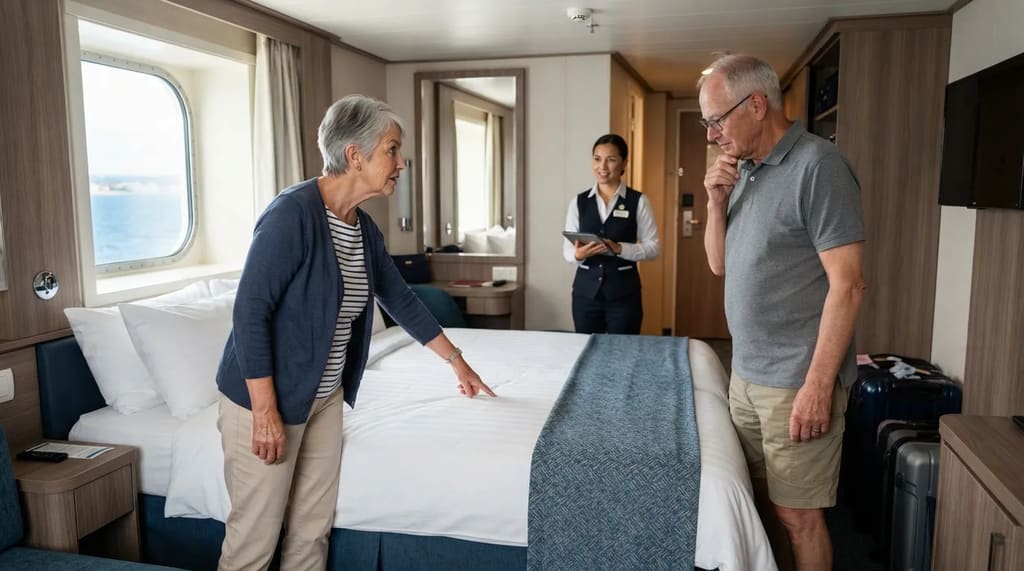
Two twin beds when you wanted a queen is the kind of problem you notice at ten at night. By then the steward is busy and the beds are already slept in.
Check the layout before you unpack. It’s far easier to change on day one than mid-cruise, and the beds can often be adjusted before you sleep that evening. This is your walk-through again, aimed at sleeping.
Say how many beds there are and how they should be arranged for everyone in your party, so the room gets set once. If bunk beds and children are involved, as with grandchildren along, settle that on the first day too.
Ask for your bed layout on embarkation day, before the first night. If the room doesn’t match what you booked, say so at once rather than adapting to it.
Every cabin carries one piece of safety information on the back of its door, and the time to read it is before any alarm sounds.
#5 – Photograph the Card on the Back of Your Door
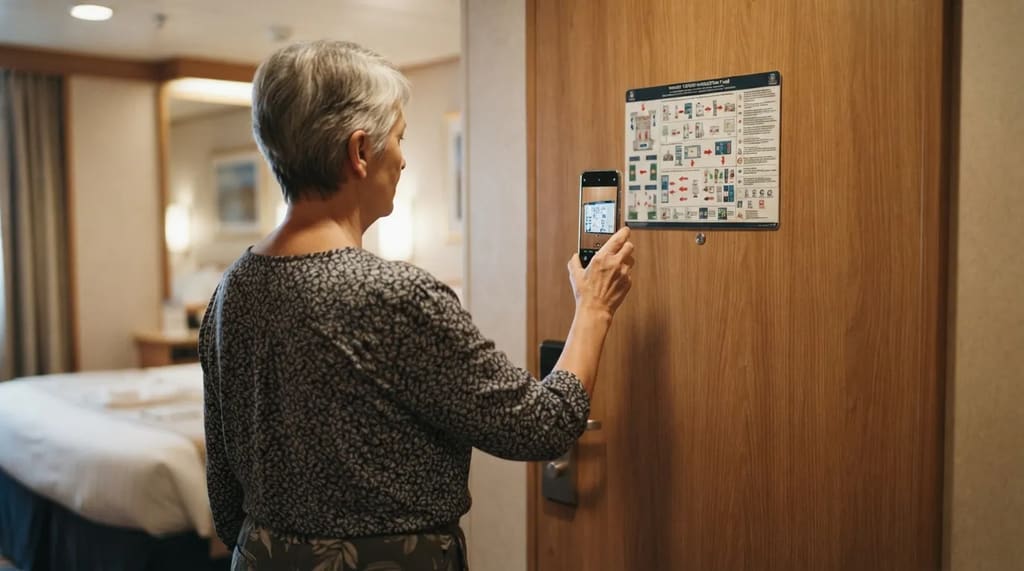
Your muster station is listed in three places: your cruise card, the ship’s app and the back of your stateroom door. Take a photo of the door card, because saved screenshots and photos work with no connection at all.
Then walk to the station once. Learn which deck it’s on and which stairs reach it, and know a second route in case one stairwell is blocked.
Walk to your muster station once and learn a second way there. If family or friends are in other cabins, make sure each of them knows their own station and where you’ll meet afterward.
#4 – Count the Life Jackets and Try One On
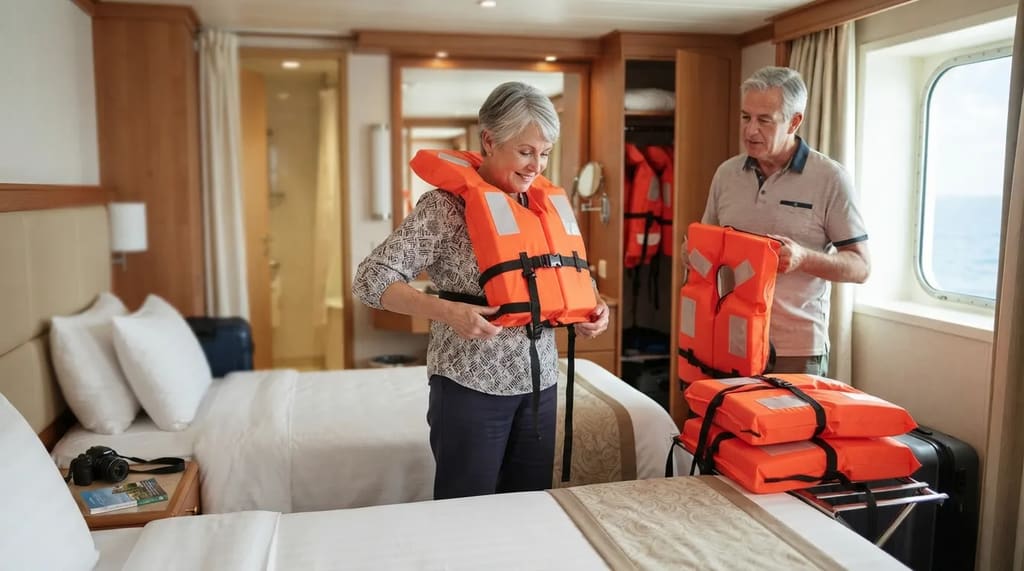
Where life jackets live depends on the ship. On many they’re in the stateroom, usually in the closet or under a bed, and on others they’re kept at the muster station.
On Disney ships they’re usually in the closet, with enough for every guest, labeled with your stateroom and assembly station. If you need a different size, your stateroom host can help.4
Many lines no longer make you carry the jackets to the drill. If yours does, you’ll be told ahead of time. If you can’t get back to your stateroom, one will be provided at the muster station.
Count the jackets and confirm each fits the person who’ll wear it. A size swap is a quick request today and a much harder one in a hurry.
At a Glance
- On many ships: in the stateroom, usually the closet or under a bed.
- On others: stored at the muster station.
- Disney: closet, enough for every guest, labeled with your stateroom and assembly station.
- Wrong size: ask your stateroom host.
- Can’t get back to the cabin: one is provided at the muster station.
That settles where the jacket is. The briefing that shows you how to wear it applies even if you’ve sailed this ship before.
#3 – Finish the Safety Video From Your Cabin
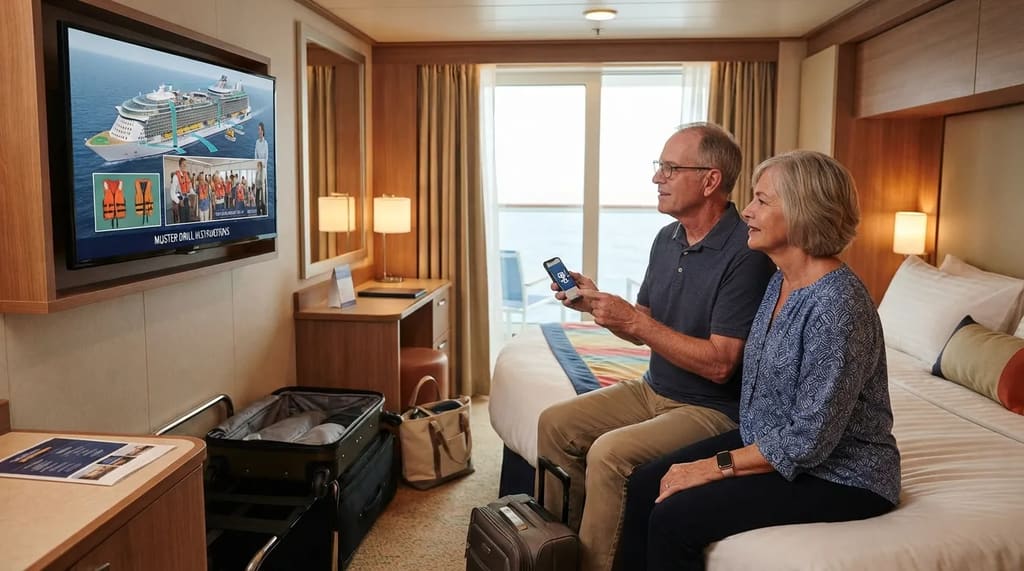
The drill is mandatory. Everyone, even children, must attend, even if you’ve sailed the same ship or line before.
Many lines now let you watch the safety briefing on a smartphone or stateroom TV before visiting your muster station. Royal Caribbean’s drill has three parts, and the first two can be completed in the app or on the TV. The third is checking in at your assigned station at the set time.5 6
If you skip it, your name and stateroom number go to crew members who track you down. The crew also keeps a record of every name at each station and takes a roll call.
Finish the video before you unpack. It’s the only item on this list with a roll call attached, and a rushed check-in is a bad moment to learn where your station is.
Related Stories From Travelbinger
That briefing covers the whole ship. It says nothing about the machine you plug in beside your pillow.
#2 – Power and Water for Your CPAP
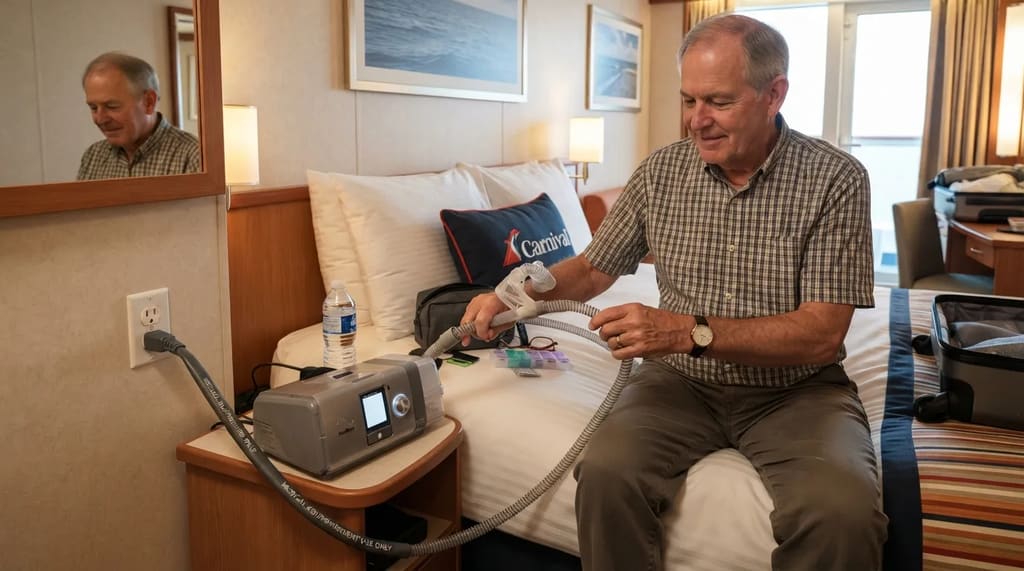
Carnival lists oxygen concentrators, CPAP, BiPAP, APAP, nebulizer and ventilator machines as permitted aboard.7 Supplies for the device aren’t available on board, so filters, tubing and masks have to come with you.
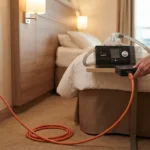
Power is the next problem. Carnival says each stateroom has one outlet near the desk or vanity, so if your bed is across the room, your CPAP needs a cord to reach it. The home surge protector from earlier can’t be that cord.
Ask the line for one. Royal Caribbean has approved cords available on request, and Norwegian allows an extension cord for CPAP without a surge protector. Cords, medication fridges and sharps containers go through a form rather than your steward, which is the split from the steward item.
Distilled water is the other half. Princess says you can request it when you make your reservation, and it’s also sold pre-cruise or from Room Service on board. Carry the CPAP yourself and label it with your name and cabin number.
Power is only one of the cabin’s limits. The small fridge in the corner is another, and it matters more than anything so far.
#1 – A Real Refrigerator for Medication, Not the Minibar
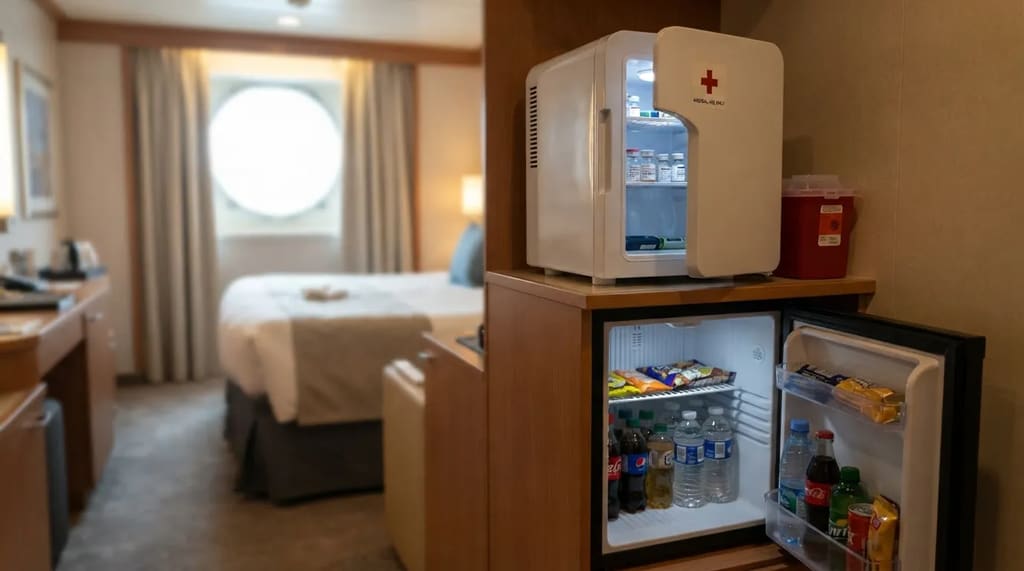
Carnival and Royal Caribbean both state that stateroom minibars hold beverage temperatures only and shouldn’t be used for medications. Disney asks guests not to put medication with specific temperature requirements in the stateroom cooler, and notes that mini-fridges may not hold insulin at the right temperature.
That makes this the costliest wrong assumption in the countdown. A stiff door or the wrong bed can be fixed with a steward’s visit, but medication that has warmed up can’t be undone.
The route is a form. Royal Caribbean has guests with injectables submit a Guest Special Needs Form to request a medical refrigerator and a sharps container. Carnival’s pre-cruise forms cover diabetes, sharps and medicine storage.8 Send the medical refrigerator request on your line’s form before you sail.
Quick Compare
- Carnival and Royal Caribbean: the minibar holds beverage temperatures only, so keep medication out of it.
- Disney: no temperature-sensitive medication in the cooler, which may not hold insulin at the right temperature.
- Royal Caribbean: a Guest Special Needs Form gets you a medical refrigerator and a sharps container.
- MSC: the Medical Center can store medication, but you can collect it only during opening hours.
It’s the same paperwork as the CPAP cord, so send both together. If cabin arrangements fall through, the ship’s Medical Center can store temperature-sensitive medications. On MSC, though, stored medication can be collected only during opening hours, which makes an evening dose awkward.
Used needles need a home too. Carnival says any medical sharp, meaning needles, lancets or blades, must go in a sharps container, and you can request one from your housekeeping steward once aboard.
My verdict: don’t trust the cabin fridge with anything your doctor says must stay cold, and carry an insulated medication case as backup. Ask your doctor or pharmacist what temperature your medication needs before you write the request.
A stateroom looks finished the moment the door opens, and that’s the trap. The made bed suggests nothing is left to do, while the things that matter most were never in the room to begin with.
So treat your first hour as editing. Send equipment requests through the form, comfort requests to your steward, and safety items to your own eyes: the card on the door, the jackets in the closet, the route to your station. A little effort before sailing beats a lot after.
What’s the one thing you now do in your first hour aboard that you wish you’d known on your first cruise?
- Cruise Power Strip Rules: https://travel-hacker.com/2026/10/16/cruise-power-strip-rules/
- Royal Caribbean Banned Outlets: https://www.yahoo.com/lifestyle/royal-caribbean-shares-final-banned-153812629.html
- Disney Prohibited Items Answer: https://plandisney.disney.go.com/question/cruise-approved-power-strip-royal-caribbean-disney-non-621605/
- Disney Muster Drill Guide: https://www.dclcruisingdad.com/disney-cruise-muster-drill-explained-and-what-to-expect-on-embarkation-day
- Royal Caribbean Muster Drill: https://www.royalcaribbean.com/faq/questions/muster-drill-onboard-safety
- Muster 2.0 Overview: https://www.royalcaribbeanblog.com/2021/11/13/what-expect-royal-caribbeans-new-virtual-safety-drill
- Carnival Medical Equipment Policy: https://help.carnival.com/app/answers/list/search/1/kw/medical%20equipment/suggested/1
- Carnival Shipboard Medical FAQ: https://www.carnival.com/about-carnival/special-needs/shipboard-medical-services-faq