


Resort fees can run from $15 to $50 a day, according to NerdWallet, which adds $60 to $200 to a four-night stay before parking, Wi-Fi or a pet is counted. Hotels decide for themselves whether to waive any of it, and no chain advertises a waiver for age alone.
The ask that sometimes works is polite, specific and well timed, and the right moment changes from charge to charge. The biggest charge on this list rewards a move you make long before you reach the desk, and the smaller ones start with the hour you arrive.
#15 – Early Check-In Before the Room Is Ready

Check-in at many hotels opens in mid-afternoon. If you land at noon or finish an overnight drive, your room may not be cleaned yet.
Some hotels sell guaranteed early check-in as an add-on, while others hand over a room for free the moment one is ready. So ask whether a room is available now, and let the price come second.
If the answer is later, ask them to hold your bags. A clean room often turns up sooner than the posted hour.
A room that opens early still has to be vacated on the other end, and some hotels price that departure hour.
#14 – What a Late Checkout Can Cost

Standard checkout falls in the late morning, and a few hotels charge for staying past it. Others extend an hour or two at no cost when the room is not needed right away.
The answer often depends on how full the hotel is that night. Raise it when you check in, not on departure morning, when housekeeping schedules are already set.
A short, specific request, such as one extra hour for a mid-day flight, gets a clearer answer than a general plea.
#13 – Paying for Faster Wi-Fi You May Not Need

At some hotels the basic connection is free and a faster tier costs extra by the night. If you read email, check the news and video call a grandchild, the basic connection will do the job.
Before you pay for anything extra, look at what the resort fee already lists. Wi-Fi is often on that list, and one fair argument for dropping the fee is that you have your own connection and will not use the pool.
Internet is a charge for the room; the next one depends on how many people are sleeping in it.
#12 – Extra Guest Charges When a Grandchild Joins

Hotels price by the room, but many add a nightly extra-person charge once you pass the standard occupancy. That can surprise grandparents who booked for two and then brought a child along.
Check the occupancy rule before you reserve, and ask whether the charge applies to children. Then compare it with the price of a room type that sleeps three or four.
Worth Knowing
- The extra-person charge usually kicks in once you pass the standard occupancy.
- Ask whether the charge applies to children, not just adults.
- A larger room type can cost less than the base room plus the nightly add-on.
- A rollaway bed carries its own fee at some properties, so ask in the same call.
Another kind of guest is billed under its own rules, sometimes per night and sometimes once.
#11 – Pet Fees Charged Per Stay or Per Night

Pet fees vary a great deal. In the Los Angeles area, a recent Journeyed hotel-fee index, which counts what hotels post on their own websites, found a median pet fee of $100 at 48 hotels.
On a long visit, the way the fee is charged can be the difference between a fair price and a poor one. Ask exactly how it works before you book.
A trained service dog is not a pet under the Americans with Disabilities Act, so a pet fee generally should not apply to one. If you are charged anyway, ask for the manager and cite the policy.
#10 – Senior Rates Missing From Booking Sites

This is the one place on the list where age is the stated reason for a lower price, and the discount applies to the room, not the extras. Some chains begin senior rates at 55 rather than 65, and Best Western, Marriott, Hilton and Choice Hotels all offer them, though eligibility and savings vary.1
Online booking sites often do not show these rates. Calling the hotel directly can turn up discounts the websites do not display.
Compare before you accept. A room labeled as a senior rate is not necessarily the cheapest available, and a loyalty, AAA, AARP or promotional rate could still beat it.
AARP discounts apply to the room rate only, not to meals or fees, so the resort fee and parking charge stay on your bill.2 At the desk, staff can sometimes layer a discount or upgrade if you ask politely and the hotel is not fully booked, but treat that as a bonus, since AAA discounts requested at the counter without a pre-booked rate are applied inconsistently.
That discount touches the room rate only and leaves the parking charge, which hotels bill separately by the night, right where it was.
#9 – Valet Parking at Twice the Self-Park Price

Valet is the most expensive way to leave a car at a hotel. Self-parking costs far less where it is offered.
Quick Compare
- Valet: a median of $60.25 a night in the Los Angeles index, and none of the 30 hotels listing it said it was free.
- Self-parking: 157 of the 218 hotels that state a price call it free, and the median charge at the rest is $30.
If a hotel offers both, take self-parking unless the walk from the garage is a real burden. In that case, ask about accessible spaces near the entrance before paying the valet premium.
Both prices assume a car, and some hotels bill for parking whether one arrived or not.
#8 – Parking Billed to Guests Without a Car

Some properties charge every guest a mandatory parking fee, regardless of how they arrived. If you came by train, bus or rideshare, you may be billed for a space you never used.
Ask at booking whether parking is optional, and check the folio before you accept the charge at check-in. A request to remove a fee for something you did not use is specific and reasonable, which makes it easier for the desk to say yes.
The hotel still decides, since a mandatory fee is a policy, not a mistake.
#7 – Hotel Parking Versus the Garage Down the Street

Hotel parking averages $44 per night nationally, according to ResortFeeChecker.com, and a nearby public garage can be much cheaper. One Denver hotel charged $40 for self-parking and $49 for valet, while a public garage nearby cost $12 a night.
The gap is not universal, though. In Mews’s city comparison, Chicago hotels charged about $10 more than public lots on average, while Miami hotel parking ran $6.67 below public options.
A ten-minute look at a map before you book is worth it. Look up the garage’s published rate and its hours while you are there.
Parking is at least labeled as parking; other charges arrive under names that say nothing about what they cover.
#6 – A Destination Fee Under Another Name

A resort fee does not always appear under that name. In New York City the fees are often called destination, facility or amenity fees, so read every line of your bill, not just the one marked resort.3
The amounts vary widely too. In the Los Angeles index, 27 hotels stated a resort or destination fee, from $3 to $125 a night.
Ask what the fee covers. Some resorts return part of it as credits for food, drinks and activities, and taking the credit is an easier request for staff to grant than a full waiver.
Whatever the label, the fee is easiest to question on a day when what it pays for is shut.
#5 – Resort Fees on Days the Pool Is Closed
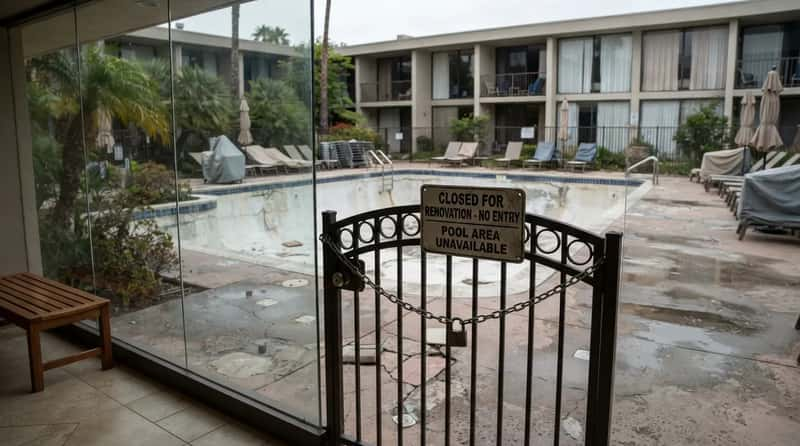
This is the strongest reason you can give. NerdWallet says you can make a stronger case if you could not have used the amenities, such as arriving after the gym and pool closed and leaving before they open.
If the pool is closed for renovation or for the season, ask whether the fee still applies.4 A reason beats your age here, because staff can see exactly what you are not getting.
The hotel decides, and there is no general right to a waiver.5 Ask while the bill can still be changed, since staff can investigate and correct it before checkout.
#4 – A Resort Fee That Never Appeared in the Price

A fee that surprises you at check-in raises a different question from a closed pool. The FTC’s rule on unfair or deceptive fees took effect May 12, 2025, and it requires businesses to disclose the true total price, including all mandatory fees, when they advertise short-term lodging.
It does not ban resort fees, so a properly disclosed fee still stands. If a mandatory fee appeared for the first time at the desk, ask the hotel to show where it was disclosed during booking.
Keep your confirmation email and a screenshot of the price. Do not simply refuse to pay, since refusing a properly disclosed mandatory fee may affect the hotel’s willingness to complete your check-in.
Even properly disclosed fees vanish for some guests, depending on how much loyalty they have built with a chain.
#3 – Resort Fees Waived for Top Loyalty Tiers

Some loyalty programs waive resort fees for their top members, with no negotiation needed. The benefit differs by brand and by property, and lower tiers often do not carry it.4
Check the specific program’s published terms before you count on it. Without status, staff often insist the fee is mandatory, which is a good reason to rely on posted benefits, not goodwill.
At a Glance
- Top-tier status: the waiver is built in, but it takes years to earn.
- Points booking: the fee comes off a single stay, with no status required.
- Desk request: the hotel decides, so bring a specific reason.
Status takes years to earn, whereas a points redemption can take the fee off a single stay.
#2 – Resort Fees Skipped on Points Bookings

Hilton Honors and World of Hyatt waive resort fees on bookings made with points.4 5 This is a choice you make before you arrive, so there is nothing to negotiate at the desk.
It matters most where the fee is large, since at some properties the resort fee can cost more than the room itself. If you hold points from a card or past stays, a heavy-fee resort is often the best place to spend them.
For a hotel with a modest fee, you may do better saving the points for something else.
Points and status help only those who hold them; for everyone else, the booking stage is the cheapest moment to raise the fee.
#1 – The Resort Fee You Raise Before Booking

The best time to ask about a fee is before you have committed to the hotel. At the desk, a no leaves you holding the bill, but before booking, a no just sends you to another hotel.
Booking sites help here. U.S. hotel searches online should now show resort fees in the total price, so compare the real totals first.
Then consider whether a hotel with no fee is the better answer. AHLA data cited in December 2024 put the share of U.S. hotels charging a mandatory resort, destination or amenity fee at 6 percent, averaging $26 a night, though those fees cluster in resort and tourist destinations.
If you are choosing between two similar hotels, the one without the fee beats any waiver you might win. Many mid-scale brands, such as Hampton Inn and Courtyard Marriott, often do not charge resort fees.
If your top choice does charge one, call the property and ask what the fee covers and whether it applies to your dates. The hotel decides, and your reason carries more weight than your age.
Look back over all fifteen and one pattern stands out: the polite ask works best when it comes with a reason and arrives early. Age on its own is rarely the lever, but a closed pool, a fee you never saw or a car you did not bring gives the desk something specific to act on.
Next trip, spend ten minutes before booking on the total price and the fee policy, and treat the desk conversation as the backup. Policies differ by hotel and brand, so check your own booking terms.
Which hotel charge has surprised you most on a bill, and did asking about it change anything?
- Choice Hotels Senior Rates: https://www.choicehotels.com/deals/senior-rates
- AARP Hotel Discounts Explained: https://everythingseniors.org/senior-discount/aarp-hotel-discounts-for-seniors
- CNBC Resort Fee Disclosure: https://www.cnbc.com/2025/05/12/resort-fees-must-be-disclosed-what-to-do-if-youre-charged-one.html
- The Points Guy Resort Fees: https://thepointsguy.com/glossary/what-is-a-resort-fee
- NerdWallet Resort Fees Guide: https://www.nerdwallet.com/travel/learn/hotel-resort-fees
