
Most people over 60 walk into a departure gate and treat it like a waiting room – somewhere to sit, guard their carry-on, and hope the middle seat next to them stays empty. What they don’t realize is that the person standing at that podium has more power to change their flight experience than almost anyone else in the building. Airlines aren’t advertising any of it. The accommodations exist, they’re real, and most of them are protected by federal law – but the gate supervisor can’t help you if you don’t know to ask.
The gap between what most travelers over 60 endure and what they’re actually entitled to is wider than almost anyone realizes. Every item below is documented, available on nearly every major U.S. carrier, and sitting right behind that gate podium – waiting for someone to speak up. A few of them will genuinely surprise you, especially the ones hiding in plain sight.
#15 – Quietly Scanning the Gate Area Before You Even Reach the Desk
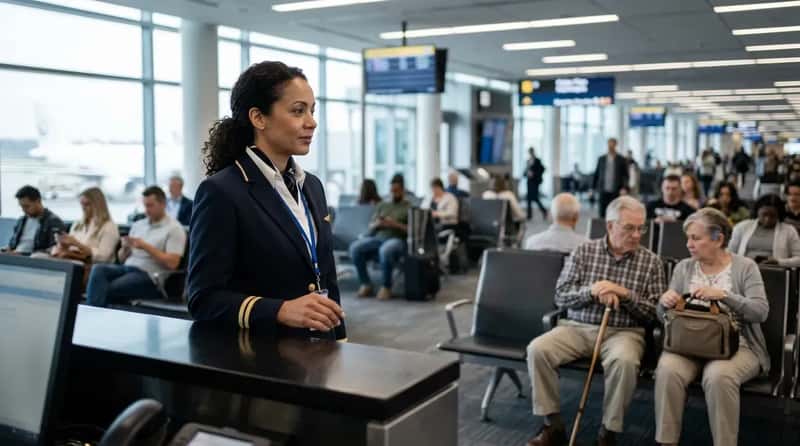
Most travelers assume a gate supervisor only notices them once they walk up and ask for something. That’s not how it actually works. A seasoned agent is constantly reading the room – watching who walks in, how they’re moving, whether anyone is struggling with a bag, who looks like they’re in pain and trying not to show it. They’re juggling seat assignments, crew issues, and last-minute changes, but the best ones are doing all of it while quietly inventorying who needs extra support before boarding even begins.
Agents spot mobility challenges, hearing aids, medical equipment, and visible fatigue – and they’re mentally flagging passengers for assistance well before any boarding announcement is made. You don’t have to approach the desk to get on their radar. Sometimes just walking through the gate door tells them everything they need to know. The ones who miss out are the ones who sit in the corner and wait to be called – because that call doesn’t always come.
At a Glance
- Gate supervisors are trained to identify passengers who may need assistance – no formal request required to get noticed
- Mobility aids, visible fatigue, and medical equipment all register with a trained agent scanning the gate area
- Sitting quietly in a corner is the single most common reason eligible travelers miss out on available support
- The earlier you arrive at the gate, the more options a supervisor has to arrange help before boarding chaos begins
#14 – Arranging Pre-Boarding Without Any Paperwork or Doctor’s Note
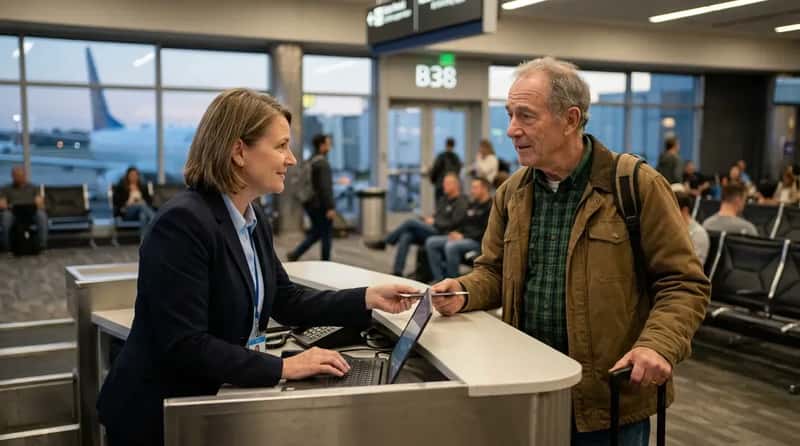
Pre-boarding sounds like something reserved for elite frequent fliers and first-class passengers. It isn’t. Airlines are required to allow passengers who self-identify at the gate as needing additional time or assistance to pre-board – no doctor’s note, no formal disability designation, no special membership required. Gate supervisors are the ones who make it happen, and they can add you to the list immediately when you ask.
The single most common mistake seniors make is waiting until they hear a boarding group announcement to bring this up – by then, it’s too late to do it cleanly. Walking up to the podium early and saying “I’d like a little extra time to board” is genuinely all it takes. Most gate supervisors will add you to the pre-board list on the spot, no questions asked. The system is designed for exactly this – it’s just not promoted anywhere.
#13 – Flagging Wheelchair Escort That Skips the Standard Wait
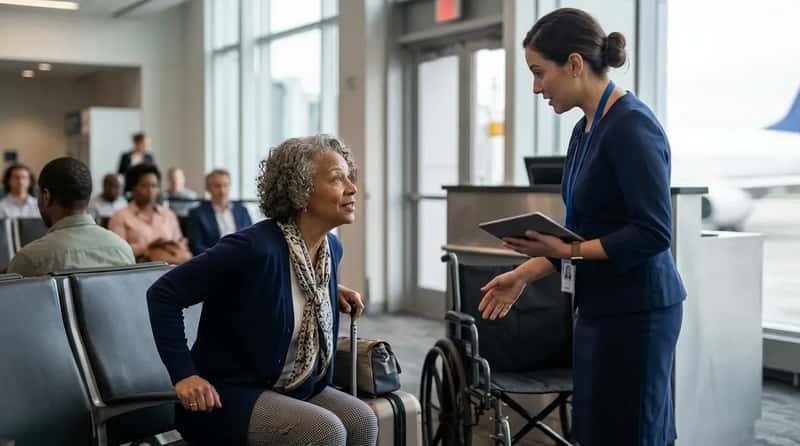
Here’s what surprises most people: you don’t need to be visibly disabled or use a wheelchair at home to request airport wheelchair service. The Air Carrier Access Act entitles passengers to free wheelchair or ambulatory assistance throughout their entire airport journey – escort through security, help with carry-ons, expedited processing, and priority boarding. That’s federal law, not an airline favor. Gate supervisors can activate this on the spot, even if it wasn’t arranged at booking.
Standard requests made only at check-in can mean a long wait at a busy hub. Travelers who confirm the request directly with the gate agent – not just at booking – often get a faster, more seamless escort, because that second mention reactivates the priority flag for that specific departure. In December 2024, the DOT issued a landmark final rule significantly expanding airline obligations for wheelchair assistance, which took effect January 16, 2025 – meaning airlines are now under stronger legal obligation than ever to deliver this service promptly and with dignity. Mention it again at the gate. It matters.
Fast Facts
- The DOT’s 2024 Wheelchair Rule took effect January 16, 2025, strengthening airline obligations under the Air Carrier Access Act
- Airlines must provide wheelchair assistance from the terminal entrance all the way to the aircraft seat – not just to the gate
- In 2023 alone, U.S. airlines mishandled 11,527 wheelchairs and scooters, prompting the toughest federal crackdown in decades
- In October 2024, American Airlines was fined $50 million by the DOT for disability-related violations – the largest such penalty ever issued
- You do not need to use a wheelchair at home to request airport wheelchair service – any passenger can ask
#12 – Coordinating a Companion Security Pass So Family Can Stay Until Boarding

Most people assume that once you pass through security, anyone seeing you off has to say goodbye at the checkpoint. That’s been the general understanding since 9/11 – and it’s not actually the full story. Airlines can issue a companion security pass that lets a non-traveling guest walk through security, reach the gate, and stay until boarding is complete. For travelers over 60 who want a family member close until the very last moment, this is one of the most quietly generous policies in U.S. commercial aviation.
Major U.S. airlines – including Alaska, American, Delta, JetBlue, Southwest, and United – offer these passes to non-passengers assisting seniors, passengers with disabilities, or military members. The pass is obtained at the ticket counter before you get to the gate, so ask early when you arrive. The helper just needs a valid ID. Most families traveling with a senior parent have never heard this option exists – and the ones who do use it say it changes the entire tone of departure day.
#11 – Carrying Carry-On Luggage to the Seat When Lifting Is a Problem
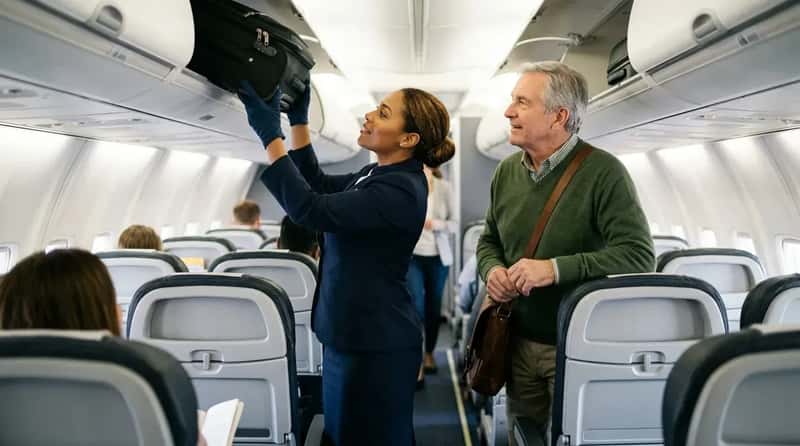
Lifting a carry-on bag into an overhead bin is one of the most injury-prone moments of any flight – and it’s the one thing most travelers over 60 silently endure rather than ask for help with. They don’t have to. Airlines are required to assist passengers in carrying their luggage when passengers are unable to do so due to a disability or physical limitation. Gate supervisors can flag this need for the boarding crew before a passenger even steps onto the jet bridge.
The key is mentioning it to the gate supervisor before boarding starts – not fumbling with the bin mid-aisle while a line builds up behind you. A single sentence – “I have some trouble with the overhead bins” – is enough to get the right crew member in position to help the moment you step on board. It’s one of those things that feels awkward to ask for until you do it once, and then you wonder why you ever struggled through it alone.
#10 – Reassigning Seats for Better Access and More Legroom
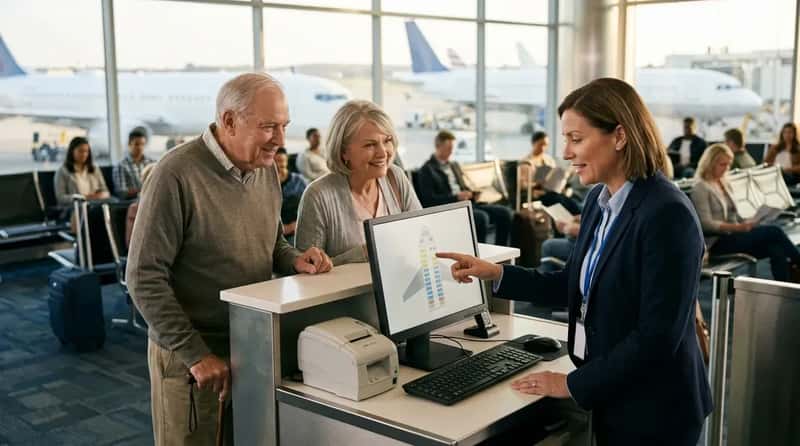
Seat assignments feel locked in once you’re at the gate. For travelers over 60 with mobility concerns, that assumption leaves a lot on the table. Under the Air Carrier Access Act, airlines are required to provide seating accommodations to passengers with disabilities who self-identify as needing a specific type of seat. Gate supervisors have direct authority to move passengers before the flight is called – and they use it more often than most travelers ever realize.
Subject to availability, passengers may request aisle seats, movable armrests, seats with greater legroom, or adjoining seats for a companion who’s there to assist. Some carriers have internal codes agents use to reassign senior travelers to premium economy at no charge under sensitive traveler policies. Same ticket, completely different flight experience – and it happens every day at airports across the country. The only thing standing between you and a better seat is a conversation you haven’t had yet.
Quick Compare
- Aisle seat: Easier boarding, deplaning, and restroom access – request by name at the podium
- Movable armrest seat: Required on half of aisle seats on aircraft with 30+ seats under federal law
- Extra legroom seat: Often reassigned at no charge under sensitive traveler policies – ask specifically
- Adjoining companion seat: Available when a travel companion is present to assist – mention that framing
#9 – Arranging Electric Cart Rides Through the Terminal
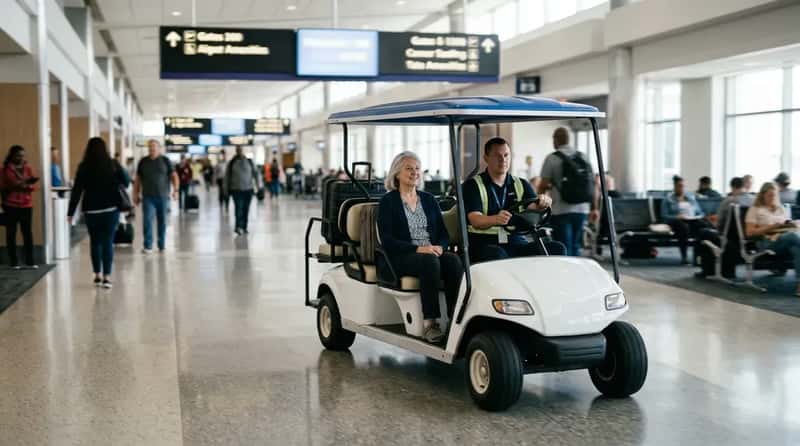
Those golf-cart-style vehicles gliding through terminal corridors are one of the most misunderstood perks in U.S. airports. Most travelers assume they’re reserved for passengers in wheelchairs or with serious visible disabilities – and that assumption costs a lot of senior travelers a lot of unnecessary pain. In reality, gate agents can flag passengers for courtesy cart assistance far more broadly, and they do it regularly for travelers who ask with the right framing.
For anyone over 60 navigating a major hub like Atlanta Hartsfield, Chicago O’Hare, or Dallas-Fort Worth – airports where a connection can mean nearly a mile of walking – this isn’t a small thing. It’s the difference between arriving at the next gate relaxed and arriving breathless with a knee that’s been complaining since Denver. A companion gets to ride along even if they’re not the one who needs the assistance. Most people don’t know that part. Ask the gate supervisor directly, not a random terminal employee, and the request gets processed faster.
#8 – Letting a Travel Companion Pre-Board at No Extra Cost
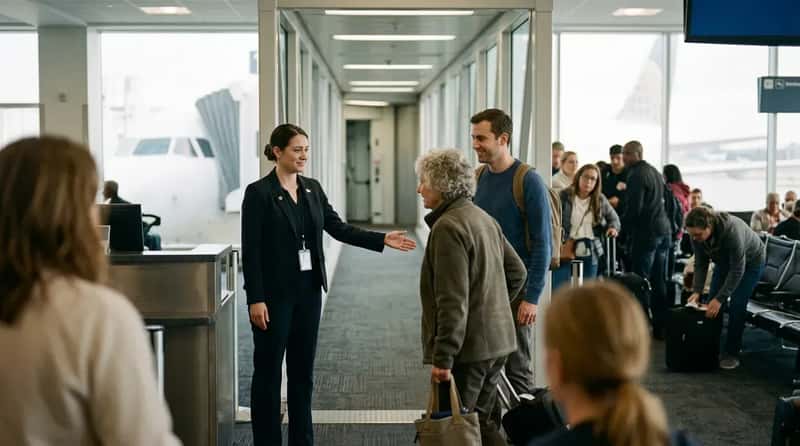
Pre-boarding is widely understood as a solo perk – something a senior or mobility-limited traveler uses quietly while their companion waits in the general boarding shuffle. That’s not the full picture. Gate supervisors at most major carriers can extend pre-boarding access to one travel companion accompanying a senior who needs assistance boarding. It’s a staff-discretionary call, and it happens far more often than airlines advertise.
Priority pre-boarding is available for those who need assistance boarding the aircraft or stowing devices – and this accommodation can include the companion who is there specifically to help. Ask clearly, ask early, and mention that your companion is present to assist you during boarding. Framing it that way makes it easier for the agent to approve without hesitation. One extra sentence changes the whole dynamic at the podium.
#7 – Personally Relaying Flight Updates to Passengers With Hearing Difficulty
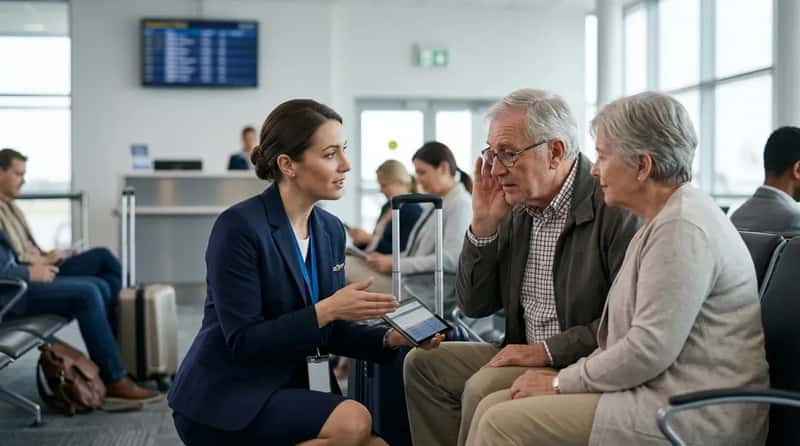
Gate announcements come fast and they don’t repeat often. For travelers over 60 with any degree of hearing loss, a missed gate change or boarding call can be genuinely disorienting – and it happens far more than people acknowledge. Gate supervisors are trained to handle exactly this situation, but most travelers who need this help never think to ask for it. If you have difficulty hearing announcements, one sentence at the podium sets the whole support system in motion.
The gate supervisor can flag your seat and physically come find you if the gate or departure time changes – but only if you’ve told them you need that. American Airlines, for example, specifically instructs passengers to inform a gate agent or flight attendant if they need help hearing important flight information, so that personal updates can be delivered directly. The system is built for this. It just requires one moment of honesty at the desk before you settle into your seat and hope for the best. That hope is unnecessary – and the ask takes about fifteen seconds.
Worth Knowing
- Airlines are required under the ACAA to provide accessible information to passengers with hearing or vision limitations
- A gate agent can physically locate you at your seat if a gate change or delay is announced – but only if you ask first
- Flight attendants are also trained to personally deliver safety briefings and updates to passengers with hearing difficulties
- Open captioning is available for in-flight safety videos on many major U.S. carriers
#6 – Flagging Medical Device Exemptions So Nothing Gets Checked or Confiscated
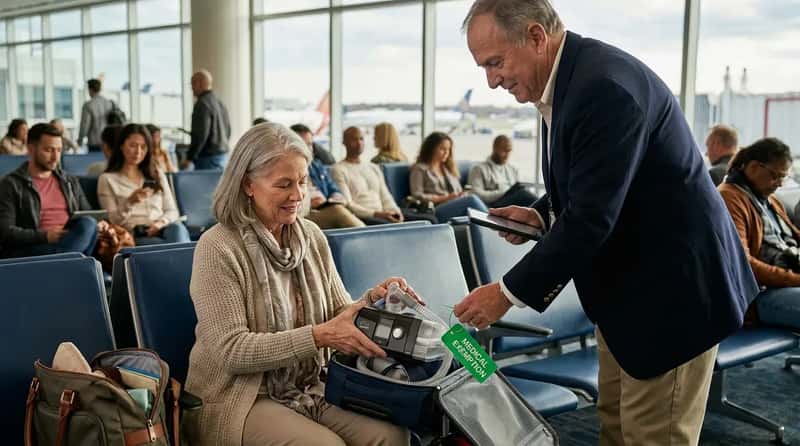
Travelers over 60 often fly with CPAP machines, portable oxygen concentrators, medical-grade liquids, and other equipment that standard carry-on rules would appear to prohibit. The rules are actually far more permissive than almost anyone realizes. CPAP and BiPAP machines are federally classified as medical devices – not carry-on bags – and travel fee-free on all major U.S. carriers. FAA-approved portable oxygen concentrators are also exempt, and these exemptions apply regardless of fare class or elite status.
Assistive devices must not count against a passenger’s carry-on limit – a rule that’s been federal policy for years but that far too many travelers still don’t know about. Mentioning your medical device to the gate supervisor before you board means it gets properly documented, which eliminates any confusion at the aircraft door. Airlines must also permit passengers to use FAA-approved portable oxygen concentrators during the flight – a right enshrined in federal regulation. Pack it separately from your regular luggage so the agent can identify it at a glance.
#5 – Arranging Gate-to-Gate Assistance for Tight Connections
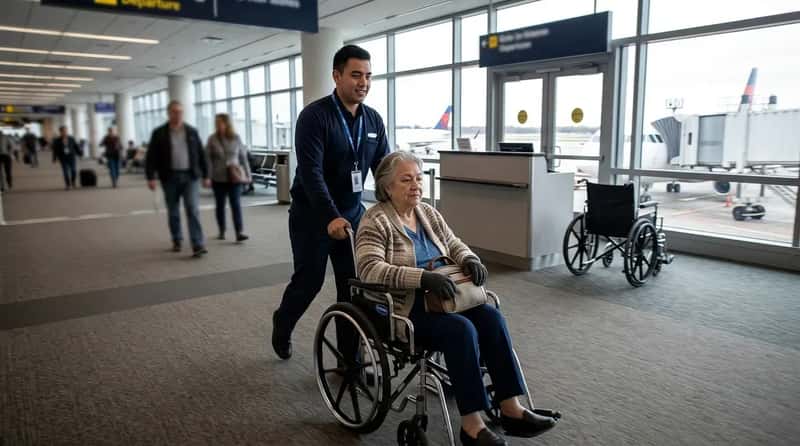
A tight connection at a major hub is stressful for any traveler. For someone over 60 dealing with reduced stamina or joint pain, it can feel genuinely impossible – a frantic walk through a terminal that doesn’t care how tired you are. Gate supervisors can arrange gate-to-gate assistance: a coordinated escort from one flight’s arrival gate directly to the departure gate of the connecting flight, at no charge, on all major U.S. carriers. Airlines are required to provide this service from your seat on the arriving flight all the way to your seat on the connecting one.
The catch is that you need to tell the gate supervisor you have a connection – don’t assume that information travels automatically through the system, because it often doesn’t. Say it clearly before you land, and again the moment you deplane. Gate-to-gate assistance is especially valuable during busy travel periods, terminal changes, or any layover under 45 minutes at a large hub. The people who use it consistently say it transforms what should be the most stressful part of the journey into something almost effortless.
#4 – Flagging Specialty Meal Preferences for the Cabin Crew
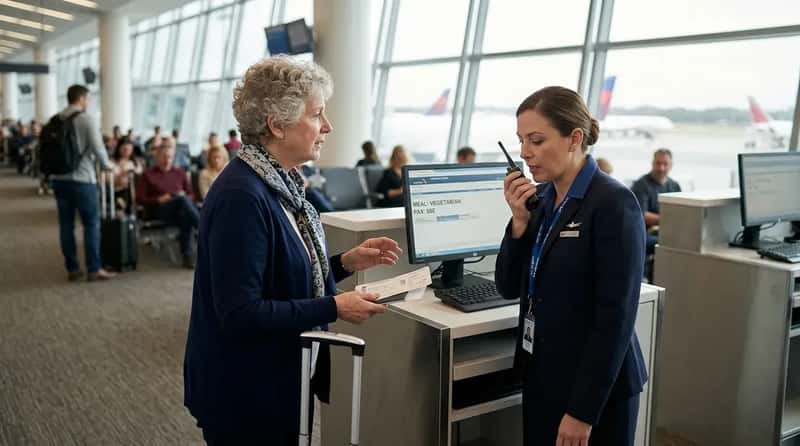
Most travelers assume that if they didn’t pre-order a special meal through the airline app before their flight, they’re stuck with whatever the standard service cart delivers. Gate supervisors can actually change that. A conversation at the gate – before you board – gives agents time to radio ahead to the cabin crew and flag a dietary need before service begins. Low-sodium, diabetic-friendly, and vegetarian options are the most widely available and the most commonly needed by travelers over 60.
On longer flights, many airlines accommodate dietary requests when they’re flagged before boarding – not mid-flight when the crew is already deep into service. That timing is the critical difference. Mentioning your dietary need at the gate is the move that actually works. By the time you’re seated and the drink cart is rolling, the window has usually closed. One sentence at the podium, before you step onto the jet bridge, is all the advance notice most crews need.
#3 – Accessing Quiet Rest Areas and Comfort Accommodations During Long Waits
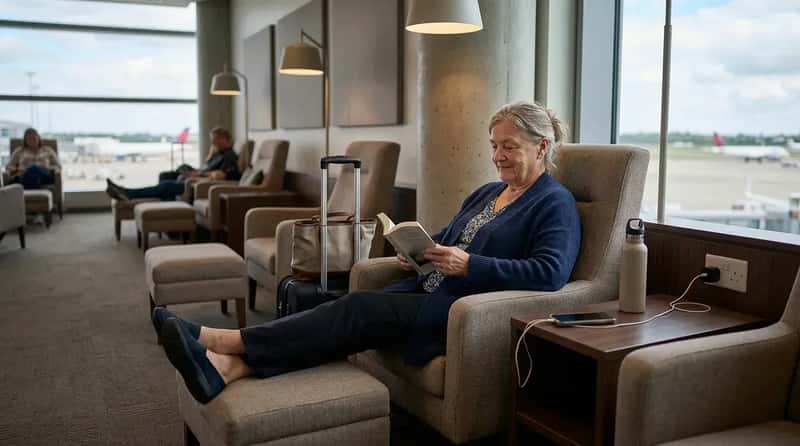
A three-hour layover in a hard plastic airport gate chair is nobody’s idea of a good time. For travelers over 60 managing chronic pain, fatigue, or post-surgical recovery, it can be genuinely depleting before the flight even takes off. What most people don’t know is that gate supervisors can sometimes point senior travelers toward quieter rest areas or more comfortable waiting options that aren’t posted on any airport map or app. Airport assistance lounges at many major hubs offer padded seating, electrical outlets for medical devices, and personnel on call if needs arise.
Gate agents may also have access to medication refrigeration or other comfort accommodations for senior travelers who ask directly. The phrase that tends to work: “I’m a senior traveler with some medical considerations – are there any quieter rest areas or accommodation options during my layover?” Tone matters here more than almost anywhere else on this list. Ask calmly, ask specifically, and agents who have the ability to help almost always will. Two hours in a comfortable chair instead of a hard plastic seat is a meaningfully different start to any trip.
#2 – Running a “Special Assistance Requested” Flag Across Your Entire Itinerary
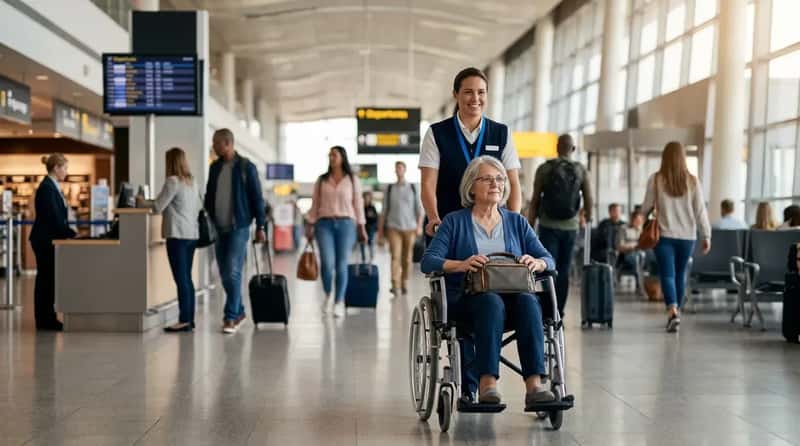
This is the one that frequent senior travelers swear by – and almost nobody outside that circle knows about it. When a gate supervisor enters a special assistance flag into your reservation profile, it doesn’t just apply to your current flight. It travels with your booking through every leg of your itinerary. Customized accommodations show up waiting at every checkpoint, every connection, every gate on the trip. Most major U.S. airports have a dedicated special assistance counter where one conversation activates the entire chain.
Seniors are legally entitled to free wheelchair or ambulatory assistance throughout their airport journey under the Air Carrier Access Act – escort through security, help with carry-ons, expedited processing, and priority boarding – regardless of visible disability or elite status. One flag, one conversation, the entire system activated for the whole trip. This is the closest thing to a VIP travel experience that most people never know they already qualify for. It doesn’t cost anything. It just requires knowing to ask.
Why It Stands Out
- A single special assistance flag in your reservation profile follows you through every flight, connection, and gate change on your itinerary
- The flag can be entered by a gate supervisor, ticket counter agent, or dedicated special assistance desk – ask any of the three
- It covers wheelchair escort, priority boarding, carry-on help, and connection coordination – all triggered by one conversation
- The Air Carrier Access Act guarantees these services at no charge, regardless of fare class or frequent flyer status
- Most senior travelers who discover this call it the single biggest change they’ve ever made to how they fly
#1 – Activating Every Accommodation at Once Through a Single Coordinated Request
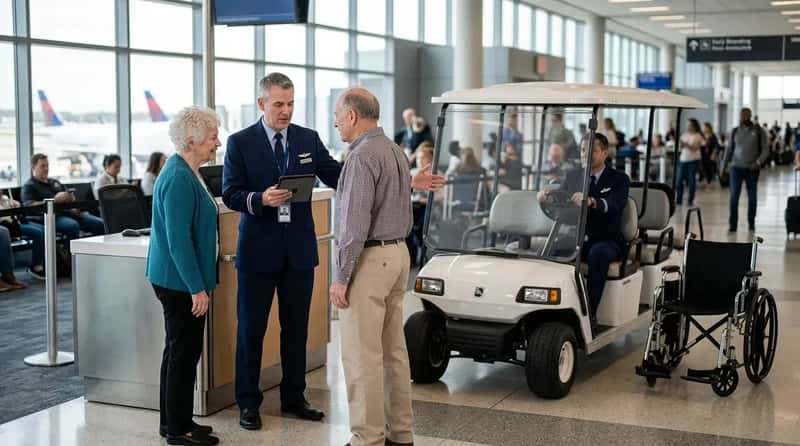
Every item on this list – the cart ride, the pre-boarding, the seat reassignment, the companion pass, the connection escort, the hearing relay, the medical flag – can be triggered simultaneously through a single coordinated request made when you first arrive at the terminal. Most travelers over 60 activate maybe one of these on any given trip, if they think to ask at all. The ones who know to ask for everything at once walk out of the airport looking like they had a completely different experience – because they did.
If you believe your rights under the Air Carrier Access Act are being violated, you can ask to speak with a Complaints Resolution Official. Airlines are required to make one available to you – in person at the airport or by phone during operating hours – at no cost. That’s a federal requirement, not a suggestion. The traveler who knows this walks into every airport with leverage the person next to them simply doesn’t have. The only real difference between an exhausting trip and a smooth one is usually knowing the system exists – and being willing to say something at the podium before the flight is called.
None of these 15 things require elite status, a special membership, or a formal disability diagnosis. They’re built into federal law, airline policy, and the training of every gate supervisor standing at that podium right now. The system is already in place. Most travelers over 60 walk past it every single time. Next trip, go to the desk first – before the boarding groups, before the announcements, before the chaos starts. One conversation changes the entire day. Have you ever had a gate agent go out of their way to help you? Drop your story in the comments – chances are someone else needs to hear exactly what you experienced.