Most people think saving money on travel means budget airlines, sad airport sandwiches, and hostels with paper-thin walls. They’re wrong.
The real savings are quieter than that. Experienced travellers have built a private playbook of small, repeatable decisions – and most tourists have never even heard of half of them.
Airfares in 2026 are running nearly 15% higher than last year. That means the gap between someone who knows these tricks and someone who doesn’t can now reach thousands of dollars a year.
Here’s what the insiders actually do – starting with the move most people get backwards before they’ve even picked a destination.
#24 – Fly Mid-Week, Not on the Weekend

Most casual travellers book flights around their work schedule and end up on the most expensive days to fly – without realising it.
Statistically, Tuesdays and Wednesdays are the cheapest days to both book and fly. According to Expedia’s 2026 Air Travel Hacks Report, flying on a Friday instead of Sunday can save up to 8%.
Business travellers flood flights on Mondays and Fridays, driving up prices. Flying mid-week is one of the simplest hacks to cut your airfare.
The savings sound small per ticket. Stack this across a family of four on a return trip and you’re talking serious money – for zero sacrifice in experience.
But #23 is where it gets sneaky…
#23 – Set Price Alerts the Moment You Start Thinking About a Trip

Booking a flight the day you feel like it is the most expensive way to fly. Seasoned travellers start watching prices before they’re ever ready to book.
If there’s a specific place you want to go, sign up for flight alerts on that route. Google Flights will email you the moment prices drop.
Some services specialise in finding mistake fares and deeply discounted deals – sometimes up to 90% off – sent straight to your inbox. Passive monitoring costs nothing.
It just requires setting up alerts once and letting the algorithm do the work for you.
#22 is the one most people get completely backwards…
#22 – Book Direct With the Airline After Comparing

Here’s one most travellers get backwards: they find the price on a comparison site, then book through that same comparison site. That’s a mistake.
Once you’ve found the best price on a comparison site, go directly to that airline’s website before clicking “book.” You’ll often find the same price – plus better seat selection, easier cancellations, and no OTA surcharges.
The comparison engine is a tool for research, not for purchasing.
Booking direct also means the airline is your point of contact if anything goes wrong – not a third-party platform with a hold queue.
#21 sounds tedious. It isn’t – not once you see the payoff…
#21 – Search Each Flight Leg Separately
Booking a return flight as a round trip on one airline is what the booking platform wants you to do. It’s rarely what saves you the most money.
Booking a one-way outbound with one airline and a separate one-way return with another is a well-worn hack. The cheapest outbound and the cheapest return rarely belong to the same carrier.
Round-trip searches default to one airline, which hides this completely. Search each leg separately, especially across budget carriers, and cheaper combinations show up almost every time.
Yes, it takes an extra twenty minutes. That twenty minutes can save you hundreds.
#20 flips the entire process upside down…
#20 – Let Flight Deals Decide Your Destination

Most people pick a place, then search for flights. Experienced travellers sometimes reverse that entirely.
Rather than fixing a destination, some seasoned travellers let the price of the airfare decide where they go next. “I think a lot of people make the mistake of setting a specific place they want to go with specific dates without any flexibility,” one avid traveller notes.
She heads to Google Flights and types in her home airport with no destination, just to see what deals surface.
This requires a flexible mindset. But the reward is often a trip you’d never have planned otherwise, at a fraction of the cost.
#19 is about geography most people never think twice about…
#19 – Consider Flying Into an Alternate Airport

Everyone flies into the obvious hub. That’s exactly why it costs more.
Swapping a New York-London flight for Paris or Amsterdam can save $500-600. Flying into alternate airports like Oakland instead of SFO cuts fares significantly too.
Some travellers save $400-plus just by driving a couple of hours to a bigger hub instead of flying from their local regional airport.
Quick Compare
- New York to London vs. New York to Paris or Amsterdam: $500-600 saved
- SFO vs. nearby Oakland: often several hundred dollars cheaper
- Small regional airport vs. a bigger hub a couple of hours away: $400+ saved
The drive is almost always worth it. Factor in parking and fuel, and you’re still often well ahead.
#18 asks you to do the one thing everyone agrees on – and almost nobody actually does…
#18 – Travel Shoulder Season, Not Peak

Everyone agrees peak season is expensive. Fewer people actually change their behaviour because of it.
Shifting a trip to April-May or September-October – shoulder season for most destinations – typically saves 20-50% on hotels and 15-30% on flights. The weather is usually still excellent.
You’ll deal with fewer crowds and shorter lines everywhere you go. Many places just feel better this way – friendlier locals, and you actually feel like you’re somewhere instead of queuing for it.
A 30-40% cut to total trip cost – just for shifting your dates by six weeks. That’s not a small saving.
#17 turns your hotel booking into something you can quietly rework after the fact…
#17 – Book Refundable Hotels, Then Keep Watching the Price

Most travellers book a hotel and consider that decision final. Experienced travellers treat it as a starting position.
Thousands of hotels offer 14- or 21-day advance rates at 10-30% off standard pricing, just for booking early. The move most travellers miss: book refundable, then keep watching the price.
If it drops before arrival, cancel and rebook at the lower rate. Hotel prices are more flexible than they look.
This is a zero-risk strategy. If the price holds, you stay at the original booking – and if it drops, you save automatically.
#16 is embarrassingly simple, and almost nobody does it…
#16 – Call the Hotel Directly

Online booking platforms aren’t the only way to get a room – and they’re often not the cheapest.
Try calling the hotel directly and asking about discounts for students, government employees, or groups like AAA. Hotels often have unpublished rates they can offer when booking direct, because they skip the platform commission entirely.
The worst they can say is no. Most people never ask – which is exactly why this keeps working for those who do.
#15 rewards the travellers who play the long game…
#15 – Stack Hotel Loyalty Points Strategically

Loyalty programmes look like marketing gimmicks until you understand how insiders actually use them.
At Marriott, you get the lowest point-value night free for every five consecutive nights booked with points. Hilton has a similar policy – Silver Elite members and above get the fifth night free on points bookings.
The gap between someone who earns points on everything and someone who doesn’t is often a free flight every year or two. That’s not a loyalty gimmick – that’s a real, recurring saving that compounds over time.
#14 is a mistake almost every tourist makes on day one abroad…
#14 – Use a No-Fee Travel Credit Card Abroad

Paying with a standard debit or credit card overseas is one of the most common – and most expensive – mistakes travellers make.
Your bank usually charges a foreign transaction fee of 1-3% on every purchase. Make one big purchase abroad, and that percentage suddenly hits a lot harder.
A good travel credit card skips the foreign currency fees entirely, and often throws in travel insurance and lounge access too.
Those 1-3% fees add up across an entire trip to a surprisingly large number. Switching cards before you leave costs nothing.
#13 catches out even experienced travellers – every single time it’s offered…
#13 – Always Pay in Local Currency
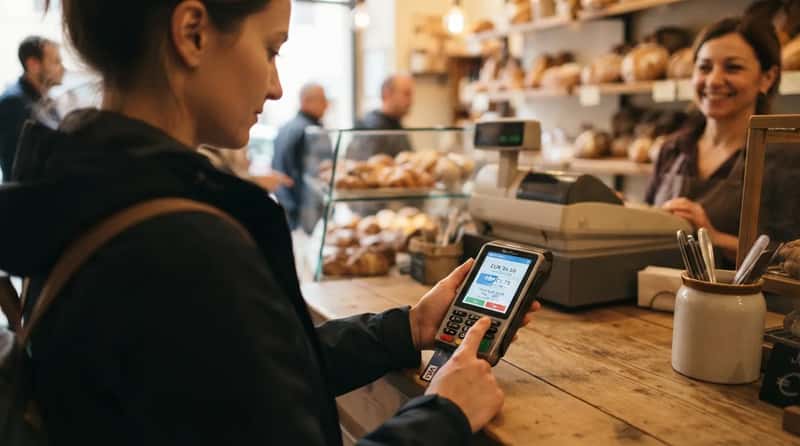
This one catches even experienced travellers off guard. When a card machine abroad asks if you want to pay in your home currency, it feels helpful.
It isn’t.
That prompt is called Dynamic Currency Conversion, and it almost always comes with a terrible exchange rate. Always choose to pay in the local currency instead.
The terminal is offering to convert at a rate that benefits the vendor, not you. Always decline, always pay local.
#12 is the trap sitting right at arrivals, waiting for you…
#12 – Skip the Airport Currency Exchange
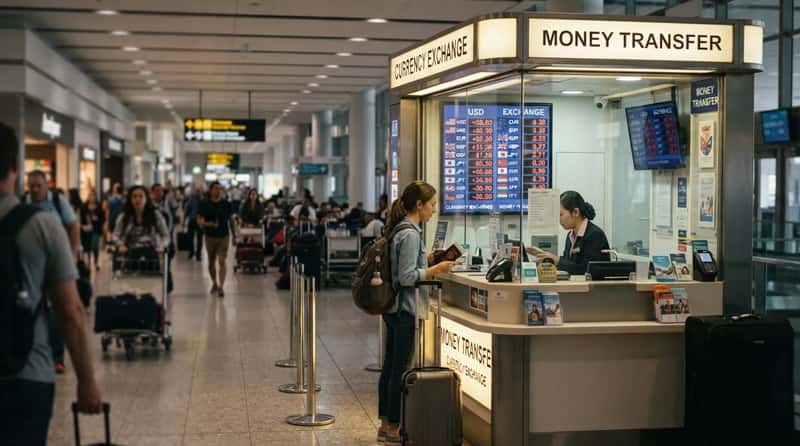
Airport currency kiosks look convenient – and that’s exactly the trap. Their exchange rates are notoriously poor.
Get a card with no foreign transaction fees, or use apps like Wise or Revolut for significantly better rates. Don’t trust the rate at the airport kiosk.
Withdraw cash from a reputable in-city ATM instead, and check whether your bank reimburses ATM fees abroad. This small pre-trip check can save a surprising amount over a trip.
#11 is where most people quietly bleed money without even opening an app…
#11 – Get a Travel eSIM Before You Board
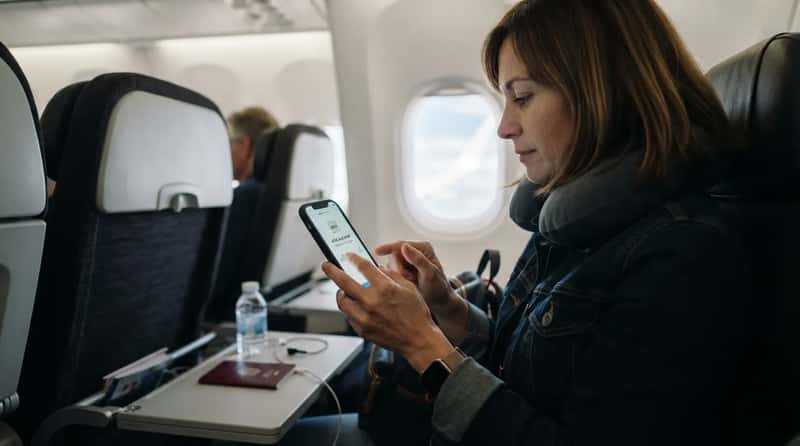
Roaming charges are one of the most reliably brutal hidden costs in travel – and one of the most easily avoided.
A single day of unchecked data roaming can cost $50-200 or more, depending on your carrier and destination. Real pricing data from major carriers shows eSIMs save 80-95% on international data.
Services like Airalo, Holafly, and Ubigi offer 5-10GB for $10-25, covering most countries. Install before you leave, activate on landing.
Fast Facts
- Unchecked roaming: $50-200+ per day
- Typical eSIM plan: 5-10GB for $10-25
- Savings versus roaming: 80-95%
- Global roaming spend by travellers: $50 billion+ a year
The GSMA estimates international mobile data roaming still generates over $50 billion annually – almost all of it from travellers who didn’t think ahead. Don’t be part of that number.
#10 is the quiet leak that happens after you’ve already saved on data…
#10 – Download Offline Maps Before You Arrive

Burning through mobile data on Google Maps is one of the quietest budget leaks in travel. Most people don’t notice until the bill arrives.
Download offline maps before you go, and navigation keeps working even with no signal. It never becomes an unexpected expense.
Combined with an eSIM, offline maps effectively reduce your data usage to near zero for navigation. It’s one of the cleanest, simplest savings on this entire list.
#9 is the one habit that changes how you pack for the rest of your life…
#9 – Pack Carry-On Only

Checked baggage fees aren’t just an inconvenience – they’re a significant, avoidable cost airlines have quietly made a major revenue line.
Carrying only a carry-on to dodge baggage fees is one of the highest-leverage travel hacks experienced travellers rely on. Wearing your heaviest shoes, thickest jacket, and bulkiest layer on the plane instead of packing them is one of the most underused packing tricks around.
Why It Stands Out
- Skips checked bag fees, which commonly run $30-60 each way on major U.S. airlines
- No baggage claim wait – straight off the plane and out the door
- Nothing to lose if a flight is rerouted or a bag goes missing
- Forces lighter, smarter packing on every trip after this one
Most seasoned travellers will tell you: once you’ve lived out of a carry-on for a week, you realise how much you’ve been over-packing your whole life.
#8 is a two-minute walk that most tourists never bother taking…
#8 – Eat Two Blocks From the Tourist Attraction

Restaurant pricing near major attractions follows one simple rule: the closer you are, the worse the value.
Walk 2-3 blocks away before eating, and use Google Maps to find highly-rated local spots. If a restaurant has photos on the menu and staff outside trying to pull people in, keep walking.
Those two extra minutes of walking regularly save $15-30 per meal, per person. Across a week-long trip for two, that’s a flight home in savings.
#7 breaks the one rule every traveller thinks they already know…
#7 – Book Flights at the Right Time in Advance

There’s a booking window that consistently produces the best fares – and most people are either too early or too late.
For international flights, aim to book 2-6 months in advance. Booking too early, six-plus months out, often means overpaying, because airlines haven’t released discounted inventory yet.
For most trips, booking 2-3 months out tends to hit the sweet spot. The conventional wisdom to “book as early as possible” turns out to be actively wrong for most routes.
#6 is the one almost nobody thinks to use, even though it’s basically a free destination…
#6 – Use Stopover Programmes as a Free Bonus Destination

This is one of the most underused travel hacks that experienced travellers quietly exploit on almost every long-haul trip.
More than a quarter of U.S. travellers now plan long layovers specifically to explore an additional city, according to Expedia’s 2026 travel data. A six- to ten-hour layover in a well-connected hub like Doha, Singapore, or Dubai gives you enough time to leave the airport, reach a landmark, eat, and get back comfortably.
Store your carry-on at the airport’s left luggage service, use downloaded offline maps, and treat the layover as a bonus destination instead of a waiting room.
At a Glance
- Doha, Singapore, and Dubai rank among the most stopover-friendly hubs
- 6-10 hours is typically enough time to leave the airport and return comfortably
- Left-luggage services mean you’re not hauling a bag around a city
- Over 25% of U.S. travellers now plan long layovers on purpose
Two destinations for the price of one flight. That’s not a hack – that’s a strategy.
#5 is decided the night before, not the morning of…
#5 – Book Morning Flights to Avoid Cascading Delays

Most travellers book mid-morning or afternoon flights because they’d rather not wake up early. That preference costs them.
Early morning flights are the least likely to be delayed or cancelled, because the aircraft is already at the gate and there’s no earlier flight to cascade a delay from. By afternoon, every late morning flight has already pushed the schedule back.
A missed connection or delayed flight can mean an unplanned hotel night, taxis, and rebooked tickets. The cost of sleeping in can run into hundreds.
The alarm clock is the cheapest travel insurance there is.
#4 costs nothing and takes five seconds, yet almost nobody bothers…
#4 – Search Flights Incognito
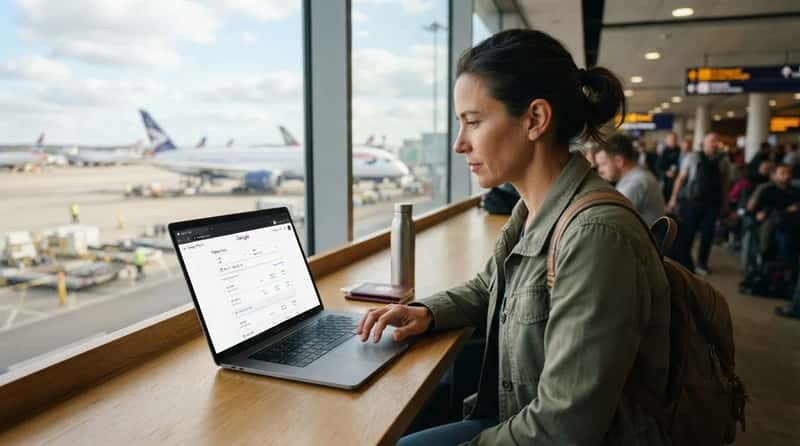
Airlines and booking platforms track your searches using cookies. The more times you search a route, the more they know you want it – and some platforms adjust prices accordingly.
Use Google Incognito or a VPN to search for flights, so you’re seeing a clean, uninfluenced price each time. It takes five seconds to open a private window, and it costs nothing.
Whether or not you believe this consistently changes fares, there’s zero downside to doing it. Experienced travellers don’t take chances.
#3 shatters the biggest assumption travellers make the second they hit “confirm”…
#3 – Rebook Your Flight If the Price Drops After Purchasing

Most people assume that once a flight is booked, it’s locked in. Turns out, that’s not always true.
The biggest mistake that travellers are making right now is assuming that once they book their flight, their job is done.
A travel industry expert
Many airlines – particularly in the US – let you rebook at a lower fare and receive the difference as a travel credit, as long as you’re not on a basic economy ticket.
Rebooking if the fare drops after you buy is one of the highest-value moves available to experienced travellers. Set an alert on the route post-booking – you might be surprised.
#2 sounds too small to matter. It isn’t…
#2 – Carry a Reusable Water Bottle Through Security
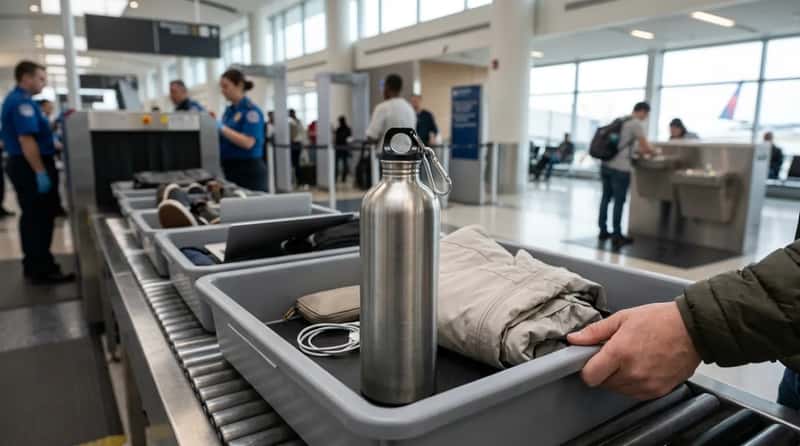
This sounds too small to matter. It isn’t.
Airport food and drink pricing is essentially a captive market, and water is one of the most egregiously marked-up items in any terminal. Carry a reusable bottle empty through security, then fill it at a water fountain.
That alone saves around $8 on a single bottle of water – and you can keep refilling it all trip. On a two-week trip, this one habit can save $50-100 in airport and convenience store purchases alone.
It’s also the simplest possible thing on this list, which is why it’s embarrassing how many people still don’t do it.
#1 is the one that actually explains everything else on this list…
#1 – Use Points for Every Single Purchase, Without Exception

This is the one that separates travellers who get one or two good trips a year from those who seem to travel for almost nothing. The gap isn’t income – it’s discipline.
Using a travel rewards credit card to earn free flights and stays is consistently ranked among the highest-leverage travel hacks available. Combined with the other habits on this list, it can save thousands of dollars a year.
The gap between someone who earns points on everything and someone who doesn’t is often a free flight every year or two. That’s groceries, utilities, subscriptions, dining – every dollar run through a points card instead of a debit card.
The secret isn’t finding a magic deal. It’s converting everyday spending into travel currency, consistently, for years – which is exactly what experienced travellers have been quietly doing while everyone else wonders how they afford it.
The Bottom Line

Shoulder season travel, smarter booking timing, and packing carry-on only alone can cut total trip costs by 30-40% compared to default habits. None of the 24 moves above require sacrificing comfort or gaming the system for hours.
They’re repeatable disciplines – small decisions that stack into serious savings on every single trip. The best travel hacks aren’t tricks or loopholes; they’re habits that quietly save real money and real time.
Start with two or three from this list on your next trip. You’ll never book travel the old way again.
Which one surprised you most – or did we miss your go-to saving trick? Drop it in the comments.