Retirement math has gotten complicated. Between rising rents, climbing grocery bills, and homeowners insurance premiums that seem to double every few years in some states, the question of where your Social Security check actually goes the furthest has become more pressing than ever.
A newly released cost-of-living analysis set out to answer exactly that, weighing crime rates alongside housing and everyday expenses across hundreds of American cities. What it found challenges a lot of assumptions about where retirees are flocking these days, and the results lean heavily toward a part of the country that rarely gets the retirement spotlight.
1. Columbus, Indiana

Columbus, Indiana landed at the very top of the new ranking, and the numbers back up the claim. Columbus, Indiana, is the nation’s safest and most affordable place to retire, with an average annual cost of living of $38,795. That figure includes housing, groceries, healthcare, and other everyday expenses for a retired household, which makes it one of the more complete affordability snapshots available right now.
Separate cost-of-living data backs this up, showing the cost of living in Columbus, Indiana is 7% less than the national average. Beyond the spreadsheet numbers, Columbus has a quieter reputation as an architectural surprise, home to a striking collection of modernist buildings that draws design enthusiasts from well outside Indiana. For a retiree, it’s a rare combination: genuinely cheap to live in, yet not without its own cultural pull.
2. Broadview Heights, Ohio

Broadview Heights, a suburb tucked into Cuyahoga County south of Cleveland, took the second spot in the study’s overall top ten. It’s part of a broader pattern the researchers noticed, since sixteen Ohio cities received mentions in the top 50, the most out of any state. That’s not a coincidence. Northeast Ohio’s combination of modest home prices and low violent crime rates keeps showing up favorably across affordability studies.
For retirees, Broadview Heights offers proximity to Cleveland’s hospital systems without the higher price tag that comes with living inside the city itself. It’s a quieter, residential kind of place, the sort of suburb where property taxes and grocery bills stay manageable even as nearby metro costs creep upward. The tradeoff, as with much of the Midwest, is a winter season that demands a coat and a snow shovel.
3. Auburn, Indiana

Auburn ranked third nationally in the same GOBankingRates analysis, giving Indiana two cities in the study’s top three. Auburn’s biggest calling card outside of affordability is the Auburn Cord Duesenberg Automobile Museum, a genuine draw for classic car enthusiasts and a small but steady source of tourism for a town this size. It’s the kind of niche cultural asset that gives a low-cost city a little more personality than the spreadsheet alone suggests.
Housing in this part of northeastern Indiana remains well below national norms, part of why the region keeps producing multiple entries on affordability lists. Retirees looking for a small-town pace, without total isolation from healthcare or basic services, tend to find Auburn workable on a modest fixed income. It won’t suit anyone chasing beaches or year-round sunshine, but that was never really the pitch.
4. Mayfield Heights, Ohio
Mayfield Heights, another Cuyahoga County suburb, secured the fourth position in the overall ranking. Its proximity to Cleveland Clinic’s Hillcrest Hospital campus is a meaningful detail for retirees weighing healthcare access against cost, since it means serious medical care is close by without requiring a move into pricier city neighborhoods. That balance of affordability and hospital proximity is a recurring theme across the Ohio suburbs on this list.
Like its neighboring communities, Mayfield Heights benefits from Ohio’s broader cost advantages, including housing stock that’s older but well-maintained and generally cheaper than comparable homes in Sun Belt retirement hubs. The pace of life here is suburban and unhurried. For retirees prioritizing medical access above almost everything else, that’s a genuinely persuasive selling point.
5. Berea, Ohio

Berea rounds out a cluster of Cleveland-area suburbs that dominated the upper half of the ranking. The city is home to Baldwin Wallace University, which brings a modest but steady stream of lectures, performances, and community events that larger retirement destinations often charge a premium for. It’s a small-college-town feel layered onto an otherwise unassuming suburban budget.
Historically known for sandstone quarrying, Berea has since settled into a quieter residential identity, with housing costs that remain well under the national median. The presence of a university campus also tends to support local healthcare and cultural infrastructure that a town of similar size might otherwise lack. For retirees who want a bit of intellectual buzz without big-city prices, it’s a reasonable trade.
6. Pingree Grove, Illinois

Public domainPublic domainfalsefalse
This work has been released into the public domain by its author, Jonoloier at English Wikipedia. This applies worldwide.In some countries this may not be legally possible; if so:Jonoloier grants anyone the right to use this work for any purpose, without any conditions, unless such conditions are required by law.Public domainPublic domainfalsefalse, Public domain)
Pingree Grove was the lone non-Ohio, non-Indiana Midwest entry in the top half of the ranking, representing Illinois in a list otherwise dominated by its neighboring states. Located in Kane County on Chicago’s far northwestern exurban edge, the village has grown considerably over the past two decades, largely through master-planned residential development. That growth hasn’t yet pushed housing costs into the territory of closer-in Chicago suburbs.
The appeal for retirees is straightforward: enough distance from Chicago to keep costs down, but still close enough for occasional trips into the city for specialized medical care, cultural events, or family visits. It’s a newer community by Midwest standards, which means fewer of the aging-infrastructure quirks that show up in some of the older towns on this list. Winters, predictably, are not for the faint of heart.
7. Parma Heights, Ohio
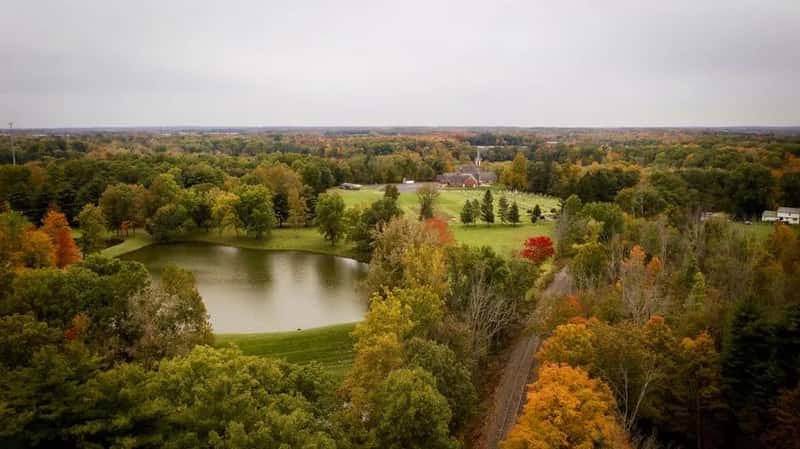
Parma Heights, adjacent to the larger city of Parma, claimed the seventh spot in the overall ranking, giving Cuyahoga County yet another entry on the list. It’s a densely residential suburb with a straightforward appeal: modest homes, low crime figures relative to national averages, and easy access to the broader Cleveland healthcare network. There isn’t much in the way of tourist draw here, and that’s largely the point for retirees who prioritize routine over novelty.
The methodology behind the ranking leaned heavily on this kind of practical data. Researchers built the list using the FBI’s 2024 Offenses Known to Law Enforcement data for crime rates, cost-of-living indexes from Sperling’s BestPlaces, average home values from the Zillow Home Value Index, and mortgage estimates based on the national average 30-year fixed rate. Parma Heights performed well across every one of those inputs, which is precisely why it made the cut.
8. Poplar Bluff, Missouri

Poplar Bluff broke the Ohio-and-Indiana pattern, representing southeastern Missouri and the Ozark foothills in the top ten. Local reporting on the study noted that Poplar Bluff rounds out the list as one of the most affordable small cities in the country for retirees on tight budgets, with GOBankingRates placing it among the top ten nationally in its 2026 affordability ranking. That distinction matters for retirees who don’t have the option of relocating to a coastal or Sun Belt destination.
What Poplar Bluff lacks in big-city amenities, it tends to make up for in straightforward affordability, with a cost structure that leans heavily favorable for anyone living primarily off Social Security. It’s a smaller community than most of the others on this list, which brings tradeoffs in specialist healthcare access that retirees should weigh carefully before committing. Still, for those prioritizing financial stability over urban convenience, the underlying numbers are difficult to dismiss.
9. Huntington, Indiana

Huntington closed out the group, giving Indiana a third city among the nine and reinforcing just how consistently the state performed throughout this particular study. The town is home to Huntington University and carries a bit of political trivia as the hometown of former Vice President Dan Quayle, a detail that occasionally surprises visitors passing through. Beyond the trivia, it functions much like the other small Midwest cities on this list: modest housing costs, a manageable pace of life, and low crime figures relative to national benchmarks.
The broader takeaway from the study’s authors was blunt about the region’s dominance, noting plainly that nine Midwest cities dominated the top 10 of the full ranking. Huntington’s inclusion wasn’t a fluke so much as a confirmation of a trend that showed up repeatedly across Indiana, Ohio, Illinois, and Missouri. For retirees stretching a fixed income as far as it will go, that regional consistency is arguably the study’s most useful finding.