You walk into the room.
The door closes behind you with that hollow, hotel-corridor click.
Your bag hasn’t touched the floor yet.
But your eyes are already moving – to the window, to the deadbolt, to the laminated card on the back of the door with the red arrows pointing toward the stairs.
You tell yourself it’s practical. Responsible. Just being smart.
But you and I both know what this really is.
There’s a version of you that the world sees – the one who books the trip, who takes the window seat, who talks about “getting away from it all.” And then there’s the other version. The one who can’t truly arrive anywhere because part of you is always already planning the exit. The traveler and the fugitive, sharing one passport. That gap – between the person who craves freedom and the person who can’t stop scanning – is the wound that travel reveals. Not creates. Reveals.
1. The Exit Inventory
You check the fire exit map before you unpack.
You note the stairwell. The window latch. The deadbolt and whether the chain actually catches.
This isn’t paranoia dressed up as preparedness. This is the compulsion to always make sure you have a way to escape, scanning the environment for the closest exits. It is one of the most recognized behavioral signatures of a nervous system that learned, long ago, that leaving had to be fast.
The hotel room is perfectly safe. You are not debating that.
But your body hasn’t received the memo. Your brain formed these pathways for a good reason. At some point, being on high alert kept you safe. The problem is that the alarm system doesn’t automatically update when the danger passes. It keeps running on the old rules.
The exit inventory is the first thing you do because it was once the only thing that mattered.
You were a child in a house where knowing the way out was a survival skill, not a safety drill.
The map on the back of the door isn’t informing you. It’s confirming what you already felt the moment you stepped inside.
The room has exits. You can leave. You are safe to stay.
2. The Wall-Back Seat
At the hotel bar. At the airport gate. At the complimentary breakfast with the stiff, wipe-clean chairs.
You always – without thinking – find the seat with your back to the wall.
Walking into a restaurant, you immediately scan for exits and position yourself with your back to the wall. It feels like preference. Like taste. Like the kind of person you simply are.
It isn’t.
It is your nervous system completing a behavioral algorithm so old it has become invisible to you. Hypervigilance is often mistaken for anxiety or overreactivity. In reality, it is a learned state of readiness. When the brain is repeatedly exposed to threat, unpredictability, or responsibility for others’ safety, the nervous system adapts.
You need to see the room.
You need to see the door.
You need to see who is coming before they arrive.
Nobody taught you this. You reverse-engineered it from a childhood where surprises were rarely good ones.
The wall at your back is the boundary you could never guarantee at home.
3. The Silent Room Audit
Before the bag is unzipped, you walk the perimeter.
Bathroom. Closet. Behind the curtain. You’re not looking for anything specific. You’re looking for the thing that isn’t supposed to be there.
Hypervigilant symptoms are clinically described as a perpetual scanning of the environment to search for sights, sounds, people, behaviors, smells, or anything else that is reminiscent of activity, threat, or trauma.
The room audit takes thirty seconds.
But it took a childhood to build.
You learned to move through spaces this way when spaces were unpredictable. When the energy of a house could shift between the front door and the kitchen. When the air itself had a weather system, and you became its most sensitive barometer.
You check the room now because you once checked every room, every day, just to know what mood you were walking into.
Checking the hotel room is the echo of checking the house. The ritual outlived the reason.
4. The Light-Sleep Protocol
You don’t fully sleep in unfamiliar places. Or familiar ones, either, if you’re honest.
You float near the surface. One ear always half-open. One part of your mind standing watch while the rest attempts rest.
Sleep disruption – falling asleep or staying asleep becomes difficult, with frequent awakenings, light sleep, or nightmares.
This is not a sleep problem. It is a safety problem wearing a sleep problem’s clothes.
After experiencing prolonged stress or harm, the brain learns to expect the worst. Stillness can feel like vulnerability. Calm can feel unfamiliar, even unsafe. The very moments that should offer rest and peace can stir up anxiety, fear, and emotional overwhelm.
You lie in the dark of a hotel room – white noise hissing through the air conditioning, the orange glow of an exit sign under the door – and you listen for something you cannot name.
You were a child who learned that nighttime was when the unpredictable happened.
Your body never fully forgot that lesson.
You sleep with one foot on the floor because some part of you still needs to be ready to run.
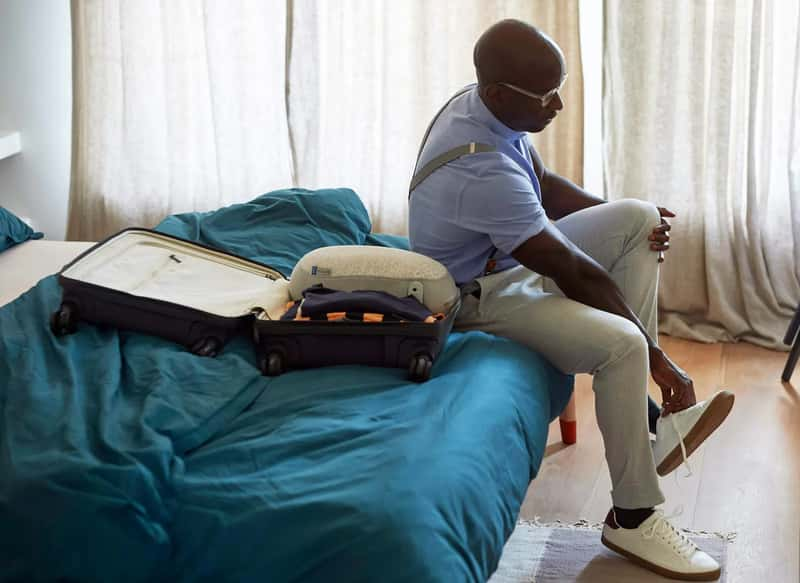
5. The Overpacked Bag
I know what’s in your suitcase. Not because I’ve seen it. Because I’ve packed mine the same way for thirty years.
There are things in there you will never use. A backup of the backup. Medications for ailments you don’t currently have. Enough layers for a weather event that isn’t forecast.
The overpacked bag is control made tangible. It is the physical declaration: I will not be caught without.
Because you were caught without, once. Without enough. Without warning. Without a plan.
Childhood trauma often affects adulthood psychology in ways people miss because it disguises itself as character traits you might even take pride in. Hypervigilance becomes “being responsible” or “detail-oriented.”
The overpacked bag looks like organization. It feels like anxiety.
Every item you’ve ever added to that bag is a direct response to a moment in your past when something was missing and its absence cost you something.
You are not overpacking for this trip. You are packing for the childhood you survived.
6. The Noise Cataloguer
The hotel settles at 2 AM. A pipe groans. Someone three floors up drags a chair.
You are awake. Instantly. Completely. Categorizing.
When you live in this state, your brain treats every sound as a potential danger. A floorboard creaking or a car door slamming outside triggers a physical reaction. This is because your brain has lost the ability to distinguish between a minor noise and a major threat. It chooses to be “wrong but safe” rather than “right but dead.”
The noise cataloguing began in a bedroom where sounds mattered.
The particular creak of a door. The specific sound of footsteps versus shuffling. The tone of a voice coming through a wall before you could hear the words.
You learned to read sound like Braille. You decoded the acoustic environment of your childhood home with the precision of someone whose well-being depended on it.
Because it did.
Now you lie in hotel rooms and office apartments and guest beds all over the world, listening for a threat that left your life decades ago but never left your ears.
7. The Emotional Weather Report
You walk into the lobby. The concierge smiles. You spend the next three minutes quietly deciding whether it was genuine.
At dinner, the waiter’s tone shifts almost imperceptibly between taking your order and bringing the bill. You notice. You file it. You wonder what you did.
It’s common for a person who’s hypervigilant to watch the people around them diligently for slight changes in behavior, tone, cadence, body language, written communication or even sentence structure. “These individuals tend to do a lot of overanalyzing of people’s moods and their expression – even things like text messages.”
You are not paranoid. You are highly trained.
The constant tension you felt at dinner? That was just “how families are.” The unpredictable moods of a parent? You learned to read the room before you learned to read books. These survival skills felt necessary then, and they can feel invisible now.
The emotional weather report – that constant, background assessment of everyone around you – is a skill you honed in a house where moods were weather systems and you were the only meteorologist.
You got very good at reading people. The price was never being able to stop.
8. The Minimal Trace Habit
You leave hotel rooms almost as you found them.
Toiletries lined up. Clothes folded back into the bag even when you’re staying another night. The sense that you should be packable in under three minutes.
This is not tidiness. This is the psychology of impermanence worn smooth into habit.
For some, childhood trauma results in an intense focus on the external environment, with constant scanning for threats and attempts to control their surroundings. This hypervigilance is a survival mechanism developed in response to an unpredictable or dangerous environment.
You learned to leave minimal trace because being visible had consequences.
Taking up space – physical, emotional, relational space – felt dangerous when you were small. So you folded yourself down. Kept your things neat. Made yourself easy to accommodate and easier to overlook.
In hotel rooms, you are practicing the art of being here without quite committing to being here. You are a guest in every room you’ve ever occupied, even the ones with your name on the lease.
The packed bag by the door isn’t laziness. It is a posture learned so early you no longer feel its weight.
9. The Catastrophe Pre-Run
You’re on the plane. The flight is smooth. You are already simulating turbulence that hasn’t come.
You have rehearsed the fire alarm. The power outage. The medical emergency in the seat behind you. You have already decided what you would do.
Hypervigilance can lead you to catastrophize, or believe that the worst possible thing is about to happen.
But catastrophizing isn’t irrational when it was once rational.
The traumatic memory “teaches” the brain to expect danger, so the alarm system remains triggered long after the trauma.
The pre-run of catastrophe is your nervous system doing the only thing it knows how to do with uncertainty: eliminate it through preparation. If you have already lived the worst outcome in your mind, it cannot ambush you.
You grew up in an environment where bad things happened without announcement. No warning. No preparation. Just the sudden shift from before to after.
So now you build a buffer of rehearsed disasters. A mental library of outcomes.
You were trying to close the gap between surprise and response. You were trying to never be caught without an answer again.
10. The Identity Suspension
This one is the heaviest.
You travel because something in you needs to stop being who you are at home. The particular weight of your name in your hometown. The expectations that have calcified around you like coral.
In a new city, in a hotel room that carries no memory of you, you are temporarily released from the obligation to be consistent.
But here is what no itinerary prepares you for: complex post-traumatic stress disorder is a mental health condition that can develop if you experience chronic trauma. Both CPTSD and PTSD involve symptoms including hypervigilance and efforts to avoid distressing reminders of the traumatic event. People with CPTSD typically have additional symptoms, including chronic and extensive issues with emotion regulation, identity and sense of self, and relationships.
The identity suspension isn’t freedom. It is the absence of a self that was never fully allowed to form.
You check into hotels as one version of yourself and check out as another. You collect identities like passport stamps. The constant traveler. The minimalist. The person who needs no one and no fixed address.
But underneath each persona is the child who learned that having a stable self was dangerous – because a stable self could be targeted, criticized, controlled. Better to stay fluid. Better to stay moving. Better to be whoever the room required.
One of the most useful models for understanding how childhood trauma affects adulthood psychology is the 4F framework. Developed by therapist Pete Walker, this approach identifies four distinct survival responses that children develop to cope with threatening environments. These patterns often persist into adulthood, shaping how you respond to stress, conflict, and relationships long after the original danger has passed.
Identity suspension isn’t wanderlust. It is the long shadow of a self that learned early: don’t get too comfortable being anyone. They might ask you to be someone else.
There is something almost holy about the moment you recognize a survival ritual for what it is.
Not a quirk. Not a preference. Not just “how you are.” But a response – faithful, exhausting, still-running – to something that happened a long time ago in a room that no longer exists.
When your trauma responses flare – the racing heart, the sudden freeze, the numbness – think of them not as enemies, but as overprotective guardians who haven’t realized you’ve already survived. Rituals become your way of gently retraining them. The fire exit map. The wall-back chair. The half-sleep vigil. These are not character flaws. They are love letters from a younger version of you who was doing everything they could to keep both of you alive.
The work – the quiet, unglamorous, deeply human work – is not to stop checking the exits. It is to slowly learn, one room at a time, that you are allowed to stay.
Somewhere between the arrivals board and the departure gate, between the person you perform and the person who checks the door at 3 AM, there is a version of you that is neither running nor hiding.
Just breathing.
Just here.