A standard inside cabin on a Royal Caribbean ship is roughly 130 to 170 square feet, and it has no window. Switch off the lights and nothing in the room tells you whether it’s 7 a.m. or midnight. These 12 habits are how seasoned cruisers turn that dark little box into a place that actually works on a sea day.
Most of them cost little or nothing, and a few are things you’d never think to ask for. Stay through #1, which changes how every other item on this list looks and may change the cabin you book next time. First, the beds.
#12 – Split the Royal King Into Two Twins
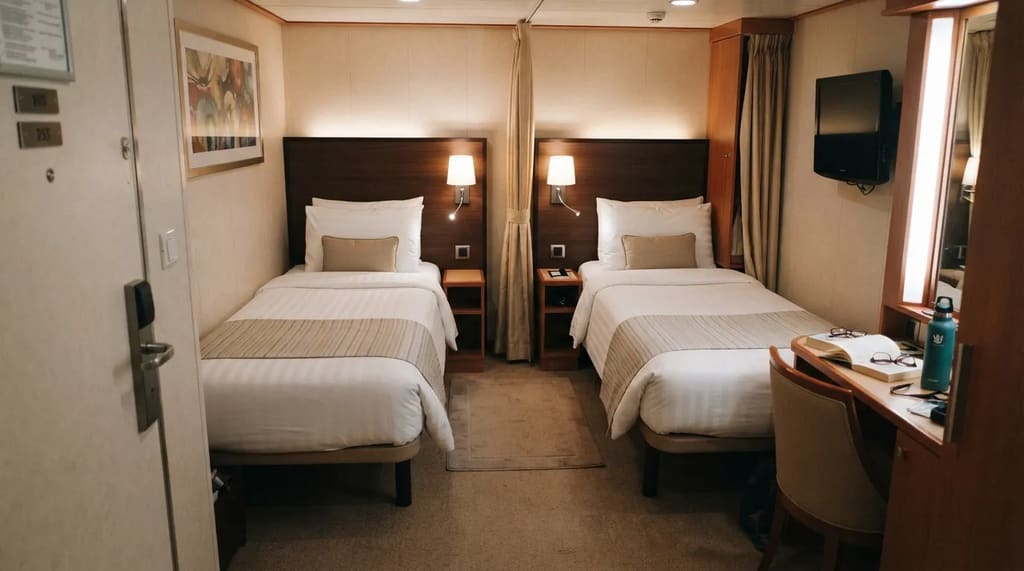
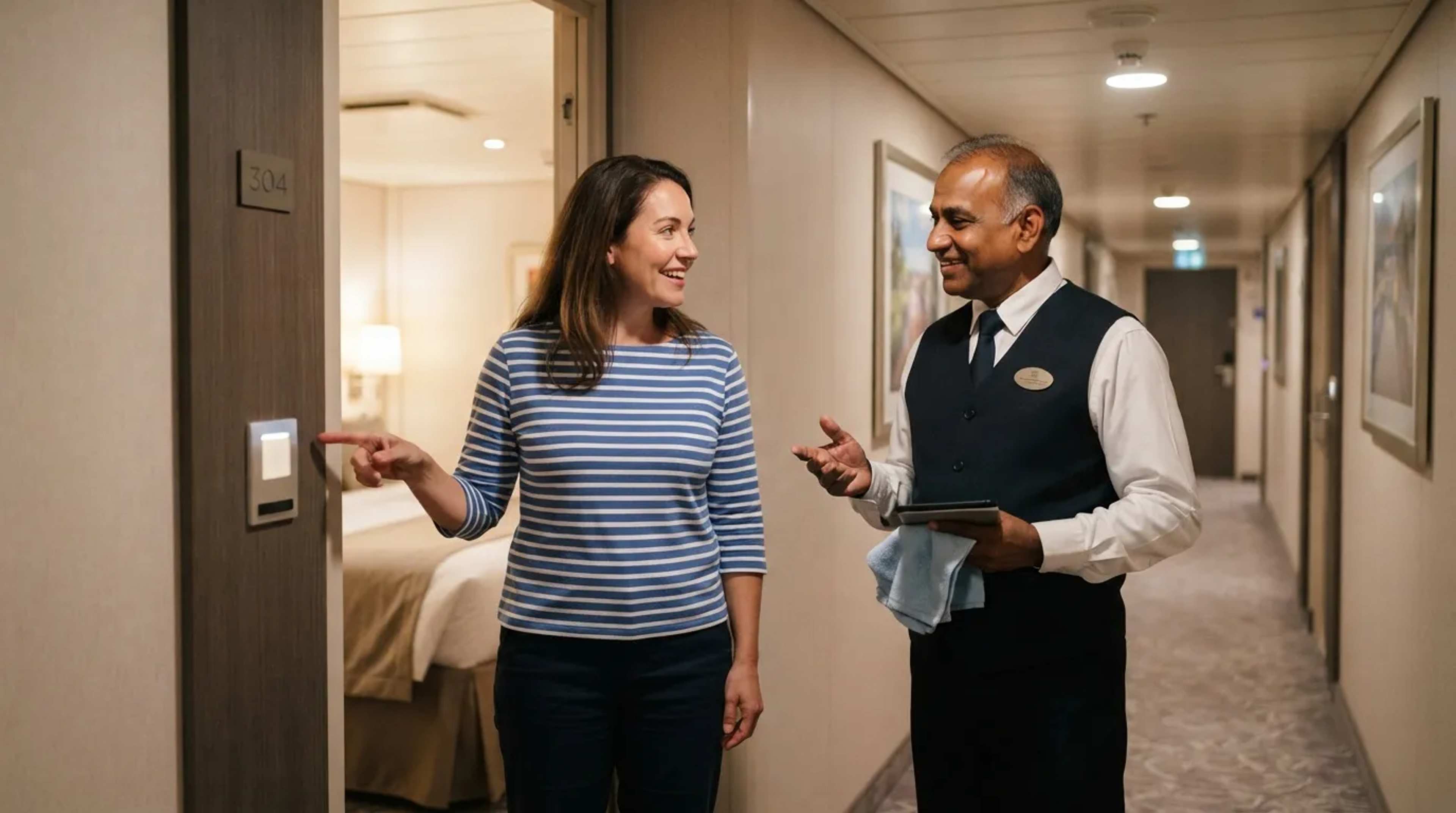
Most Royal Caribbean staterooms come with a Royal King bed that can be separated into two twin beds on request. It takes one conversation with your stateroom attendant.
You can ask your attendant to split or combine the beds at any time. You’re not locked into the arrangement you find on arrival, and you can switch back if you don’t like it.
In an inside cabin the split pays off right away. With the beds apart you get a real walkway between them, instead of a sliver of floor around the edges of the room.
At a Glance
- Who to ask: your stateroom attendant
- When: any time, including the first evening
- Reversible: yes, you can combine the beds again
- What to pack: nothing
Try it the first night, since the change is reversible, and see whether crossing the room in the dark gets easier. It’s the cheapest change on this list, and the only one that needs no packing.
Once the beds are sorted, look at the walls. They hold more storage than the closet does, and tape and adhesive hooks aren’t how you get at it.
#11 – Magnets Turn Metal Walls Into Storage
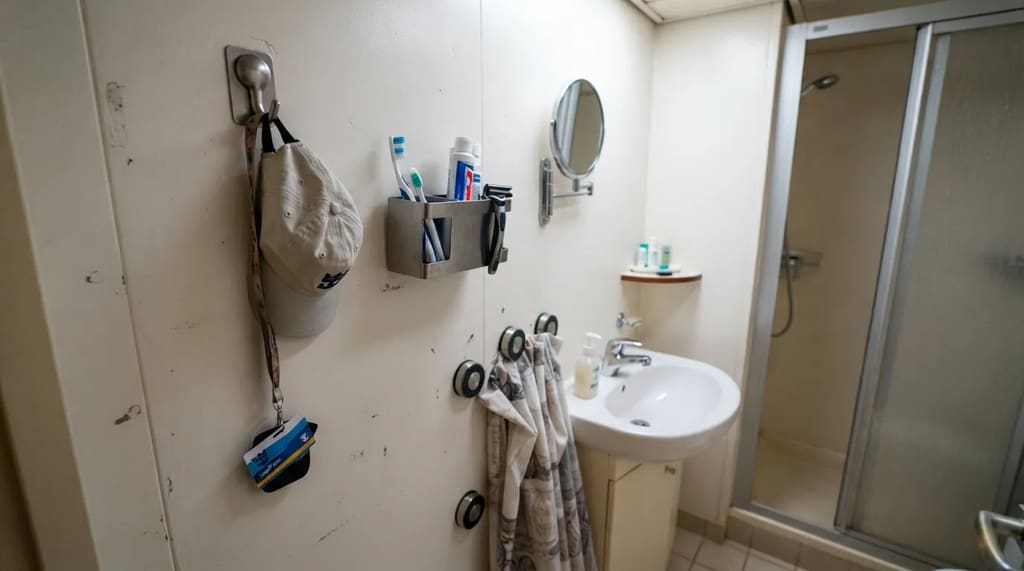
The walls of a cruise cabin are metal, which means a handful of magnets can give you shelf space a hotel room never would.
The walls in the bathroom and cabin are made of metal, so magnets work nearly anywhere. Adhesives that could damage the walls aren’t an option, which makes magnets the one way to add storage without touching the finish.
The bathroom is where they pay off fastest, because cruise ship bathroom counters are tiny whatever cabin class you book. Here’s what to hang:
- A magnetic toothbrush holder or cup, to clear the counter
- Strong magnets that pin a cloth shower curtain to the wall and keep it off you
- Magnetic hooks for a lanyard, a hat or a light jacket
Strong magnets add storage on metal walls, where adhesives are off limits. Of everything you can pack for an inside cabin, they give the most for the least money, and I’d pack them before any gadget on this list.
Storage is solved, but charging isn’t. One common item in a carry-on can be taken at the terminal before your bag ever reaches the room.
#10 – The Charging Item Security Will Confiscate
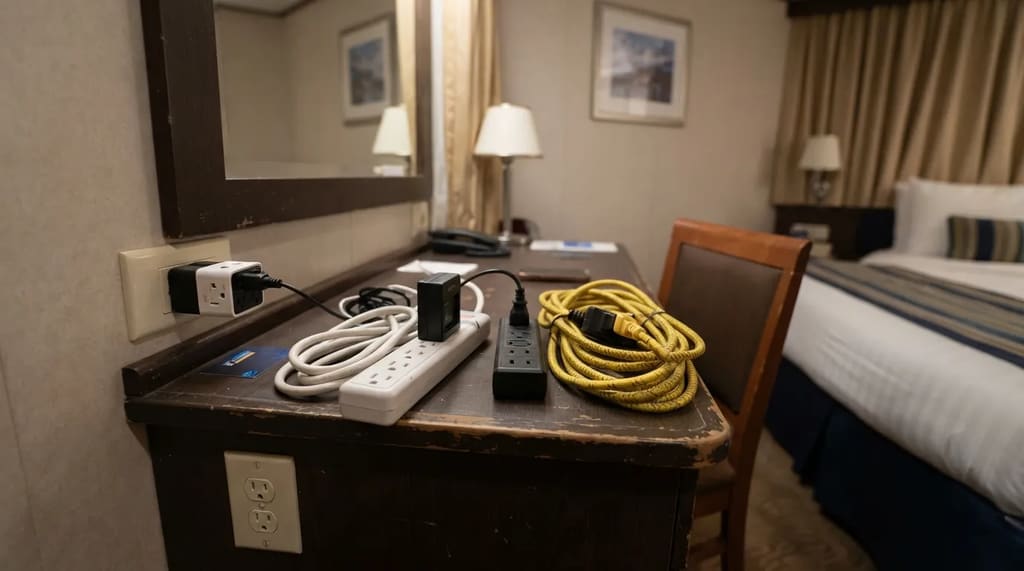
Some cabins offer only a couple of American outlets, and the obvious fix is the one Royal Caribbean doesn’t allow.
The current policy names extension cords, power strips and multi-plug outlets among prohibited electrical equipment. That covers plain strips as well as surge protectors, which the line has banned for a long time because of how cruise ship electrical systems work.1 2
What the line does permit is a charging block with USB ports. Devices that add USB and USB-C ports are fine as long as they don’t add a power outlet.1 The wording of this rule has changed and confused travelers, so read the current prohibited-items page before you pack.
Quick Compare
- Pack: a USB-only charging block
- Pack: a device that adds USB or USB-C ports but no outlet
- Leave home: extension cords, power strips and multi-plug outlets
- Leave home: surge protectors
Luggage is screened at the terminal before it’s delivered to your cabin, so a strip gets found long before it reaches the room. Pack a USB-only charging block and leave the power strip at home.
A strip isn’t worth losing at the pier when a USB block covers a phone, a tablet and a pair of earbuds.
A fan that charges over USB sidesteps the outlet problem altogether, and where you aim it matters more than which one you buy.
#9 – Aim a Small Fan at the Vent
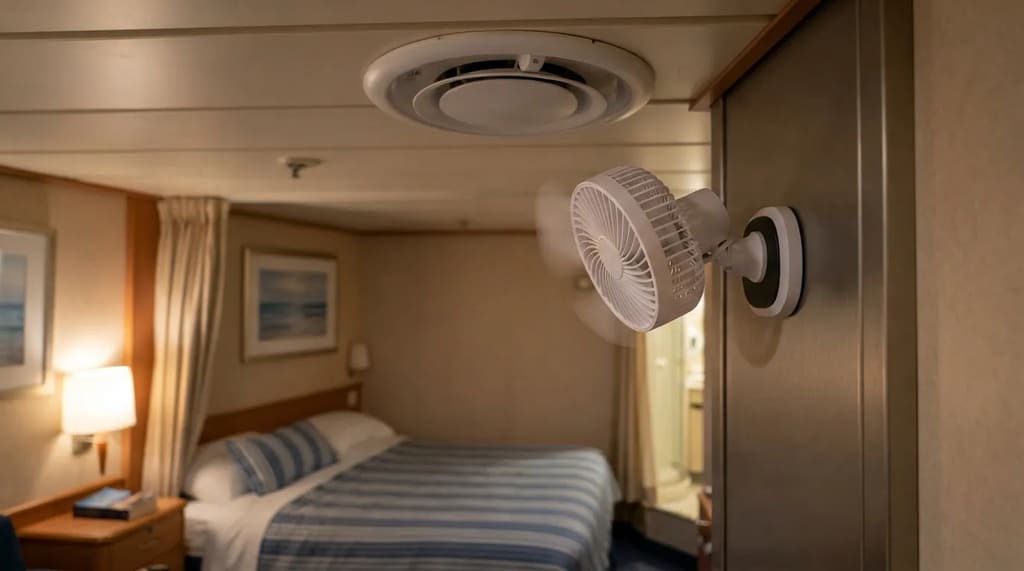
Moving air is the cheapest cooling you can bring aboard, and the right kind doesn’t need an outlet at all.
Pack a small fan that runs on batteries or a USB charge. One with a magnetic base can attach almost anywhere, which, thanks to #11, means the cabin wall rather than your nightstand.
One cruiser placed a fan near the ceiling air conditioning vent so cold air blew straight onto the bed. Aim a battery or USB fan at the ceiling vent. After a hot afternoon on deck, move it to the wall and point it at your chair.
The same fan has a second job. An inside cabin is shut off from the sound of the ocean, and a noise machine can help if you’re used to sleeping with white noise. A fan’s steady hum does much the same thing.
Cool air is only part of what a windowless room changes. The rest shows up at 3 a.m., when nothing tells you which way the bathroom is.
#8 – A Glow for 3 A.M., a Sunrise for 7
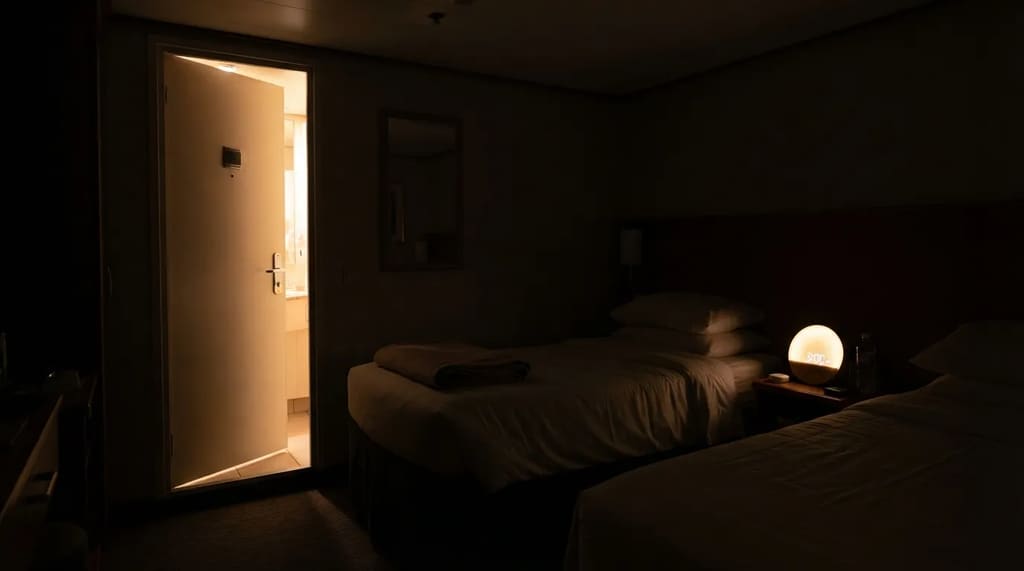
Switch off the lights in an inside cabin and the dark is complete, with no streetlight or moon to help you cross the room.
A small nightlight works, and so does the bathroom light with the door slightly ajar, which makes a soft glow. Leave the bathroom light on with the door ajar as a free nightlight.
The morning is the other half of the problem. With no window, you can’t tell sunrise from midnight, so some travelers bring a sunrise alarm clock that brightens gradually, the way a bedroom does at home. A plain phone alarm will wake you, though it won’t do it gently.
Whichever you bring, choose one that runs on batteries or USB. Outlets are already scarce, as #10 showed, and a nightlight shouldn’t take one from your phone charger.
Light fixes the night. The clutter that makes a cabin this size feel smaller by midweek is a luggage problem, and the storage is already under your bed.
#7 – Where the Suitcases Belong
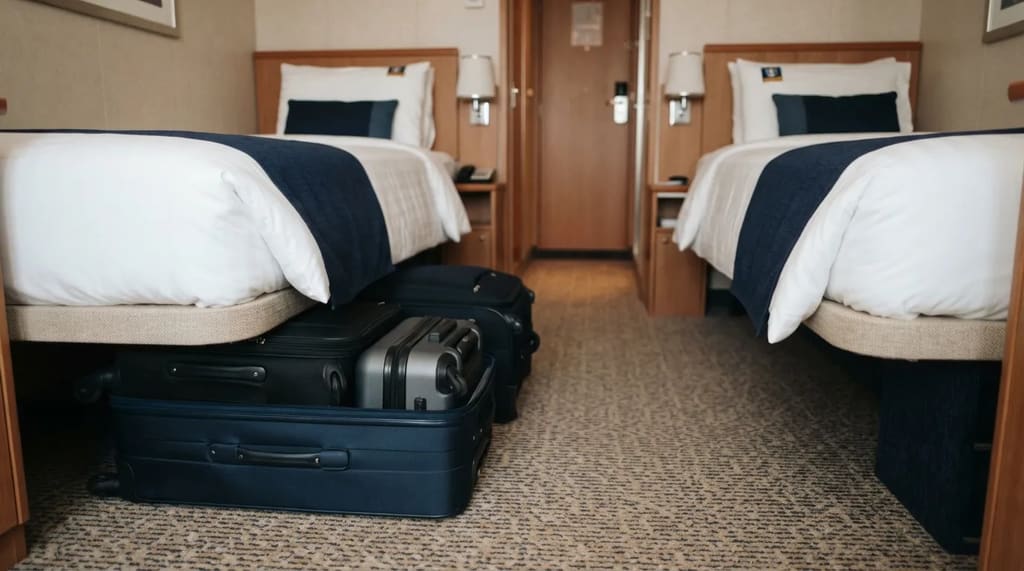
Suitcases are the biggest objects in your cabin, and the closet isn’t where they belong.
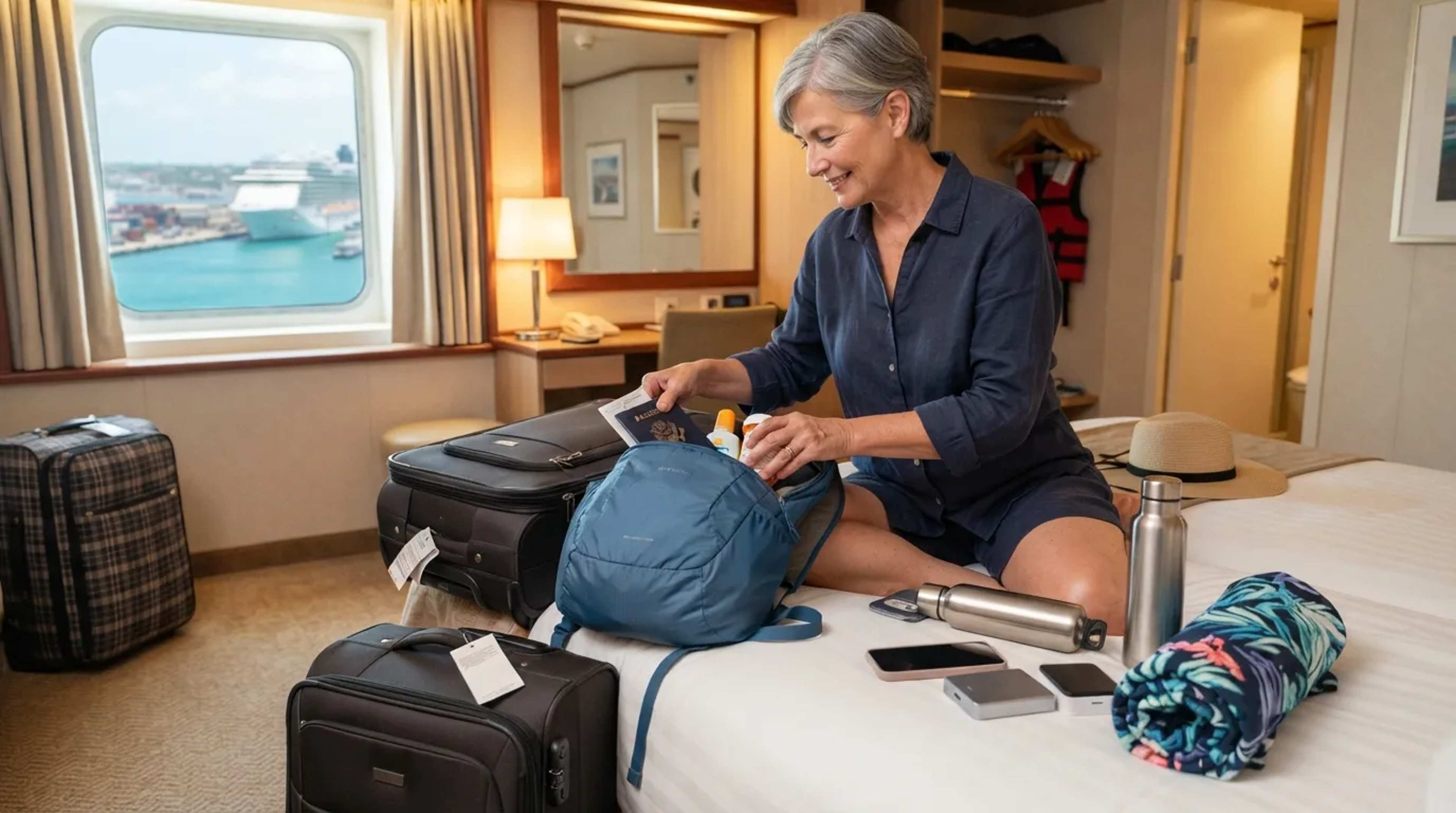
Nest the luggage inside each piece, then slide it under the bed until the end of the sailing. Nest your suitcases and slide them under the bed.
This works best if you unpack as soon as your luggage is delivered. You see the full layout of drawers and closet while the room is still empty, so you place things once instead of rearranging all week.
It also protects the walkway you created in #12. Split beds give you floor space between them, and the floor stays clear only if the bags are out of sight.
#6 – The Bow Camera on Your Cabin TV
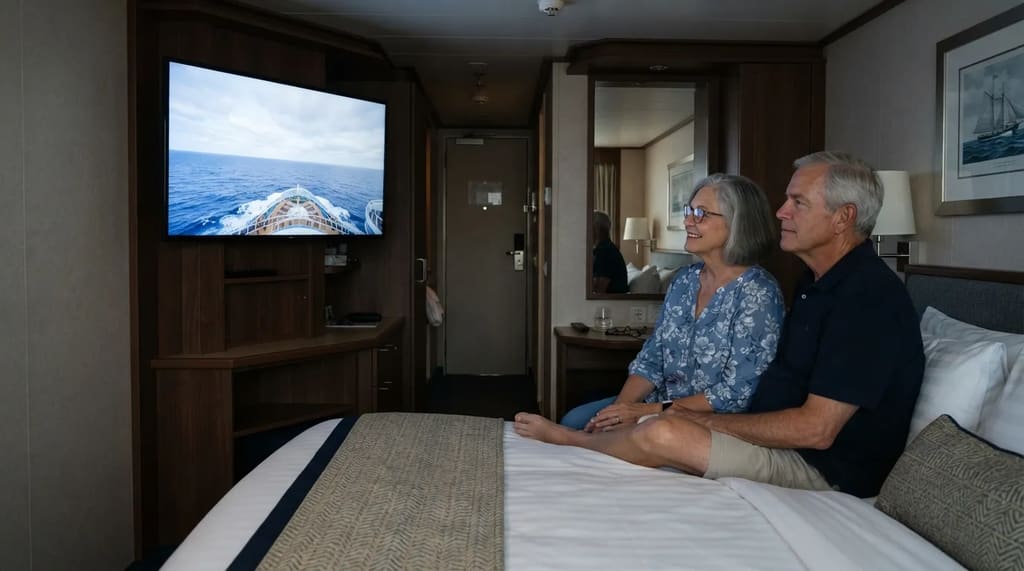
Before you pay for a view, check what the television already shows.
Cabin TVs commonly carry a ship channel showing the bow, and sometimes other camera angles from around the ship. Turn it on with the sound low in the morning and you have a live look at the water, which is what a window would have given you.
It’s also a quick way to get your bearings. Open sea or a dock tells you at a glance whether the ship is underway or tied up, and the sky tells you whether the deck is worth a jacket.
Channel lineups differ from ship to ship, so scan the guide on your first evening. Check the TV’s ship channel for a live bow camera.
On some ships the television isn’t the only screen. Another one covers most of a wall.
#5 – Find Out If Your Inside Cabin Has a Virtual Balcony
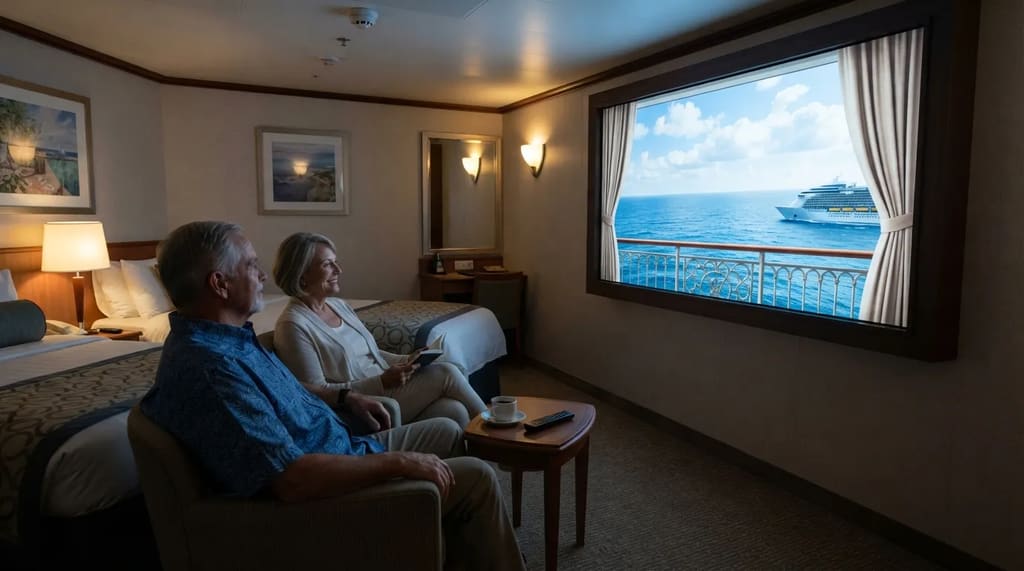
Not every inside cabin has a virtual balcony, even on ships that offer them.3
Where it exists, it’s an 80-inch high-definition screen showing real-time views and sounds of the ocean and destinations.3 Look for “Virtual Balcony” in your stateroom category, not just the ship name. Whether it adds to the fare depends on the ship and sailing, so ask for the difference in writing.
You stay in charge of it. Guests can choose to have the screen on or off, and the setup includes a virtual railing and ocean sounds with volume control or mute.4 A lit screen is the opposite of a dark room, so switch it off at bedtime.
The view is designed to be true to life. In port, that means a building may block it, just as it would from a real balcony.3
My view: I wouldn’t pay extra for one on its own. If your sea-day mornings are spent elsewhere, the screen is a pleasant touch and not a reason to book.
Staying in on a sea day means eating in, too. One order comes to your door free, and every other order carries a charge that stacks up fast.
#4 – Breakfast Delivered at No Charge

Five hot breakfasts ordered one at a time cost $39.75 in service charges before you’ve paid for a single egg.
Room service runs around the clock, but only continental breakfast, with coffee, tea, toast and cereal, is delivered at no additional cost. Other orders carry a $7.95 service charge, plus an 18 percent gratuity added to your check.5 6
Fast Facts
- Free: continental breakfast, including coffee, tea, toast and cereal
- Everything else: $7.95 service charge per order
- Gratuity: 18 percent added to your check
- Hours: room service runs around the clock
Continental breakfast is free; everything else costs $7.95 per order plus gratuity. The charge applies per order, not per item, so one larger order beats several small ones.6
On a sea day, the free breakfast lets you stay in bed as long as you like without missing the meal entirely. Save the paid menu for the morning, or the late night, when it earns its fee.
I’d treat paid room service as an occasional treat, not a routine, because the same fee returns with every order.
The person who services your room can supply more than clean towels, and you’re already paying for that help.
#3 – What the Daily Gratuity Already Covers
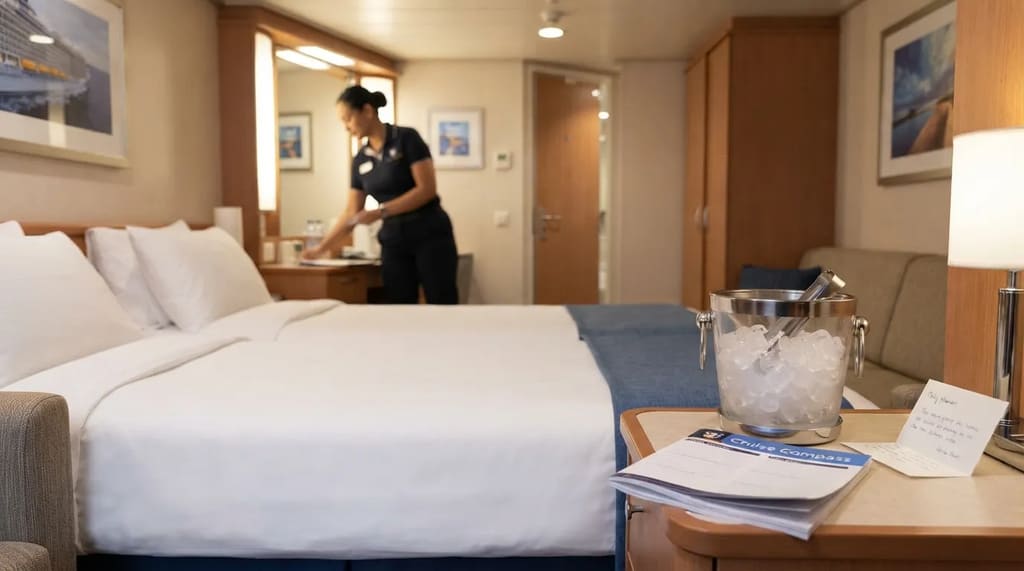
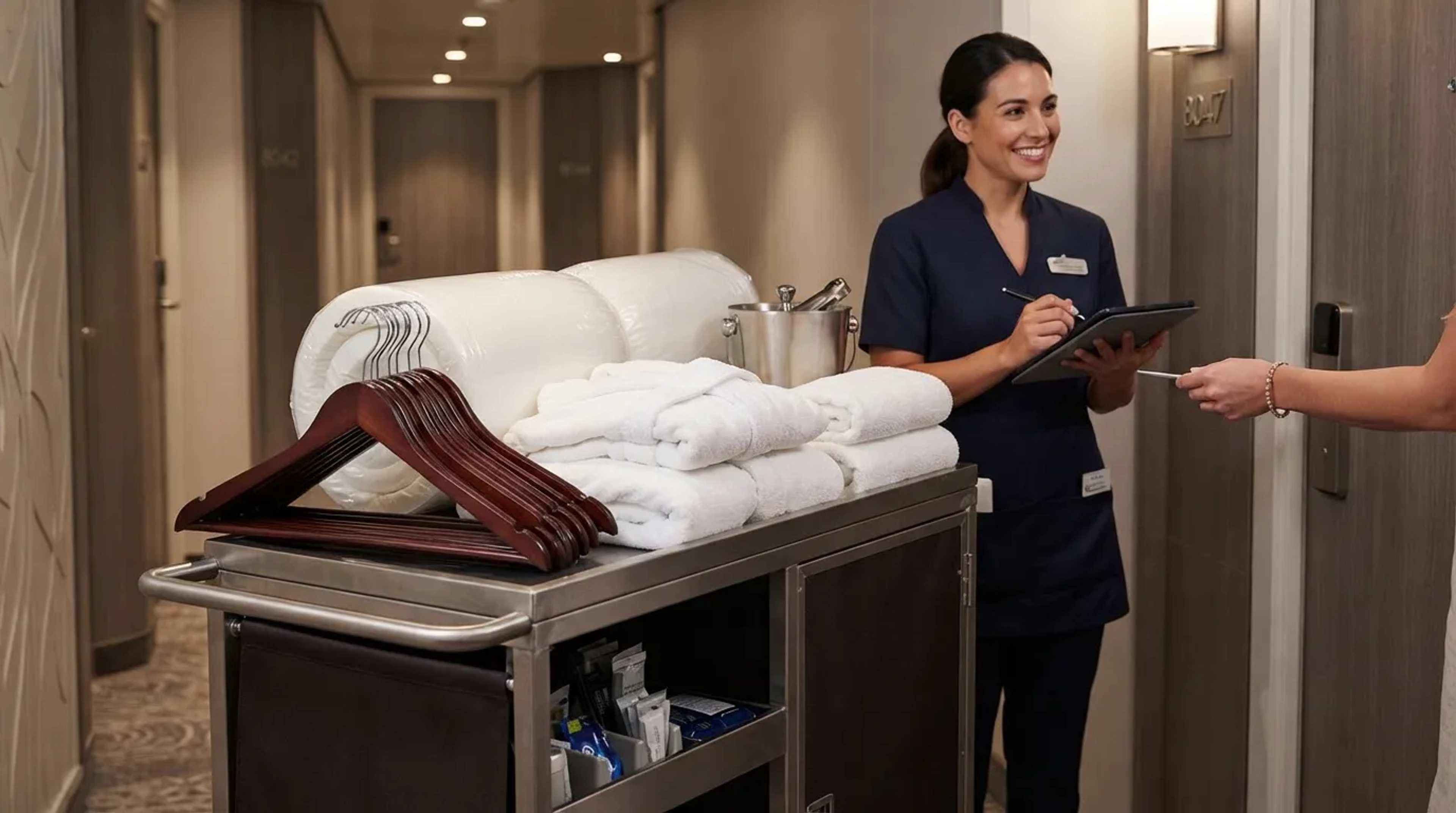
Royal Caribbean’s automatic gratuity is currently $18.50 per person per day in a stateroom. It’s added to your onboard account and shared across the crew who look after you, your stateroom attendant among them.5
For two guests over seven nights, that’s $259.7 Use your attendant on day one for ice, a paper schedule and the bed split.
Related Stories From Travelbinger



Attendants are the ones who deliver the flyers and paperwork about what’s happening each day. If you’d rather read tomorrow’s plan on paper than on your phone, ask for it, and set up the beds from #12 in the same conversation.
#2 – Plan Tomorrow Before You Fall Asleep

The best use of the cabin on a sea day is a few minutes at night spent planning the morning.
Read tomorrow’s schedule before bed, from the paper flyer your attendant delivers or from the Royal Caribbean app. The app can serve as a digital key, manage your bookings and make reservations for dining and entertainment.
Some of that planning belongs before the trip. AAA Northeast’s travel magazine advises booking shore excursions, special-occasion dinners at alternative restaurants, spa appointments on sea days and even seats for some shows before you board.
Book spa times and specialty dinners for sea days before you board. A booked time gives the day a shape, which matters on a ship where nothing forces you out of bed. Aim for one fixed appointment per sea day and leave the rest open.
Every habit so far makes the room better. The last one is about when to leave it, and it can change what you book next time.
#1 – Treat the Cabin as a Bedroom
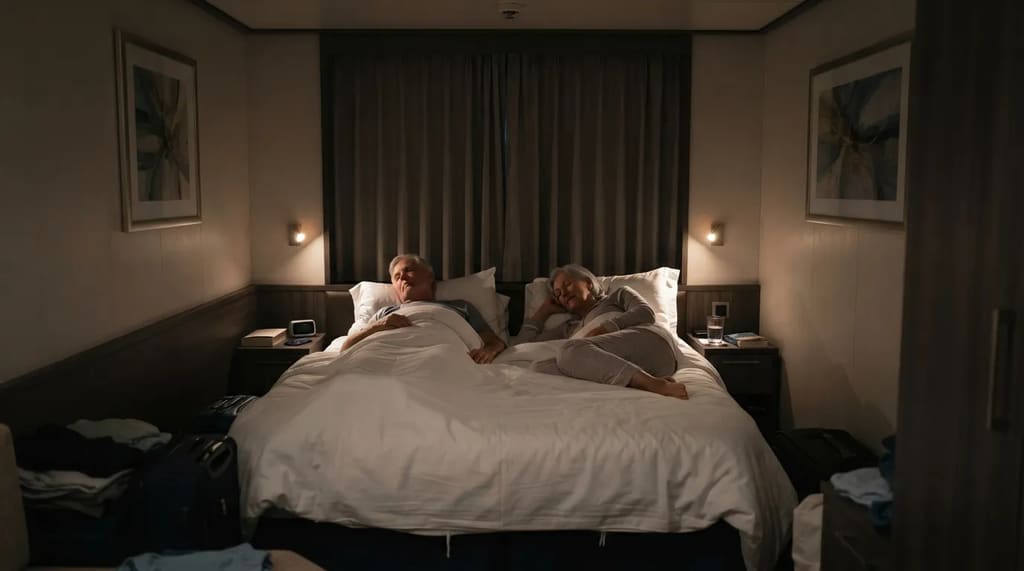
An inside cabin saves you money only on the days you aren’t in it.
AAA Northeast’s travel magazine makes the same point: windowless inside cabins are bargains if used simply for sleeping.8 An inside cabin is a bargain only if you use it for sleeping.
That’s why every habit above aims at rest: dark at night, cool, quiet, organized and easy to leave. None of them turns a small room into a place to spend a sea day.
Most cruise ships have plenty of outdoor seating where you can enjoy ocean views without paying extra for a window or balcony. Quieter spots exist on the promenade deck or at the back of the ship, and a room near the elevators makes it easier to come and go.
Worth Knowing
- Book inside if: you’ll be out of the room most of each sea day
- Book oceanview if: you already expect to spend sea-day afternoons in your room
- Virtual balcony: worth it only if you’d really sit and watch it
- Outdoor seating: gives you ocean views at no extra fare
Here’s the test for your next booking. If you already know you’ll spend sea-day afternoons in your room, the inside discount is the wrong saving, and an oceanview cabin is the better buy. The virtual balcony from #5 repays you only if you’d really sit and watch it.
Look back over the list and you’ll notice what each habit really is: a stand-in for the window. A glow replaces the light, a fan replaces the air, a bow camera replaces the view. A window supplies a clock, a weather report and a picture of the sea, and none of it shows up on your fare.
So judge an inside cabin by what you’ll spend to replace those things, plus the hours you’ll spend outside it, and not by the price per person. The room is cheap because you supply what the window would have.
What’s the one thing you pack to make a small cabin feel like yours?
Bonus #13 – Pick Your Own Cabin Number, Then Check What’s Above and Below It
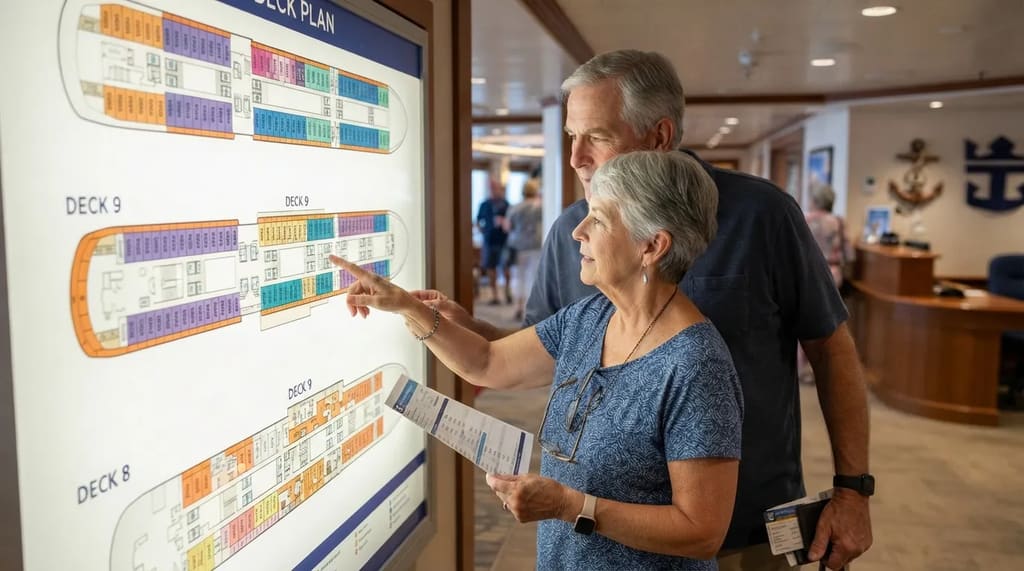
In a windowless room, the biggest sleep-wrecker isn’t the dark. It’s noise from the deck above or below you, and you can screen for it before you pay.
- Choose a specific cabin number. A guarantee fare can be cheaper, but the line picks the room for you, and you can end up in a spot you’d have skipped.
- Open your ship’s deck plan and look straight up and straight down from your cabin. You want more staterooms on both sides, not a pool deck, galley, theater, nightclub or lounge.
- Weigh the elevator trade-off. A room near the elevators is easy to reach, but the corridor is busier. If you sleep lightly, take a room a few doors away.
- Cross-check before you book. Read recent guest reviews for that exact cabin number and ship. Reviewers often mention noise, and a pattern across several is worth believing.
Do this for the one thing no gadget on this list can fix: a quiet room is the cheapest upgrade an inside cabin can get.
- Royal Caribbean Blog Banned Item Rule: https://www.royalcaribbeanblog.com/2026/07/28/royal-caribbean-updated-the-rule-banned-travel-item
- Cruise Power Strip Rules: https://travel-hacker.com/2026/10/16/cruise-power-strip-rules/
- Royal Caribbean Virtual Balcony FAQ: https://www.royalcaribbean.com/faq/questions/what-is-a-virtual-balcony
- Royal Caribbean Symphony Balcony FAQ: https://www.royalcaribbean.com/cruise-ships/symphony-of-the-seas/balcony
- Royal Caribbean Included Guide: https://www.royalcaribbean.com/guides/what-is-included-on-a-cruise
- Royal Caribbean Blog Room Service: https://www.royalcaribbeanblog.com/2022/05/09/royal-caribbean-room-service-guide-tips
- Royal Caribbean Gratuities 2026: https://deeparrival.com/cruise/cruise-lines/royal-caribbean/gratuities/
- AAA Northeast ABCs of Cruising: https://magazine.northeast.aaa.com/daily/travel/ocean-cruises/the-abcs-of-cruising/