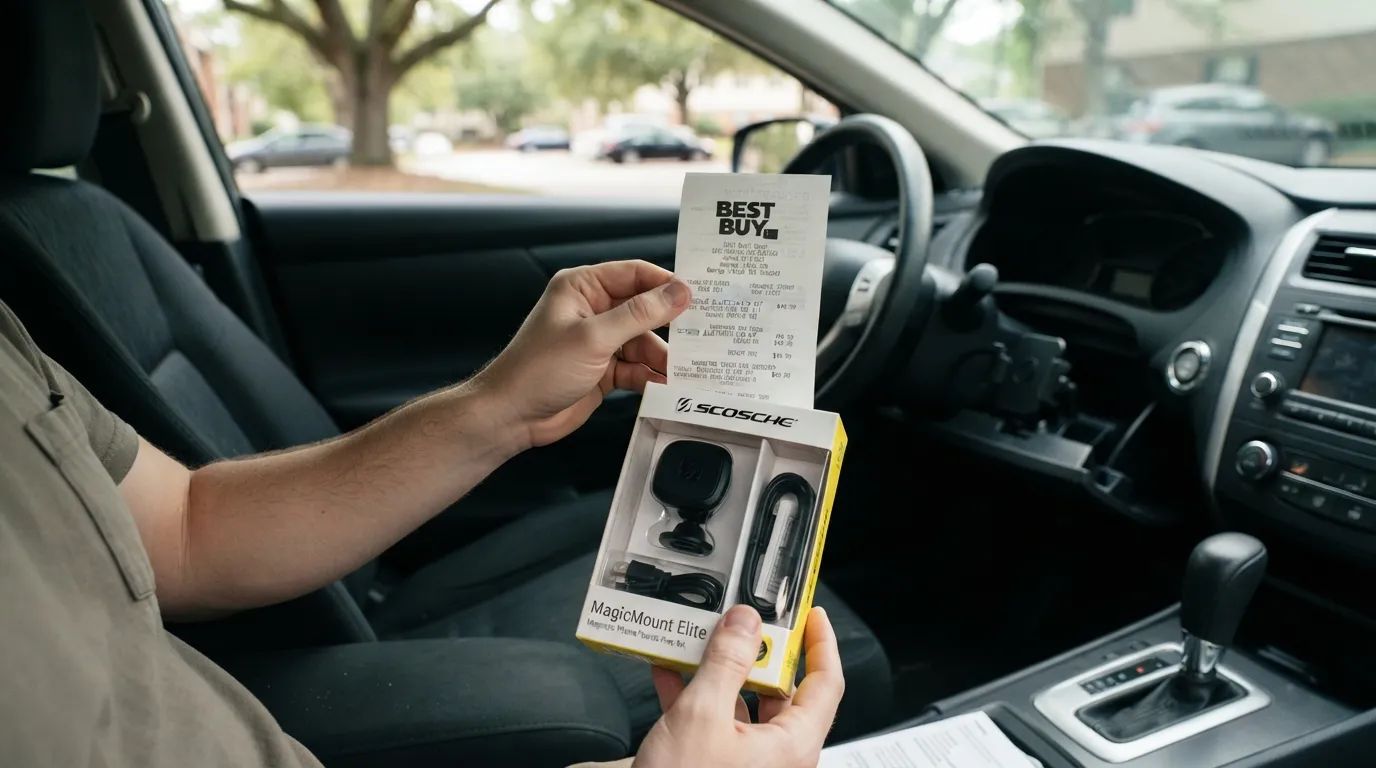
Georgia keeps two clocks for out-of-state drivers, one set at 30 days and one at 90, and a six-week stay lands in the gap between them. Forty-two days is long enough to pass the first deadline and short enough to feel safe about the second.
The thirteen items below run from small driving habits to real money, so they cost more as you go. Stay for the last one, because it’s the 30-day test on Georgia’s own driver services site that decides which of the other twelve apply to you. Start with the plate on your car.
#13 – Your Plate Has to Be Current and Visible
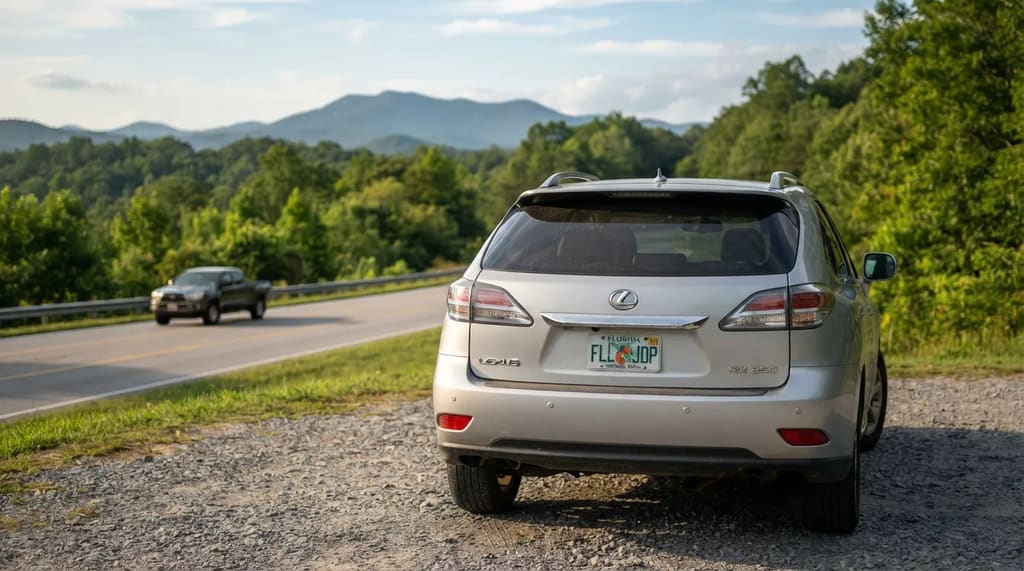
Georgia lets a visitor drive on home-state plates for up to 90 days, for pleasure purposes only.1 That permission comes with a condition that’s easy to miss.
The car has to be properly registered and visibly display valid plates from the owner’s home state. If your registration lapses while you’re away, the visitor exemption loses its footing.
Georgia’s code also says the registration number and the state’s initial letter must be displayed and plainly visible.1 A frame, a bike rack or a hitch carrier that covers part of the plate can create a problem you didn’t need.
Check your registration’s expiration date before you leave home. Check it again if your stay will run into a new month, since a renewal notice can sit unopened in a mailbox for weeks.
A valid plate keeps the car legal. The lane you choose on a four-lane highway can still draw a stop, even when you’re doing the speed limit.
#12 – The Left Lane Rule on Multi-Lane Highways

The interstates that carry winter traffic through Georgia, I-75 and I-95 among them, run two or more lanes each way. The left lane on those roads comes with a rule.
Georgia law bars a driver from lingering in the left lane of a multi-lane highway while holding up traffic behind. The lane is there for passing and for left turns.
The rule matters most if you’re towing a trailer or driving an RV. You’re slower on grades, and cars bunch up behind you faster than you’d expect.
After you pass, move back to the right lane. Make it a habit at every exit instead of a decision you make once a truck fills the mirror.
The cruise control setting doesn’t change any of this. If cars keep coming up behind you in the left lane, you’re in the wrong lane.
Moving right also helps with the rule that follows, though that one has nothing to do with traffic behind you. It’s about a flashing light on the shoulder ahead.
#11 – Flashing Lights on the Shoulder Ahead

Georgia’s Move Over law applies when you approach a stationary emergency vehicle, tow truck or maintenance vehicle with flashing lights.2 The tow truck on the shoulder counts just as much as the patrol car.
When conditions allow, you’re expected to move over one lane. If traffic or the road layout makes that unsafe, slowing down is the standard fallback.2
Towing makes this harder, because a trailer needs extra distance to change lanes. The decision has to be made well before you reach the lights, not at the last second.
Change lanes early, or slow down if the next lane is full. A swerve across a lane at the final moment is how a courtesy rule turns into a crash.
The phone in your cup holder is a bigger exposure than any shoulder. Georgia’s rule on it reaches further than texting.
#10 – Your Phone at a Georgia Red Light

You’re stopped at a red light and glance at the phone in your lap to check the map. In Georgia, that glance is the violation.
The hands-free law prohibits holding or supporting a phone with any part of the body while driving.3 It applies to every driver operating a vehicle on Georgia roads, so out-of-state plates don’t change anything.
Being stopped at a light doesn’t exempt you, because the vehicle is still being operated. The law also bars writing, sending or reading text-based messages and watching video.
Voice calls and voice commands through Bluetooth or a car system are fine, and so is a mounted phone used for GPS. Mount the phone and set the route before the car moves.
If the map needs a change mid-trip, say it aloud or pull over. Reaching over to tap the screen is what gets drivers stopped.
Fast Facts
- Not allowed: holding or supporting the phone with any part of your body
- Also banned: reading or sending texts and watching video
- Red lights count: a stopped car is still being operated
- Still fine: voice calls, voice commands and a mounted GPS
The first ticket under this law is cheap. The second inside two years costs double, and the third costs triple.
#9 – The Fine Ladder and the One-Time Dismissal
A first conviction costs $50 and one point, a second costs $100 and two points, and a third or later costs $150 and three points. Convictions within 24 months of each other bring the $100 and $150 fines.3
The higher fines apply only when convictions fall within 24 months of the first. A winter visitor who returns each year can stay inside that window without noticing.
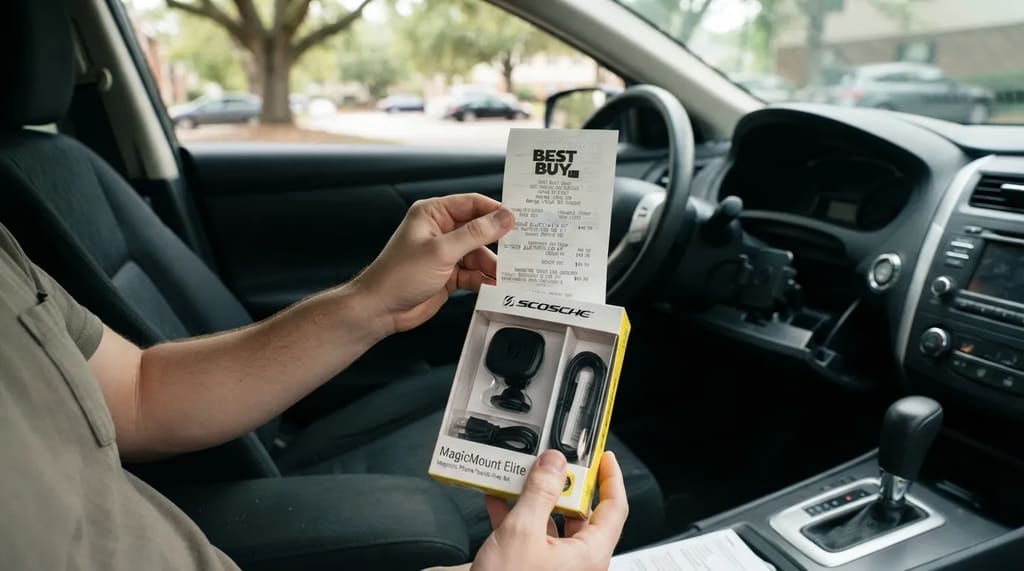
A first-time offender may have the charge dismissed by showing the court proof of buying a hands-free device before the court date, and that option is available only once. That’s a courtesy, not a plan.
A phone mount in the glove box is a better plan than counting on the dismissal, which works once and requires going through the court process. Points can also affect insurance premiums at renewal.
Those points are small beside what one speeding ticket can add. At the top of the scale, a single conviction carries as many points as three phone convictions in a row.
#8 – Speeding Points Start at 15 Over

Georgia assesses no points for speeding less than 15 mph over the limit. Points are assigned by how far over you were going.
The scale climbs with speed. Fifteen to 18 over is two points, 19 to 23 over is three, 24 to 33 over is four, and 34 or more is six.
Quick Compare
| Miles per hour over the limit | Points |
|---|---|
| Under 15 | 0 |
| 15 to 18 | 2 |
| 19 to 23 | 3 |
| 24 to 33 | 4 |
| 34 or more | 6 |
Fifteen points in any 24-month period results in suspension of a Georgia license.4 A visitor would need several serious tickets to get there, so the dollar costs in the next item deserve more attention than the point count.
The missing points under 15 over are a gap in the points, not in the ticket. You can still be fined for going 10 over, and the fine is yours to pay either way.
The cost that follows an 85 mph reading doesn’t depend on points at all. It arrives as a separate bill from a different state office, usually after you’ve gone home.
#7 – The $200 Super Speeder Fee in the Mail

Georgia’s state fee is $200 for a conviction at 85 mph on any road or 75 mph on a two-lane road. That $200 is on top of the court fine.5
The fee applies equally to Georgia residents and out-of-state drivers. The Department of Driver Services bills it after conviction, and it doesn’t appear on the original citation.
DDS sends the notice to the driver’s address on file. If that’s a home mailbox you won’t open until spring, the payment deadline runs while the envelope waits.
If the fee isn’t paid, DDS suspends your nonresident driving privileges in Georgia. Reinstatement adds a $50 fee.5
On a two-lane road, 75 mph is the most expensive speed on this list so far. Set the cruise control and leave it there.
What you’re doing while you’re here decides the rule after this one, and it can cut your 90 days to 30.
#6 – The Pleasure-Only Condition on Your 90 Days
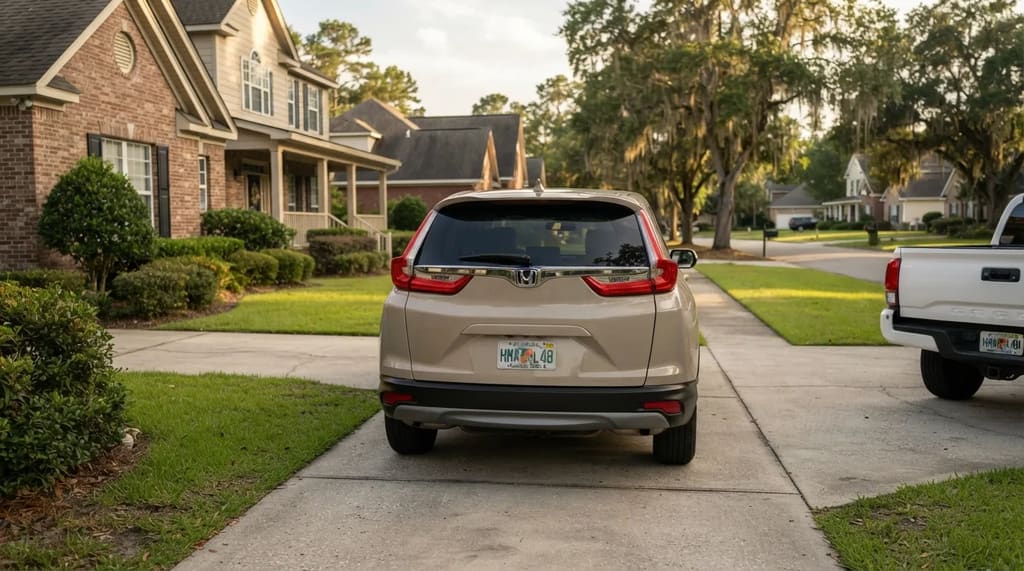
At six weeks, a visitor’s car has 48 days left on the 90-day clock. A nonresident’s 30 days ran out 12 days ago.
The difference is what you’re doing in Georgia. The code defines a nonresident as someone who doesn’t live here but takes a job, engages in a trade, profession or occupation, or enters children in public schools.1
People in that group must buy a Georgia tag or decal within 30 days after entering the state. The visitor allowance isn’t open to them.
At a Glance
- Visitor: lives elsewhere, no job, trade or school enrollment, 90 days for pleasure
- Nonresident: works, runs a trade or enrolls children in school, tag or decal within 30 days
- At day 42: the visitor has 48 days left, while the nonresident is 12 days past the deadline
A paid winter job or a business you run while staying can fall under that wording, even if the rest of the trip feels like a vacation. Paid work or school enrollment cuts the 90-day window to 30.
Outstaying either window leads to the same place, the county tag office. Before it will register anything, it checks something your insurer has to do on its end.
#5 – Georgia Insurance Is Verified Electronically

Georgia requires liability insurance to register a vehicle. The proof isn’t a card you slide across the counter.
Insurance must be electronically transmitted to the Georgia Insurance Database before registration. So the paper card in your glove box doesn’t do the job at the tag office.6
Georgia’s minimum liability limits are $25,000 for injury to one person, $50,000 for injury to everyone in one accident and $25,000 for property damage. Check that your policy meets them if the car will be kept in Georgia.
Call your insurer before the tag office visit and ask it to file coverage with Georgia. Tell the agent how long you’ll be in the state and where the car will be kept.
Insurance is only one item, and the order of the others matters. Get them backwards and the tag office sends you away.
#4 – Two Agencies and a Fixed Order of Visits

Georgia splits the job between two offices that don’t share a counter. Licenses come from the Department of Driver Services, not the Department of Revenue.
Vehicle registration goes through the Department of Revenue and is processed at your county tax commissioner’s office. That’s why one trip never covers both.
The order is fixed. You need a Georgia driver’s license or ID from DDS before the tag office can process the registration.
You’ll also bring the insurance filing from the last item. Your out-of-state title is exchanged for a Georgia title.
Visit DDS first, then the tag office, and finish both within 30 days of moving. That is the new-resident deadline for registering your vehicles.
With both stops done, the bill arrives, and it isn’t a flat fee. It’s a percentage of what the car is worth.
#3 – The One-Time Title Tax Based on Car Value

New residents owe a one-time title ad valorem tax based on the vehicle’s fair market value, in place of sales tax or annual ad valorem tax. It’s charged once, at registration.
For new residents, the rate is reduced to 3%. The reduced rate is 3% of the car’s fair market value, paid once.6
For a stay that really is a pleasure visit under 90 days, registering in Georgia just to be safe is the wrong fix. It buys you a new license, an insurance filing and a tax bill to solve a problem the visitor rule already handles.
Related Stories From Travelbinger



Ask the tag office to confirm the current rate and how it values your vehicle, since both can change. That call is worth making before you pay anything.
The license has its own cost, and it comes with a commitment longer than any winter.
#2 – An Eight-Year License With No Refund

A recently renewed license runs for eight years, and DDS offers no refunds if you move out of state. DDS refunds nothing if you leave Georgia after getting a license.
The transfer also costs you your old card, because you must surrender your out-of-state license. DDS hole-punches it and returns it with an interim license.
Drivers with a valid out-of-state license usually avoid the written and road tests. That keeps the visit short, but it doesn’t change the price.
If you’ve made Georgia your home, pay for the license and move on. If you haven’t, don’t buy one as insurance against a ticket you may never get.
Both of those steps rest on one question that Georgia answers in different ways: when does a visitor become a resident? The agency that issues licenses gives a number, and it’s smaller than 90.7
#1 – The 30-Day Clock That Starts When Georgia Becomes Home

The 90-day visitor allowance is the number everyone remembers. It’s the wrong number to watch once Georgia has quietly stopped being a stop and started being home.
DDS tells new residents to get a Georgia driver’s license within 30 days of establishing residency. The clock runs from the day you became a resident, not from the day you crossed the state line.
That’s the test hiding under the other twelve items. A snowbird who keeps a home in Florida, plans to go back and isn’t working or enrolling children in school here is a visitor.
A paid job or a school enrollment changes the answer, as item #6 showed. So does a decision to stay, and none of them waits for day 90.
Worth Knowing
- The visitor window: up to 90 days, for pleasure purposes only
- The resident window: 30 days to get a Georgia license once you establish residency
- When it starts: the day Georgia becomes home, not the day you cross the line
- What can flip it: a paid job, a school enrollment or a decision to stay
Ask yourself one question: is Georgia where I’m staying, or where I live now? The day the honest answer flips, the 30 days start, and items #5 through #2 come due.
If you can’t tell which side of the line you’re on, ask DDS or the county tag office before day 30 instead of after. A phone call costs nothing, and a missed deadline can cost a lot more.
The Six-Week Mark, Reconsidered

Day 42 feels like a finish line to a lot of snowbirds. It’s really the point where Georgia’s two clocks have split apart.
Everything from the plate to the phone to the left lane applies from your first mile, no matter where you live. Everything from the insurance filing to the eight-year license applies only once the 30-day clock starts.
So keep the plate current, the phone mounted and the cruise control under 75 on two-lane roads. Forward your mail, too, because the costliest Georgia surprises tend to arrive after you’ve left.
Six weeks in Georgia won’t catch you out. Not knowing which clock you’re on will.
- Georgia Code 40-2-90: https://law.justia.com/codes/georgia/title-40/chapter-2/article-4/section-40-2-90/
- GOHS Move Over Law: https://www.gahighwaysafety.org/move-over-law/
- DDS Hands Free Georgia Law: https://dds.georgia.gov/press-releases/2018-05-25/hands-free-georgia-law-hb673
- DDS Points System: https://dds.georgia.gov/section-10-continued
- DDS Super Speeder FAQs: https://dds.georgia.gov/georgia-licenseid/violations-suspensions-revocations/violations-and-suspensions-faqs/reinstatement
- Hall County Vehicle Registration: https://hallcountytax.org/vehicles/vehicle-registration/
- Georgia Code 40-2-1: https://codes.findlaw.com/ga/title-40-motor-vehicles-and-traffic/ga-code-sect-40-2-1/