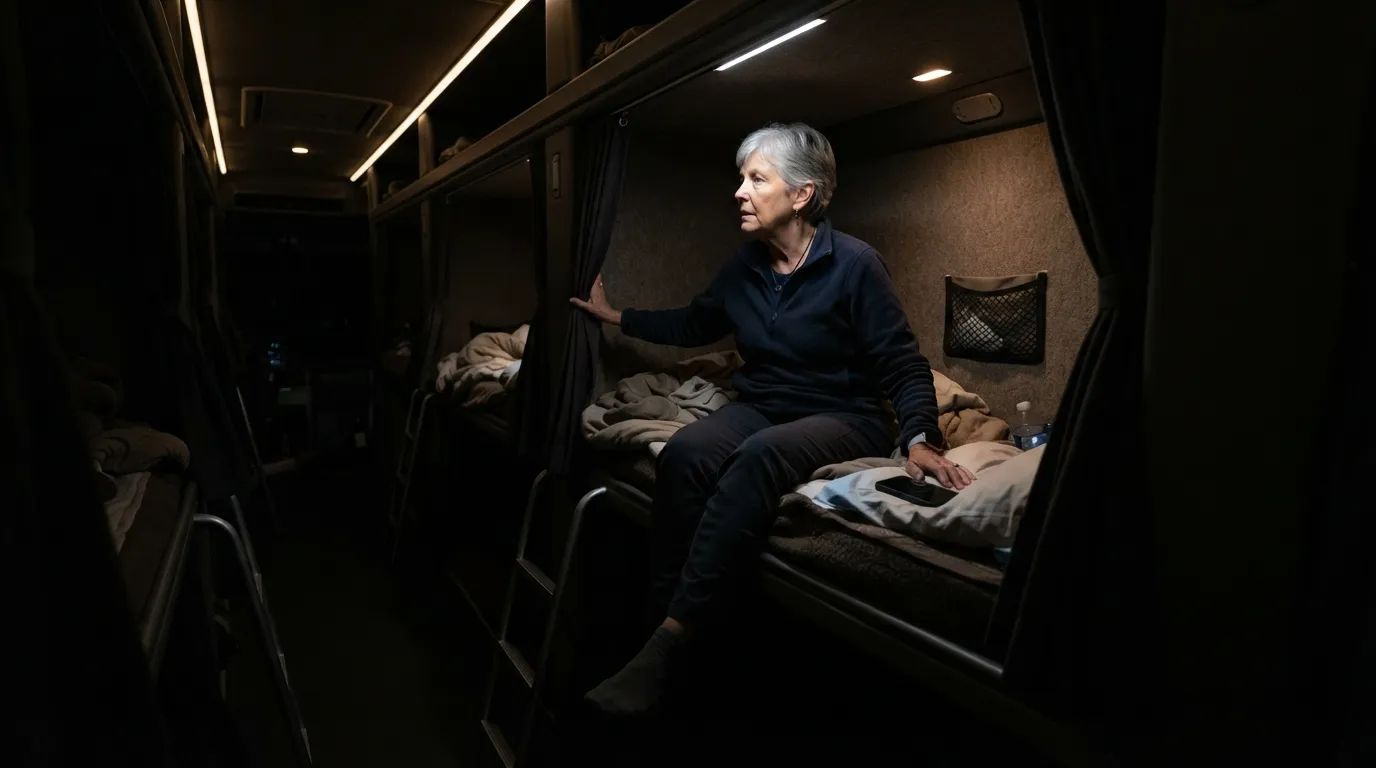
Picture the cabin at 2 a.m.: curtains drawn, engine humming, one stranger’s cane sliding slowly into the aisle. Most of the habits that keep an overnight coach ride safe are ones nobody can do for you once the lights go out.
These 14 rules draw on federal guidance and public health advice, and they climb in stakes as you go. An overnight run can cover a long stretch while you sleep, because a passenger-carrying driver may drive up to 10 hours after 8 consecutive hours off duty, within a 15-hour on-duty limit.1
Stay for #1, because it involves a federal rule that doesn’t cover you the way you’d expect. First, the cheapest fix on the list involves your shoes.
#14 – Shoes, Bags and Canes Kept Out of the Aisle
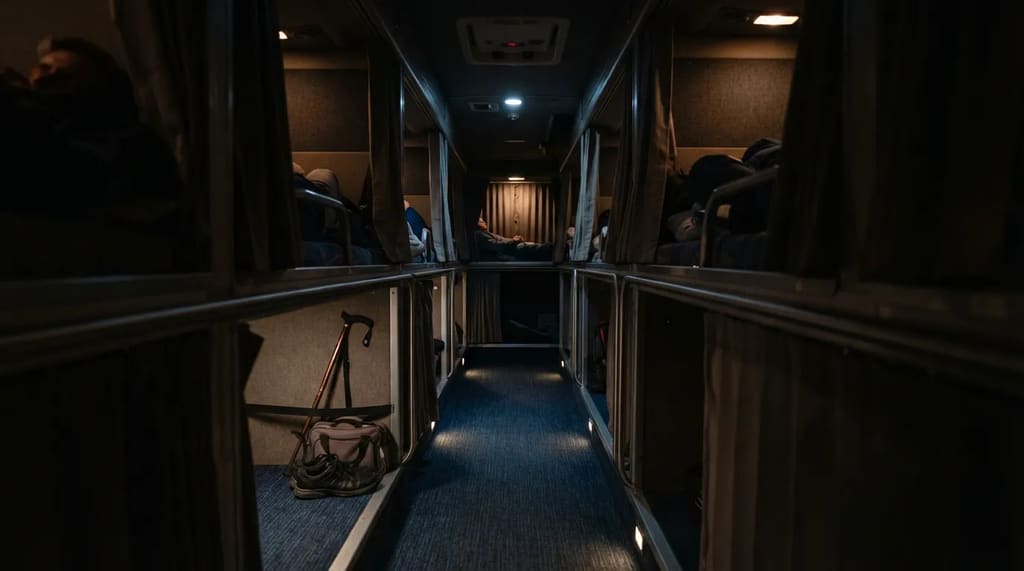
Anything left in the aisle is something a half-asleep passenger can trip over at 2 a.m. Rhode Island’s driver manual tells bus drivers not to let riders leave carry-on baggage in a doorway or aisle.
It also says to keep anything that might trip riders out of the aisle. That rule governs loading, so it protects you only until you start unpacking.
Once you’ve kicked off a shoe or leaned a cane against a rail, keeping it clear is your job. Nothing of yours belongs in the aisle or the doorway.
Bags have a second job on a coach. The manual says baggage should be secured so riders can still leave by any window or door in an emergency, and so a falling or shifting bag can’t injure anyone.
Clear floors don’t help if the one device that can call for help is zipped into a bag in the luggage bay.
#13 – A Charged Phone Within Reach of Your Pillow
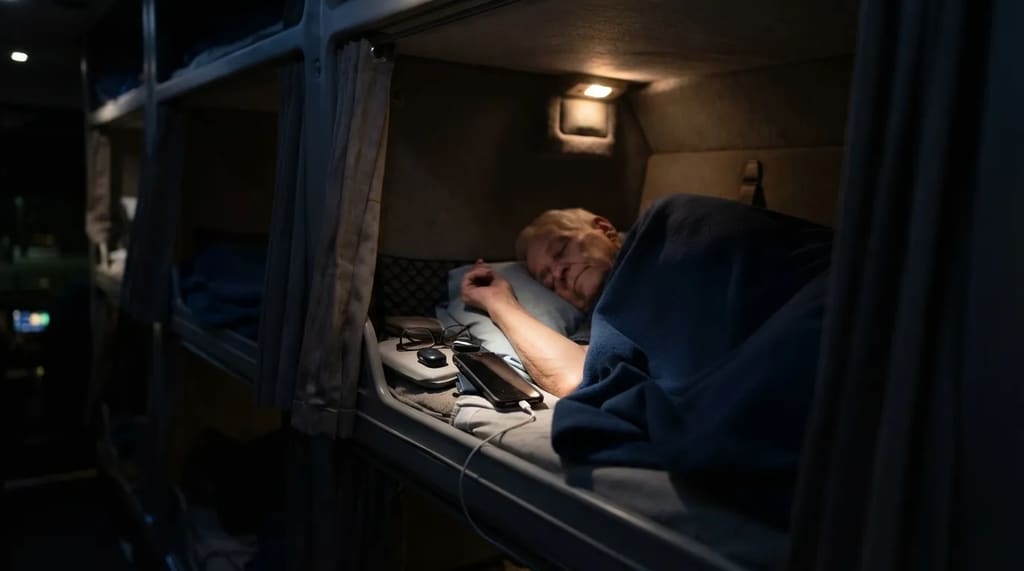
FMCSA’s pre-trip safety topics for coach passengers include a plain instruction: call 911 by cellular telephone in an emergency.2 A phone sitting in a bag under the floor can’t do that.
Keep the phone charged and within arm’s reach all night. A short charging cable is worth packing, though you shouldn’t assume there’s an outlet you can reach while lying down.
Glasses and hearing aids belong in the same spot. If you wake to noise in a dark cabin, you’ll want to see and hear before you do anything else.
At a Glance
- Phone: charged, and within arm’s reach of your pillow
- Cable: a short one, with no promise of a reachable outlet
- Glasses and hearing aids: in the same spot every time
- Emergency call: 911 by cell phone
Before you sleep, note the last stop or the last highway sign you passed, because a 911 dispatcher will ask where you are. Even a rough answer saves minutes.
Which bunk you take changes how far you climb and how much you sway, and that choice is often yours.
#12 – The Lower Bunk Beats the Upper One
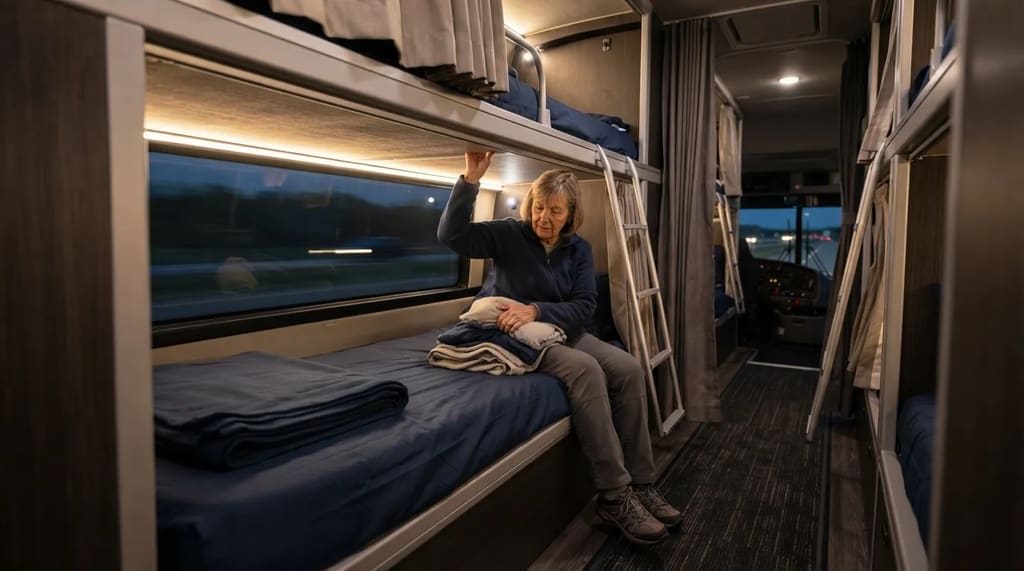
Take the lower bunk if you’re offered a choice, and don’t let a better view talk you out of it. The lower berth sits close to the chassis, so it tends to stay steadier.
The upper bunk generally swings more on sharp bends, which can toss a sleeper from side to side. For stiff knees or a sore hip, there’s another reason too.
A lower bunk means a shorter climb in the dark, when you’re half awake and reaching for a rail you can’t see. A little extra privacy up top doesn’t justify a ladder at 70.
Pick a lower bunk near the middle of the coach, especially if motion sickness is a problem for you. The middle is where the rocking is gentlest.
A night-time bathroom trip is the likeliest reason you’ll be up and moving, and the room at the end of the aisle holds a switch you should know about before you need it.
#11 – The Restroom Emergency Button, Found Before Dark
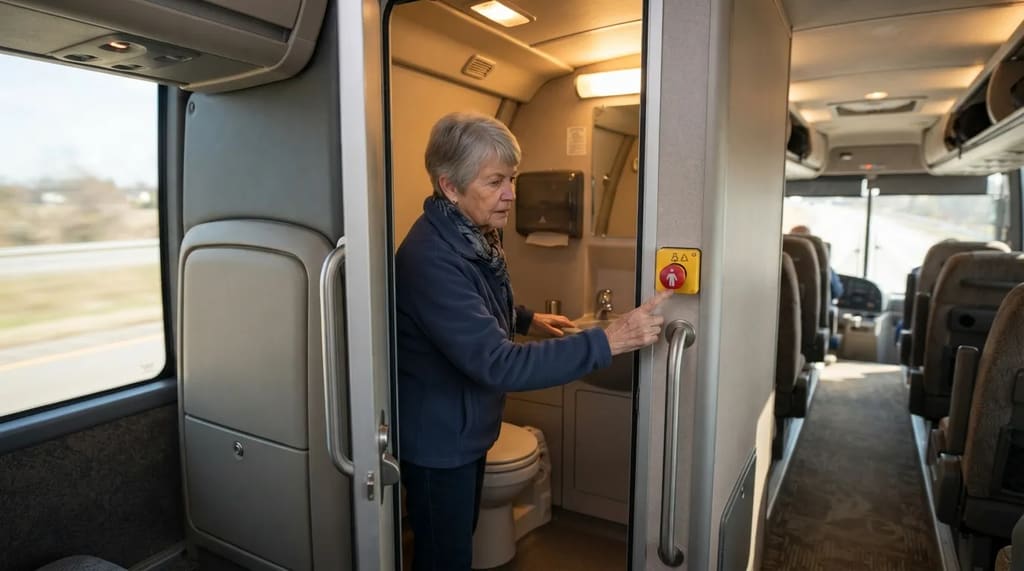
FMCSA’s pre-trip topics for motorcoach passengers include the restroom emergency push button or switch. It lets you contact the driver if you need help.3
Find it on your first visit, while the cabin is lit and nothing is wrong. Learning where it is on your third trip, at 3 a.m., is how a small problem becomes a long one.
The button matters most if you tend to feel dizzy when you stand up from lying down. Behind a closed door, in a moving coach with the driver far forward, it may be your only way to signal.
On the walk there and back, use the seat backs or overhead supports as handholds while the coach is moving. Locate the restroom signal on your first visit, not your last.
#10 – Where the Fire Extinguisher Is Kept
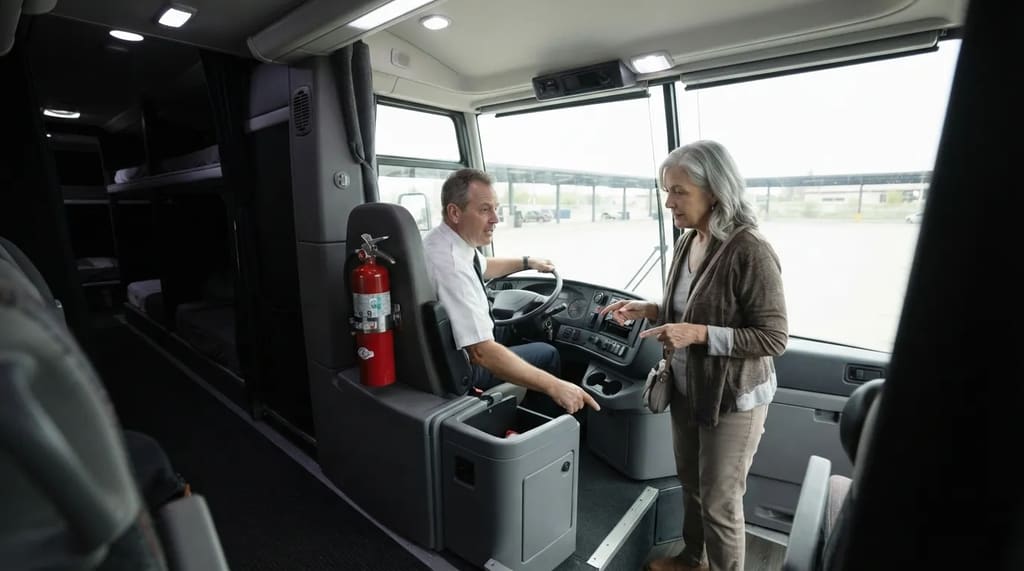
FMCSA’s passenger guide says a coach’s fire extinguisher is usually stored toward the front. It may also be behind the driver’s seat, under a right-side passenger seat or in an overhead compartment.3
Because the location varies, the reliable method is to ask. If you can’t spot the extinguisher, ask the driver where it’s kept.
Do it at boarding, with the cabin lit. If your bunk is toward the rear, you’ll also see how far the front sits from where you’ll be lying.
Knowing the spot doesn’t mean fighting a growing fire. The guidance says to listen to and follow the driver’s instructions in an emergency, so the driver’s directions and the exits come first.
Knowing where equipment sits is half the job. The other half is a fact about you that nobody aboard can guess.
#9 – Telling the Driver What You Can’t Do
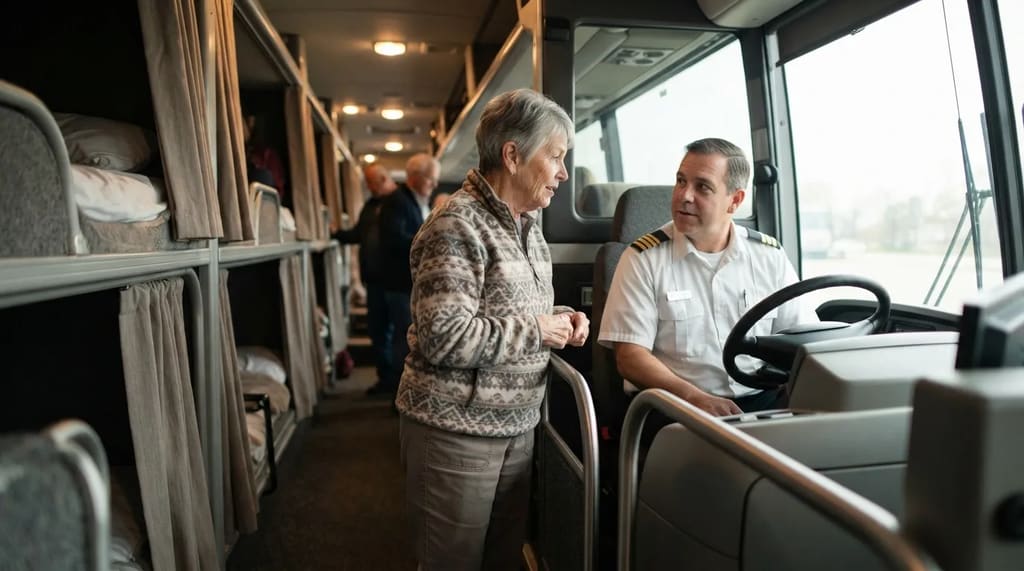
Say it while the lights are still on: you can’t climb quickly, you can’t hear an announcement without your hearing aids, or you can’t work a stiff latch. It feels awkward for about five seconds.
FMCSA’s guidance encourages able-bodied passengers to help injured or mobility-impaired riders during an emergency evacuation.4 A helper can only help someone he or she knows is there.
Tell the driver at boarding, and tell whoever sleeps nearest you. One sentence is enough, such as that you’d need a hand getting down quickly.
If you take a medication that makes you groggy, mention that as well. Keep a current medication list in your phone or wallet so a stranger can read it for you.
Boarding is also when the safety briefing happens, and it’s the one piece of the evening you’ll be tempted to tune out.
#8 – The Safety Briefing You’ve Heard Before
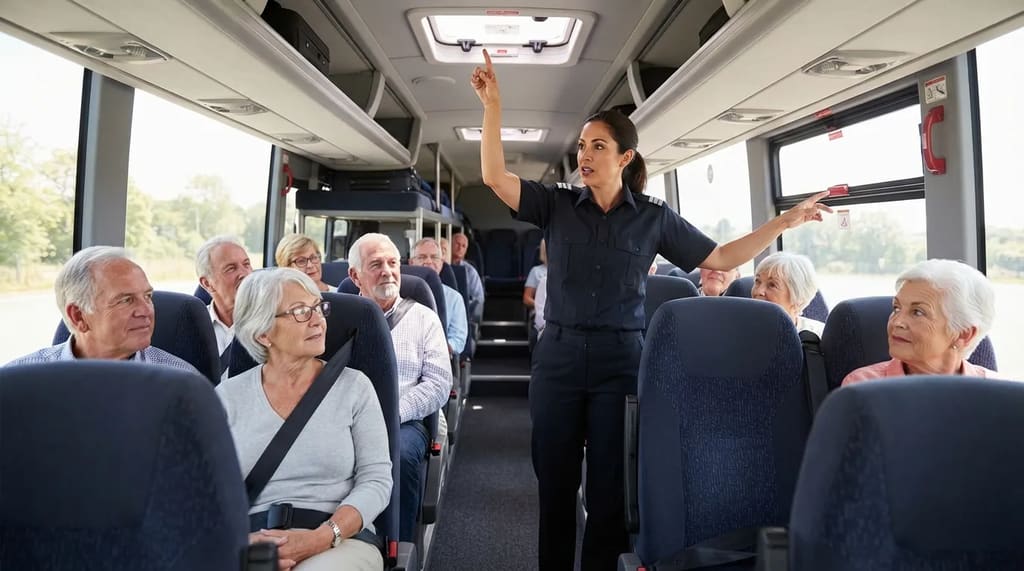
FMCSA’s guidance says charter and tour operations should give the safety information after boarding and before the coach moves. Fixed-route service should give it at major stops after new passengers board.2
The recommended topics are concrete. They include the push-out windows, roof vent and side door, seat belt use, and calling 911 by cell phone.2
Fast Facts
- Charter and tour trips: briefing after boarding, before the coach moves
- Fixed-route service: briefing at major stops once new passengers board
- Exits covered: push-out windows, roof vent and side door
- Also covered: seat belt use and calling 911 by cell phone
Tuning the briefing out because you’ve heard it before is a bad trade. The extinguisher’s home varies from coach to coach, and window exits come with their own instructions to pull or push a lock.
A new boarding stop should bring a new briefing. If you joined late and missed it, ask for it, because a pamphlet in the seat-back pocket is only one delivery method and a bunk may not have a seat back.
That briefing covers the coach. The clock that decides when the coach must stop is a separate matter, and on an overnight run it shapes your whole night.
#7 – The Driver’s Clock Behind Every Night Stop
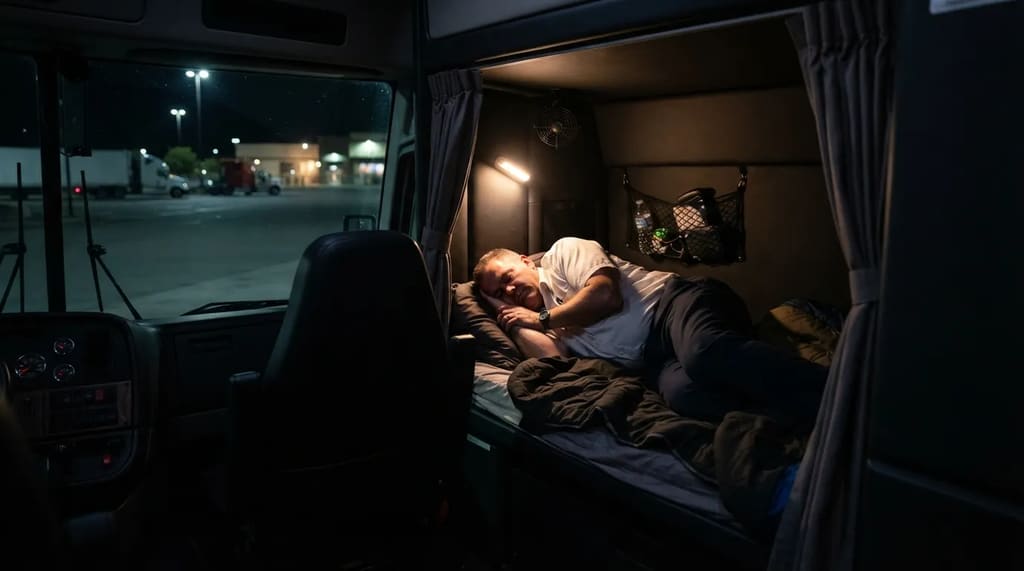
The daily ceiling for a passenger-carrying driver is 10 hours of driving, 15 hours on duty, 8 hours off. A driver must take 8 consecutive hours off duty before a shift, then may drive up to 10 hours.
Off-duty time isn’t counted in the 15-hour period. A driver using a sleeper berth must take at least 8 hours in it, and may split that time into two periods of no less than 2 hours each.1
Adverse driving conditions allow the 10-hour driving limit and the 15-hour on-duty limit to stretch by up to 2 hours.1 That’s how an arrival time can slip within the rules, and why a stop can come with little warning.
So don’t press a driver to push on when the coach pulls in to rest. That stop is the rule doing its job, and a driver near the limit is exactly the one you want to see park.
Those forced stops are useful to you as well, because the best time to move your legs is when the wheels aren’t turning.
#6 – Walking at Stops, Not in a Moving Aisle
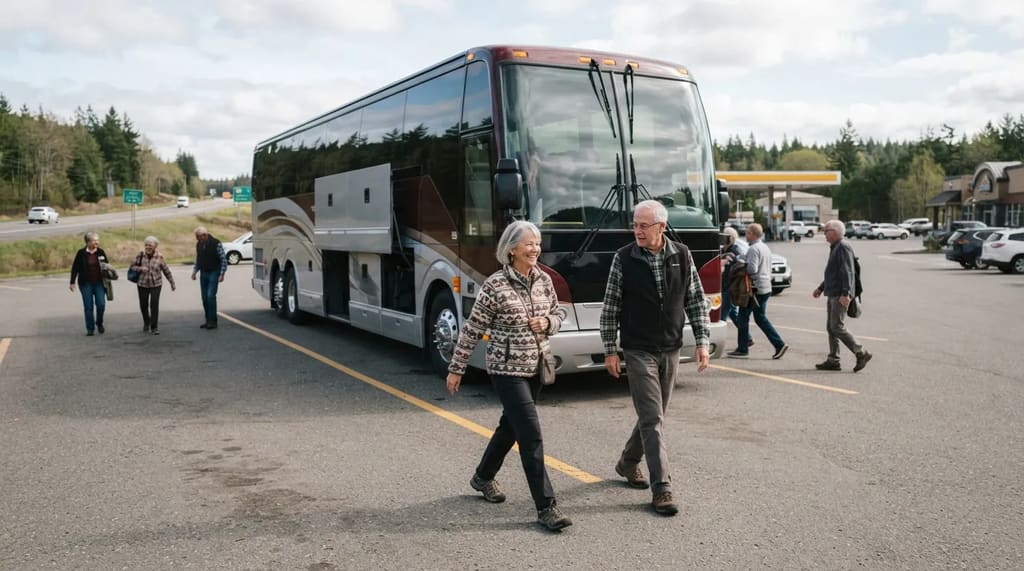
The CDC says anyone traveling more than 4 hours, whether by air, car, bus or train, can be at risk for blood clots. Its advice is to move your legs frequently and walk around every 1 to 2 hours.5
FMCSA’s passenger guidance seems to point the other way on first reading. It encourages passengers to stay seated as much as possible while the coach is in motion.
The two pieces of advice fit together at stops. Pacing the aisle of a dark, moving coach is the wrong way to follow the clot advice, and sleeping through a rest stop to stay in your bunk is the habit to break.
Use every stop to get off and walk for a few minutes. Ask the driver how long the stop will last so you can plan your lap.
Walking helps most if you know what a clot looks like, and about half of the people who have one feel nothing at all.
#5 – Clot Symptoms During and After the Ride
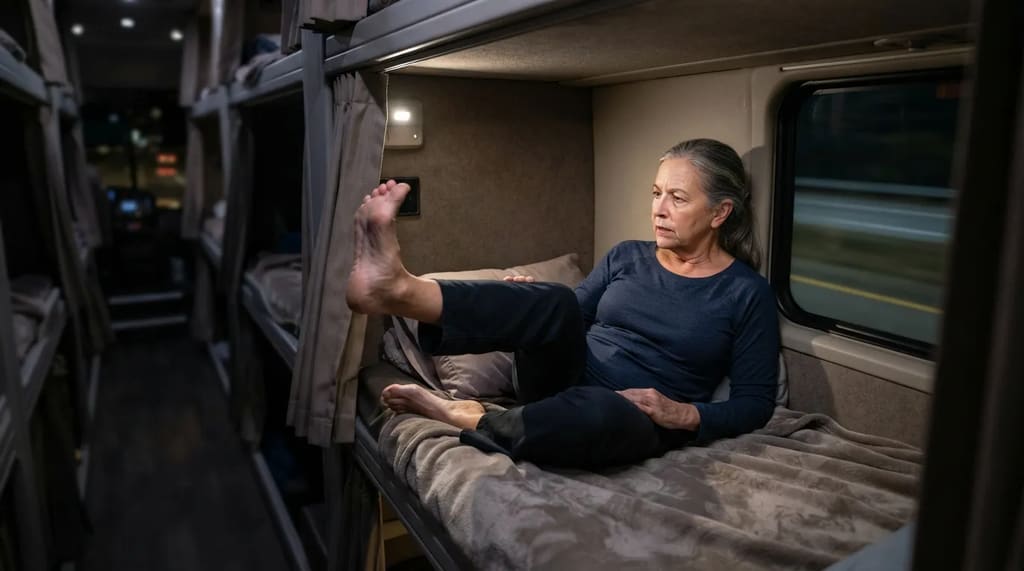
Sudden shortness of breath or chest pain requires emergency care, according to the CDC. Don’t wait for morning, and don’t assume it’s indigestion from the rest-stop dinner.
Quieter signs show up in the leg. The CDC lists pain or tenderness with no clear cause, and skin that’s warm to the touch, red or discolored.
Because about half of cases have no symptoms, prevention carries the weight. The University of Michigan’s health service suggests pointing your foot upward, clenching your toes for three seconds and repeating 10 times on each foot every half hour, which you can do during any stretch you’re awake.
Age raises the odds. Older age is a listed risk factor, along with a previous clot, a clotting disorder, and a recent surgery, hospitalization or injury.
If any of those apply, ask your doctor before you book, since a doctor may prescribe compression stockings.
Clots build over hours. The risk at a window exit is measured in seconds, and it depends on a latch you may be lying beside.
#4 – The Window Exit Beside Your Bunk
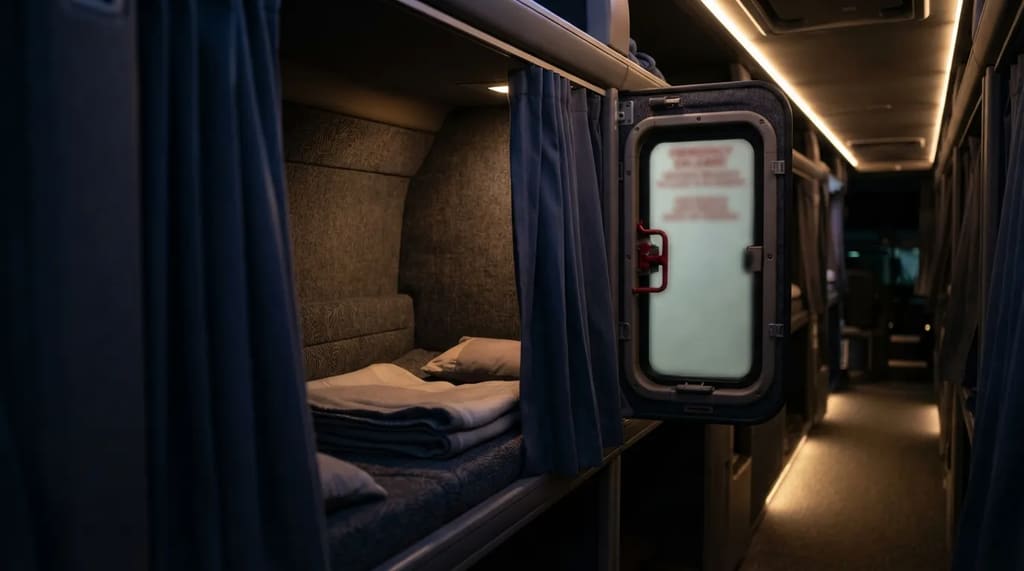
Not every window is an exit, and the ones that are come with a lock you have to work yourself. Exit windows are marked, with instructions to release a pull or push lock.3
FMCSA’s list of exits includes push-out windows, the roof vent and the side door. Its passenger guide tells riders to locate the window and rooftop hatch exits.
Then comes the rule that matters if you have arthritis or a weak grip. If you’re seated beside a window exit and don’t think you can operate it, FMCSA says to move to another seat.3
Worth Knowing
- Marked windows are the ones meant to be exits
- Each one has release instructions for a pull or push lock
- Arthritis or a weak grip is a good reason to change seats
- A coach should never be driven with an open emergency exit
Read the release instructions and rehearse the hand motion without opening anything. If you can’t work the latch, move before the lights go out.
#3 – The Coach’s Build Year and the 2016 Belt Rule
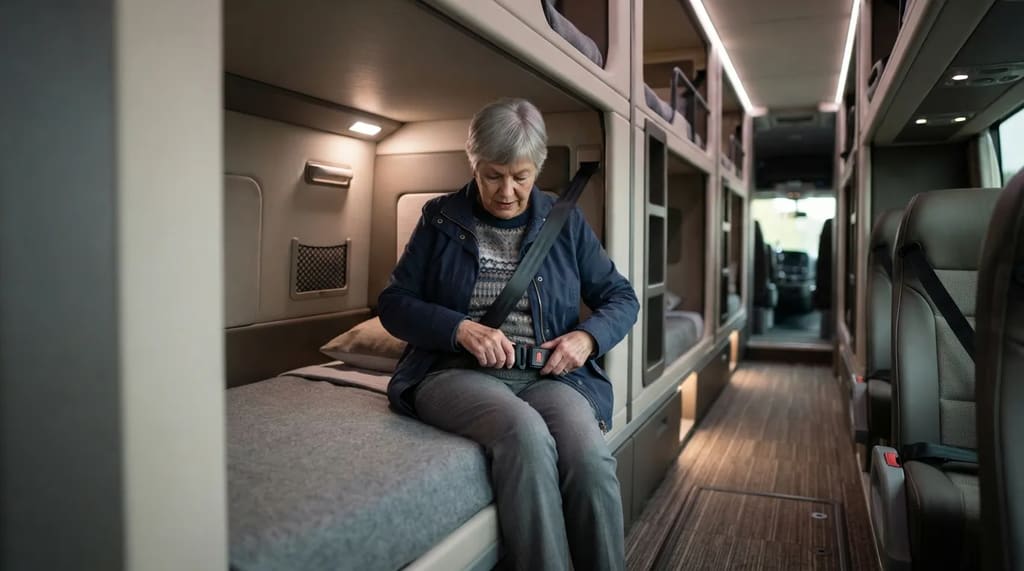
Lap/shoulder belts at every passenger seating position became a federal requirement for new over-the-road buses with a rule that took effect November 28, 2016.6 The wording matters.
The rule covers new over-the-road buses, so a coach built before that date can legally lack belts a newer one has. That’s why the build year is a real question and not small talk.
Ask the operator for the coach’s build year before you book an overnight trip. Ask also whether there are lap/shoulder belts at the places you’ll sit or sleep.
Related Stories From Travelbinger



Bunks deserve their own question. The statute speaks of safety belts at each designated seating position, so ask separately how a bunk is restrained.
Belts are only part of what happens if a night goes wrong. The first minute after waking in the dark has a sequence of its own.
#2 – Your First Minute After a Sudden Stop
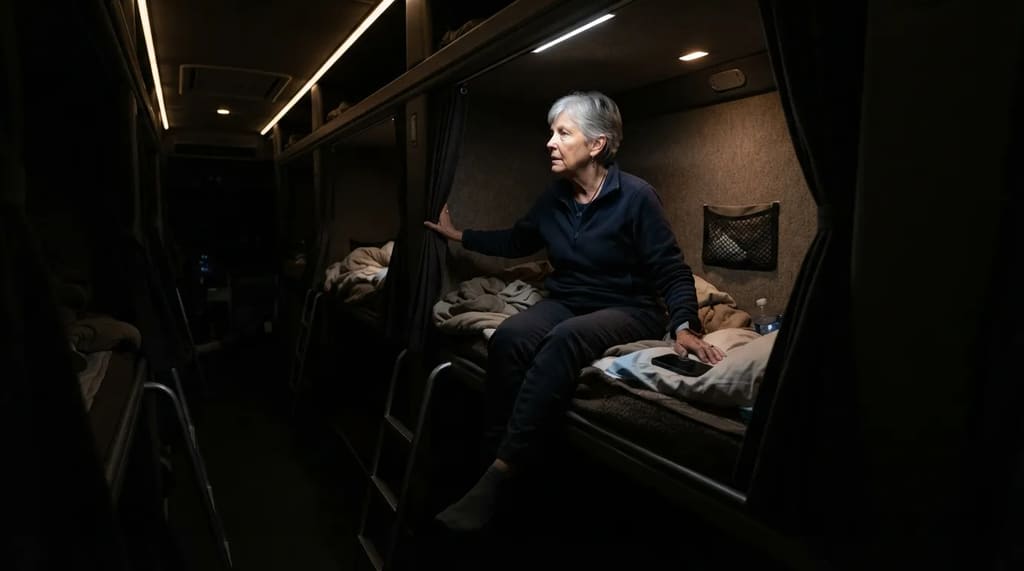
Plan the first minute before you lie down, because you won’t plan it afterward. A hard stop or a burst of noise at 3 a.m. leaves little time to think.
FMCSA’s passenger guide says to listen to and follow the driver’s instructions, and to call 911 if you believe your safety or others’ safety is in immediate danger. Listen for the driver’s instructions before you move.
Then use what you set up earlier. Your shoes are in the pouch from #14, your phone is at your pillow, and you’ve already decided which exit you’d use and whether you can work its latch.
If you can, help someone who needs it, which is exactly why you told the people near you what you can’t do. FMCSA’s guidance encourages able-bodied passengers to assist others in an evacuation.
All of that assumes you’re still in your bunk when it counts. Whether you are depends on one strap that no federal rule requires anyone to check.
#1 – The Bunk Strap No One Has to Check
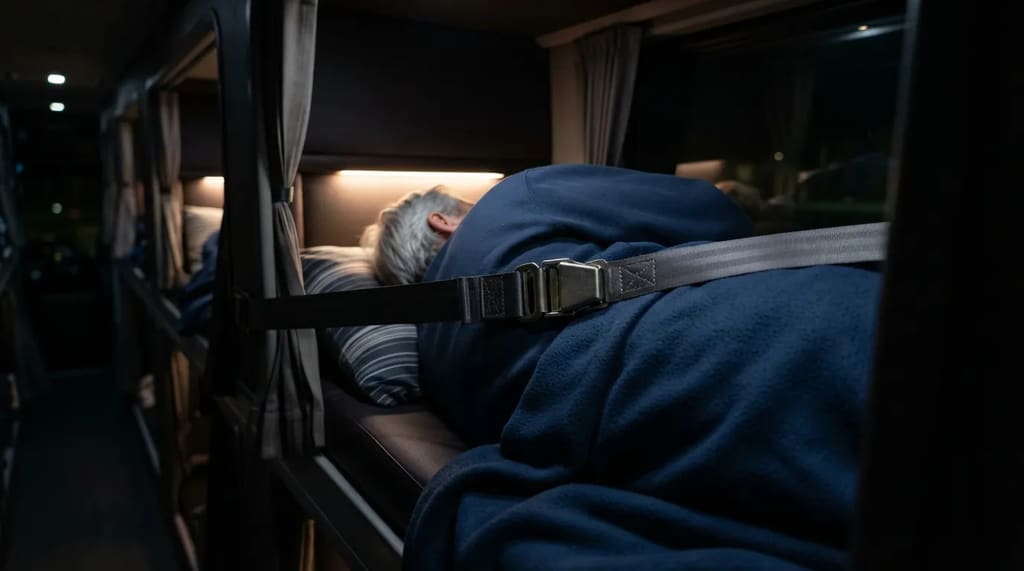
FMCSA’s seat belt rule puts responsibility on carriers and drivers, but only for passengers in property-carrying commercial vehicles. The agency has stated that it does not require seat belt use by passengers in passenger-carrying vehicles.7
What exists for coaches is guidance. FMCSA recommends using shoulder/lap belts whenever passengers occupy any seating position, if the coach is equipped with them.
A recommendation made at a boarding briefing is easy to forget at midnight. For sleeper berths, the equipment rule is more specific: 49 CFR 393.76 calls for a means of preventing the occupant of a sleeper berth from being ejected when the vehicle decelerates.
Quick Compare
- Passenger belts: FMCSA recommends using them where equipped, but doesn’t require it
- Sleeper berths: 49 CFR 393.76 calls for a way to prevent ejection when the vehicle slows
- Fastening it: no rule makes anyone check, so that part is yours
That strap, net or belt only works if it’s fastened. Look for it before you settle in, and ask the driver to point it out if you can’t find it.
No federal rule makes anyone responsible for checking your restraint after the cabin goes dark, so the check falls to you. Find your bunk’s restraint, fasten it and leave it fastened all night.
Ten seconds before lights out is the cheapest safety step on this list.
What to Settle in the Lit Cabin Before You Sleep
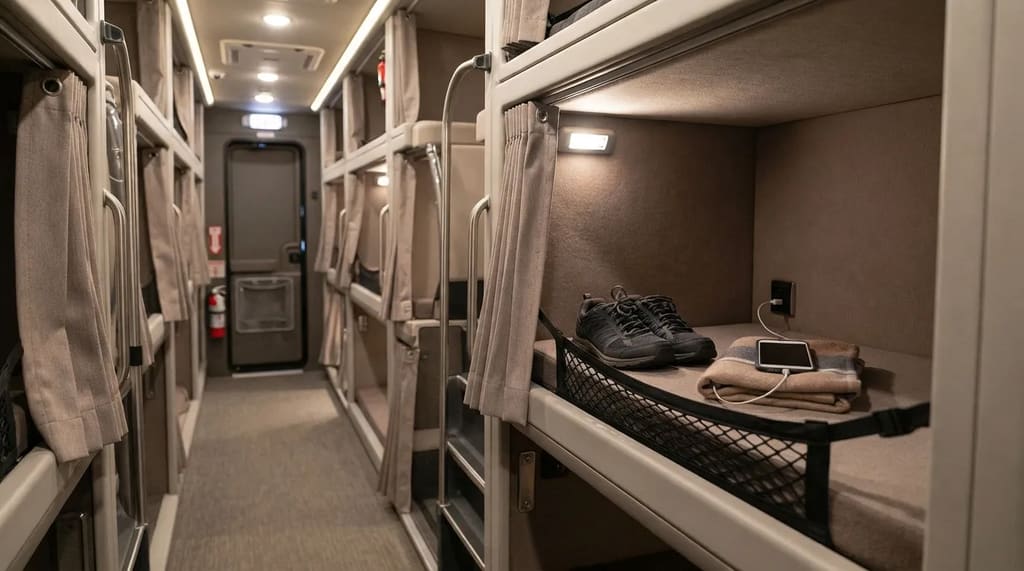
Every item here has one thing in common: it takes seconds when the cabin is lit and becomes nearly impossible once it’s dark. The briefing, the exits, the extinguisher and the belt all get checked once, at the start.
After that, you’re relying on what you did while you could still see. Treat your first ten minutes aboard as the whole inspection.
A few questions to the driver and a few motions with your hands will do more than any amount of worry at 2 a.m. The coach will keep rolling through the dark either way.
What you control is whether, when it matters, your shoes, your phone and your strap are exactly where your hand expects them to be.
- FMCSA Hours of Service Summary: https://www.fmcsa.dot.gov/regulations/hours-service/summary-hours-service-regulations
- FMCSA Pre-Trip Safety Topics: https://www.fmcsa.dot.gov/safety/passenger-safety/pre-trip-safety-information-bus-passengers
- FMCSA Learn Before You Board: https://www.fmcsa.dot.gov/sites/fmcsa.dot.gov/files/docs/LearnBeforeYouBoard_V1_4_print_LL_508%20(1).pdf
- FMCSA Passenger Safety Pre-Trip Guidance: https://www.fmcsa.dot.gov/safety/passenger-safety/pre-trip-safety-information-motorcoach-passengers
- CDC Blood Clots and Travel: https://www.cdc.gov/blood-clots/risk-factors/travel.html
- NHTSA Bus Seat Belt Rule: https://regulations.justia.com/regulations/fedreg/2013/11/25/2013-28211.html
- FMCSA Passenger Seat Belt Rule: https://www.govinfo.gov/content/pkg/FR-2016-06-07/html/2016-13099.htm