Royal Caribbean’s senior fare sits behind a link labeled “Apply a promo code and exclusive rates,” and the age it asks for is 55, not 60 or 65. If you never click it, you pay the full fare.
That is the pattern behind most of the 15 perks below: they exist, but you have to ask for them.
Skip them and you can end up paying for wheelchair help you never arranged, a port you cannot reach, or a doctor’s visit that lands on your onboard account.
The cheapest item in this piece, a travel insurance policy, is tied to the largest bill of all. But it starts with the document a cruise line may ask to see when you claim an age-based rate.
#15 – The Photo ID That Backs Up Your Age
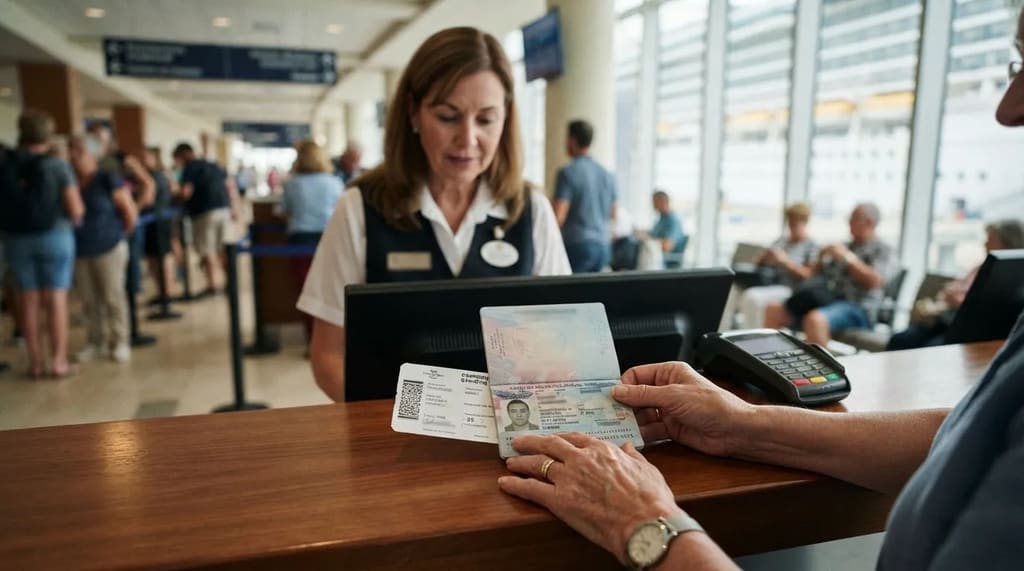
Senior discounts at cruise lines are generally promotional, not permanent perks, which means the rate you were quoted depends on the promotion still being valid on the day you sail. You may need to show proof of age at check-in, so keep a government ID with your birth date in the same folder as your boarding documents rather than packed in a suitcase.
The age itself varies. Most cruise lines that offer senior discounts require travelers to be at least 55, though some promotions require 60, 62, or 65.
That makes the terms printed on the specific promotion more reliable than any general rule you have heard.
Fast Facts
- Most common minimum age: 55
- Other cutoffs you may see: 60, 62 or 65
- When proof may be requested: at check-in
- Best place for your ID: with your boarding documents, not in a suitcase
Age is only the first test. How many people in the cabin must meet it differs by line, and Royal Caribbean’s rule is the easiest to satisfy.
#14 – Royal Caribbean’s 55+ Box Behind the Promo Link

The steps are short, and you can check them in a few minutes at the guest-count stage of booking:
- Click “Apply a promo code and exclusive rates.”
- Select “Seniors (Age 55+)” in the pop-up.1
- Click “Apply discounts.”
That is the whole sequence. The part that helps couples with an age gap is that at least one guest in the cabin must qualify, so a 56-year-old traveling with a 52-year-old spouse can still get the rate.
The fare applies to selected sailings only. A Royal Caribbean representative told Money Talks News that discounted rates “vary depending on season and availability.”
So run the search for two or three departure dates before you decide the box did nothing.
Carnival uses the same age cutoff but gives you no price to look for.
#13 – Carnival’s Senior Calendar With No Posted Price
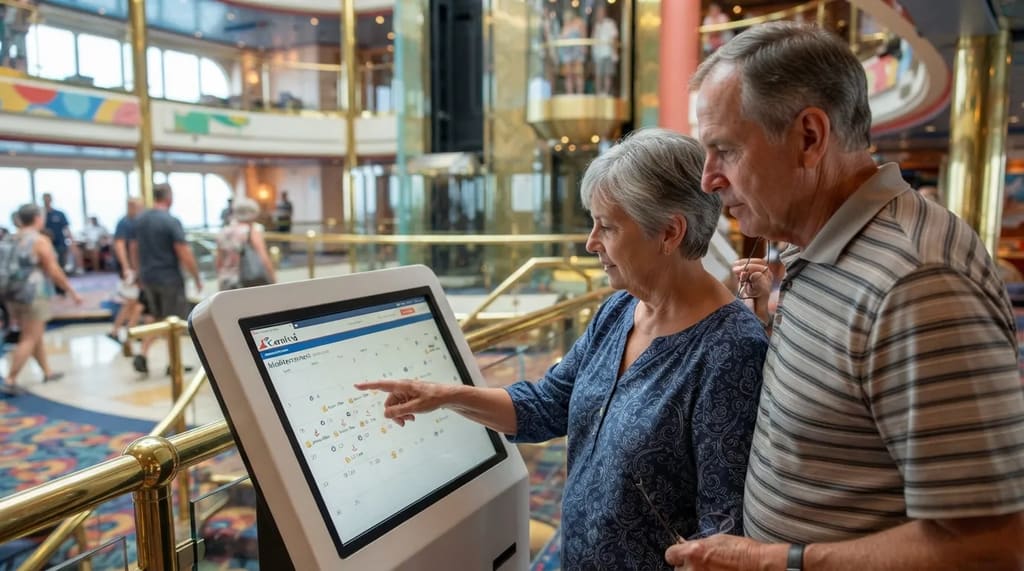
Carnival offers senior fares for passengers aged 55 and older, but doesn’t advertise a set rate, and the discounts aren’t available for every cruise.2 What it does have is a dedicated calendar for seniors aged 55 and up, so you can view the lowest fares for that age group.
You can also reach the discount during booking, because Carnival will ask whether you are 55 or older. Cruise Critic’s tip is to add the “Deals” filter and choose “Age 55+”.
Because there is no posted rate, you have nothing to compare against unless you price the same sailing both ways. Senior rates usually cannot be combined with other promotions, so a general sale can beat the senior fare, and the only way to know is to check both.
#12 – Celebrity’s “First Two Guests” Rule

Celebrity offers senior rates to guests 55 and older on select sailings and stateroom categories. The fine print covers who in the cabin benefits.
The discount usually applies to the first two guests in a cabin, so a grown child or friend sharing a three- or four-berth cabin would pay the regular fare.
To check, search the website and apply the “Senior (55+)” fare category when booking. Compare that total with what you would pay on a line that discounts the whole cabin, because the headline percentage matters less than the final bill for everyone sharing the room.
The rule works well for a couple traveling alone, and it works against families. MSC’s version starts from the opposite premise, and it is stricter still.
#11 – MSC’s Senior Club and the Whole-Cabin Test

MSC uses 65 rather than 55 for its U.S. Senior Club, which takes 5% or 10% off when everyone in the cabin qualifies.3 4
If you are 70 and your spouse is 62, the discount does not apply to your cabin. That is a harder test than Royal Caribbean’s single-guest rule, and it is the reason a couple should check eligibility before choosing a line on price alone.
Quick Compare
- Royal Caribbean: age 55+, and only one guest in the cabin must qualify.
- Celebrity: age 55+, with the discount usually covering the first two guests.
- MSC U.S. Senior Club: age 65+, 5% or 10% off, and everyone in the cabin must qualify.
Published guides do not agree on the age. One lists MSC’s discount for guests 65 and up and another says typically 60 or older, with the difference tied to region and promotion.
One roundup adds that the discount applies to guests who book on MSC’s own website.
Age-based rates are not the only discount available, since some lines reward membership or loyalty instead.
#10 – AARP, Military and Past-Passenger Discounts

Some cruise lines offer additional discounts if you are an AARP member, a military veteran, or a past passenger of that cruise line. With some lines these may stack on top of the senior rate, which is why they are worth raising as a separate question.
The AARP benefit does not always look like a discount. On at least one line there is no published senior fare, and AARP members get onboard credit instead, per stateroom, sized by cabin and cruise length, up to $200.
That offer isn’t valid on single cabins or the World Cruise, and can’t be combined with other offers.
Some lines also make you ask. Norwegian and Princess require you to call or chat with a reservations agent to request the senior rate.
When a line works that way, make the call and ask about each discount in turn: senior, AARP, military and past passenger. Then ask which ones can be used together.
Knowing which discounts exist matters less than knowing when the fare drops, and that depends on the calendar.
#9 – The January Window and the Half-Empty Ship
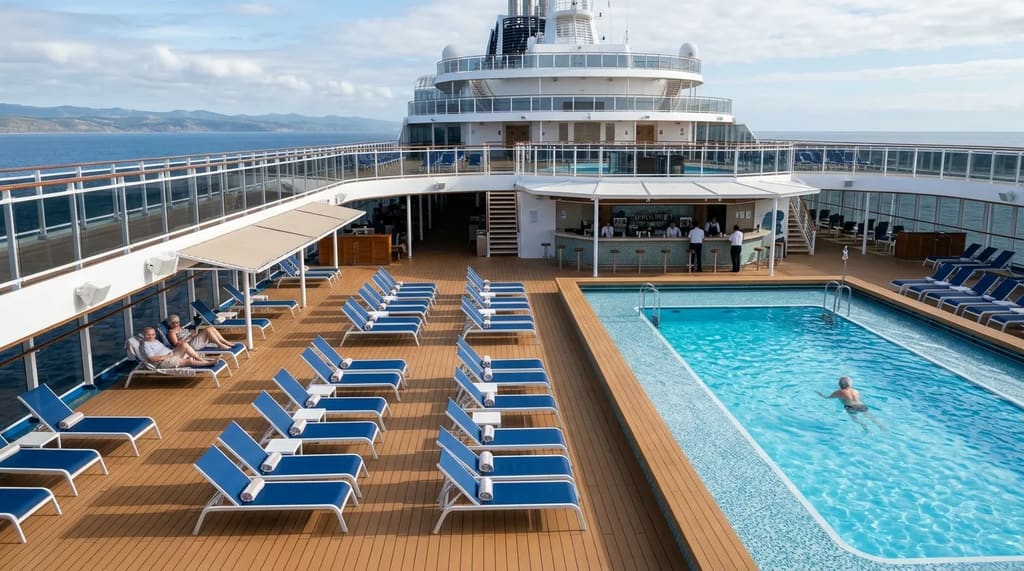
Two different calendars produce lower fares. Wave Season, January through March, is when the deepest fares and onboard credits tend to appear.
The other comes near departure, because cruise lines offer large discounts when they need to fill remaining cabins. They suit different travelers, since booking in January gives you the choice of cabin and booking late gives you price but fewer cabins to pick from.
Some senior-discount sites promise 60 to 70 percent off. Those figures belong to last-minute fill-in deals, and the age-based fares discussed above are quoted far lower, so do not expect a senior card alone to produce them.
If you need accessible equipment, a specific cabin or flights that connect, the late-booking route carries more risk. The later items on mobility assistance show how much of that has to be arranged in advance.
Whatever fare you land on, it buys the same standard cabin, and some lines sell a step up with “concierge” in the name.
#8 – What Celebrity’s Concierge Class Includes

Concierge Class functions as an upgraded Veranda Stateroom, sitting between standard Veranda rooms and full Suites. The name overpromises slightly, because it does not offer a personal concierge, though a dedicated concierge is available to all Concierge guests.
What you do get includes priority check-in, a welcome bottle of sparkling wine, and fresh daily snacks, plus preferred seating times at the main and specialty restaurants, based on availability.
The room is the same size as a standard veranda, and it does not include access to the exclusive restaurants reserved for AquaClass or suite guests.
That settles the value question. The upgrade is a modest one focused on convenience, location and service, not space or exclusivity, so pay for it only when the price gap is small, and skip it when it costs close to a suite upgrade.
Several of the smaller extras in that package can be used the day you board, starting with the pillows.
#7 – The Pillow Menu, Umbrella and Binoculars
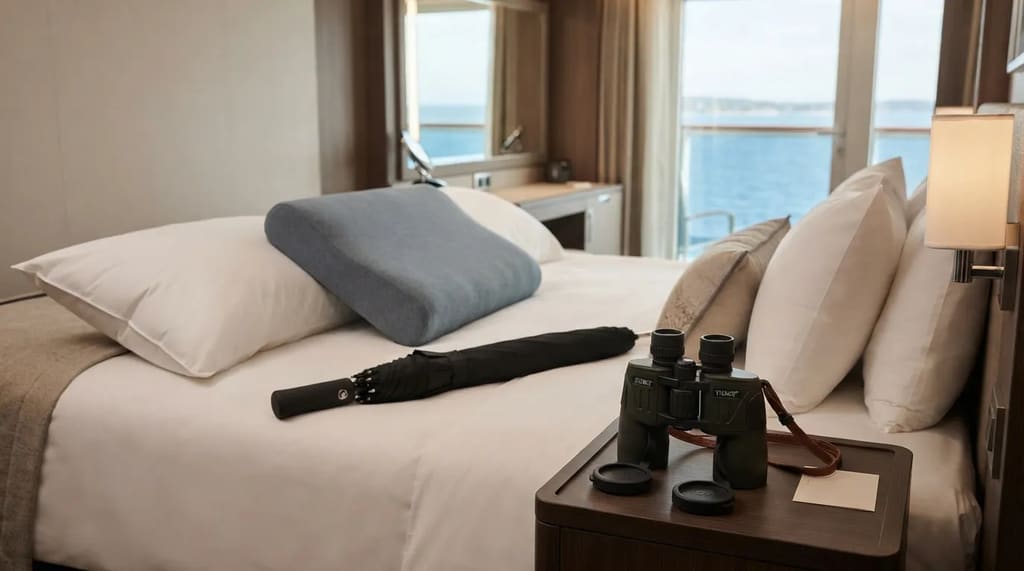
The Concierge Class pillow menu has five options, including goose down, a firmer conformance pillow and a hypoallergenic version. If you dislike your choice, you can ask the Concierge to swap it at any point in the cruise.
A pillow that hurts your neck on night one does not have to be endured for seven.
The loaner items are practical for a port day. The package includes an umbrella and binoculars for the length of the cruise, though the binoculars can’t leave the ship for excursions, along with complimentary shoe-shining and a second in-room hair dryer.
These small services are most noticeable on busy sailings, where lines, reservations and logistics can otherwise take more time. They are conveniences rather than reasons to buy the upgrade, which is why the Concierge Class verdict above still stands.
#6 – Suite Tiers, Lounges and the Daily Cost

Other lines build their concierge offer around a lounge. Disney sells concierge staterooms with a private lounge and sun deck and earlier booking for onboard activities.
On Royal Caribbean, Sea Class offers some perks but no lounge access, while Star Class adds a personal “Royal Genie” and complimentary specialty dining. Norwegian’s The Haven pairs a concierge with 24-hour butler service.
Check the specific ship before you assume any of this exists. Not all cruise ships have concierge lounges.
The price gap is also large, since concierge-level cabins on a Disney ship can cost hundreds of dollars more per day than a standard room. At even a few hundred dollars more per day, a week at sea adds well past $1,000.
For most couples, a free breakfast and a quiet lounge do not justify that. The parts of the package that save real effort are the priority tender boarding and the escorted exit from the ship.
#5 – Priority Tendering and the Escorted Exit

Where the ship cannot dock, guests are taken to shore by small boats called tenders. On Royal Caribbean, suite guests get priority access, so they are among the first ashore.
The same ship also lets suite guests relax in the lounge on the last day and be escorted off at their leisure, avoiding the main rush.
Disney’s concierge guests get a similar service, including priority access to tender boats. Between 7:15 and 8:15 a.m., a concierge team member meets you in the lounge and escorts you toward midship, where you can get off the ship quickly.
If standing in a crowded corridor or waiting in a long queue is the hard part of travel for you, this is the most useful part of the concierge tier. It is also worth asking about before you pay for the rest.
A cabin category is not the only route to help at the gangway, because lines also run assistance programs that cost nothing but must be requested ahead.
#4 – Wheelchair Help at the Pier, and When to Ask
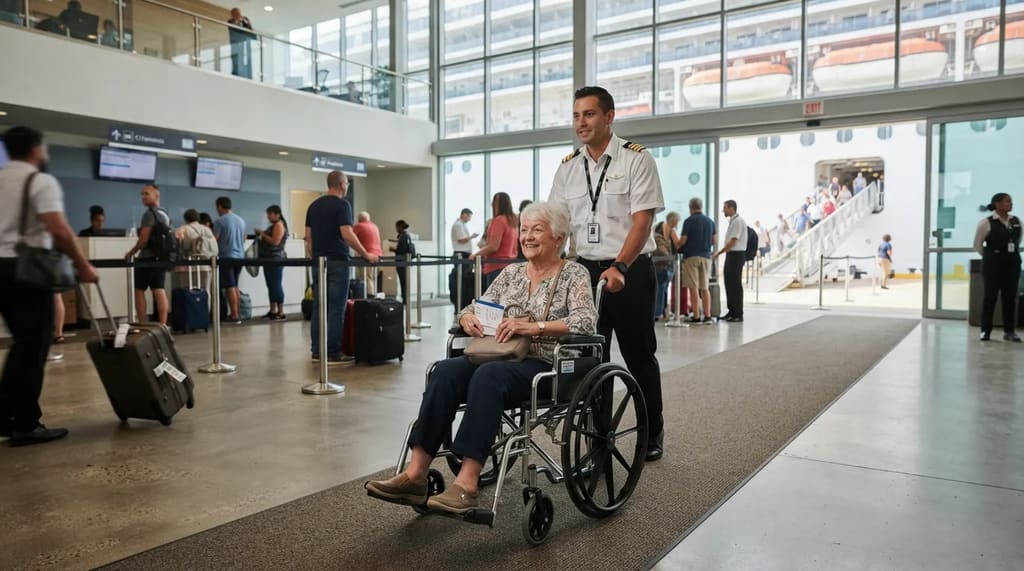
Royal Caribbean offers boarding and departure assistance to guests in wheelchairs or with mobility disabilities, and asks you to contact them 30 days before your cruise so they can prioritize your assistance.5
Norwegian’s rules show how the details differ. Guests must enter the terminal before they can be given wheelchair assistance, and it typically does not start until 11 a.m.
Equipment is another gap. Norwegian has a limited supply of wheelchairs onboard, kept for emergency rental on a first come, first served basis.
On Carnival, wheelchair assistance is available only during embarkation and debarkation at the home port, so if you need a chair or scooter during the cruise, bring one or rent one.
The price comparison site CruiseClarify puts rental at roughly $150 to $185 for a scooter on a seven-day cruise from a U.S. port, and about $50 to $85 for a wheelchair. Submit your accessibility form right away, which gives the line time to arrange services.
A rented scooter or power chair works at the pier and in the cabin, then stops at the edge of a tender port.
#3 – Tender Ports and the Scooter That Stays Aboard
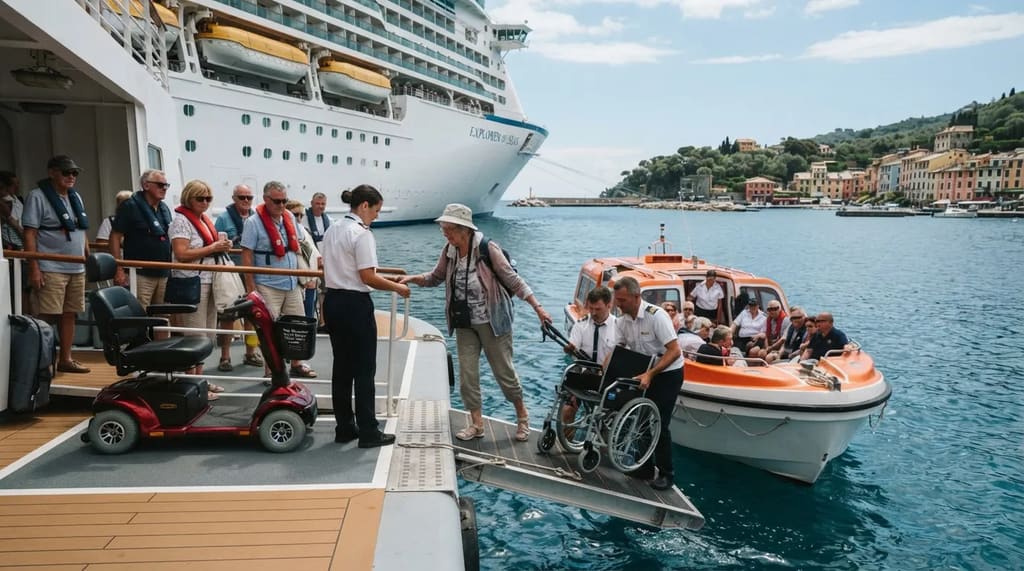
Royal Caribbean states that guests must be able to take steps and use a collapsible manual wheelchair to board most tenders. Also, motorized wheelchairs and mobility scooters cannot be taken on tenders unless roll-on capability is available.5
If you cannot go ashore for these reasons, there will be no refund or credit for missed ports. On Carnival, boarding depends on weather and tides, and the captain makes the final decision.
Related Stories From Travelbinger



Cruise Critic advises scooter and power chair users to pick an itinerary with few, if any, tender ports. Newer ships help in places, since Millennium-class and Edge-class ships have a tender loading platform that wheelchair users and smaller scooters can use.
This is where the senior discount from the earlier items stops being the point. A 10 percent saving does not buy back a port you cannot leave the ship to see.
A missed port is a disappointment you can plan around, whereas a medical problem at sea is billed immediately.
#2 – What a Ship’s Medical Center Charges

Every major cruise ship has a medical center staffed by licensed doctors and nurses, open for emergencies and walk-in appointments. The care is not free.
Published estimates show how quickly the cost climbs:
At a Glance
- Daytime visit: $100 to $300
- After-hours visit: $300 to $600 or more6
- Overnight infirmary stay: often $1,000 to $3,000 per day6
- X-rays, lab tests, IV fluids and medications: billed separately
The charges are billed as you go. They post directly to your onboard account, and you will almost always pay before you walk off the ship.
Your regular coverage does not help much either. According to the CDC and Department of State, most cruise lines do not accept U.S. health insurance or Medicare, so passengers pay out of pocket and seek reimbursement later.7
Even a routine problem can become a four-figure bill by the end of the week.
Those bills look small beside what happens when the ship cannot treat you and you have to be moved to a hospital.
#1 – The Evacuation Bill Behind a Cheap Policy
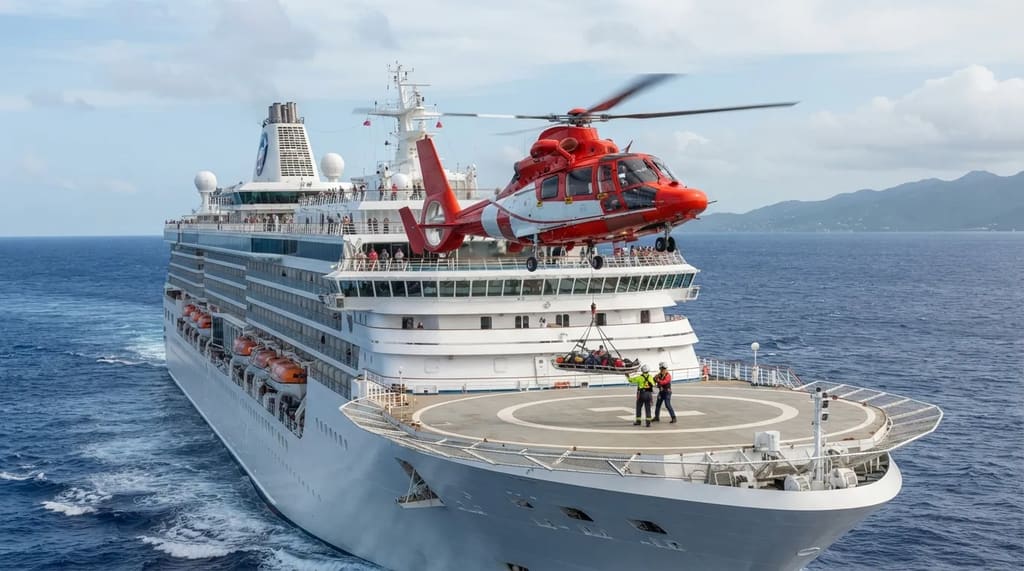
Estimates for a medical evacuation vary widely, depending on where the ship is and how you are moved. One travel insurance association official puts it at $10,000 to $50,000.7
Another insurer places a helicopter evacuation to a mainland trauma center at $50,000 to $200,000, with an air ambulance from a Caribbean port to the U.S. running $30,000 to $80,000. The ship’s care comes first and is billed on top of the evacuation, because the ship’s medical center will stabilize you first, charging $150 to $200 per hour.
Protection is cheap by comparison. Travel insurance for a cruise typically runs 5 to 10 percent of your total trip cost, and for a $3,000 cruise for two, that means $150 to $300 for complete coverage including medical evacuation.
That is about the same size as the senior discount you worked to find at the start, so you can think of the discount as paying for the policy.
Check the evacuation limit on whichever plan you choose, because the gap between plans is wide.
Worth Knowing
- Royal Caribbean’s plan: $500,000 of evacuation coverage
- Princess’s Platinum plan: $100,000
- Disney’s plan: $50,000
- Source of the comparison: the insurance site CoverTrip
Ask the insurer, or a licensed agent, how pre-existing conditions are handled before you pay.
Questions Worth Asking Before You Book
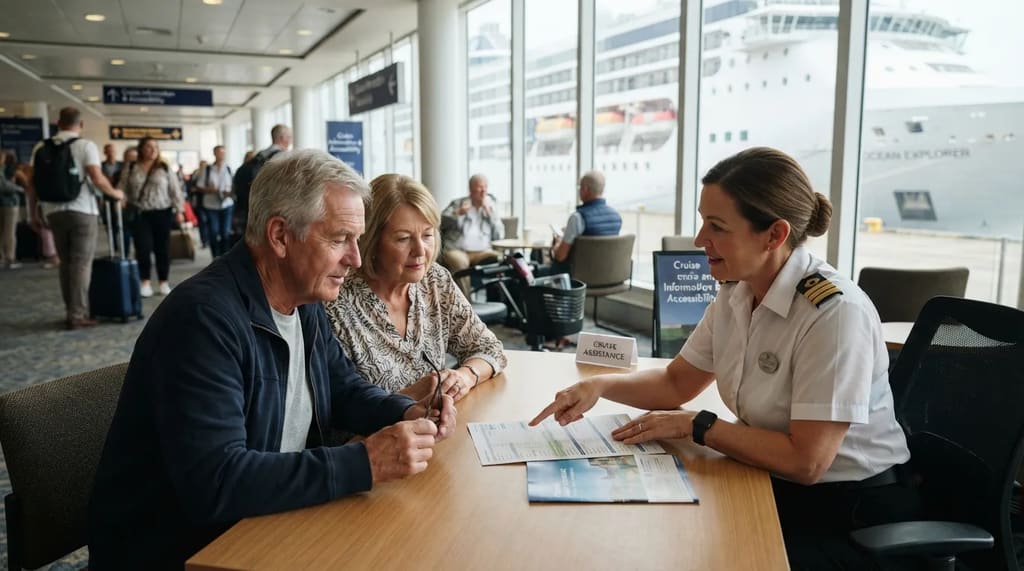
Each item here works the same way: the benefit exists, and the line will provide it once you ask for it. The senior fare, the AARP credit, the wheelchair help at the pier and the right travel policy all depend on a question asked weeks before you sail.
Since the senior discount and the insurance premium are about the same size, treat them as a pair. Claim the discount, and spend it on the coverage.
What did you ask a cruise line for before sailing, whether a rate, a service or a piece of equipment, and how did they respond?
- Royal Caribbean Senior Discount Guide: https://www.royalcaribbeanblog.com/2025/03/01/royal-caribbean-senior-discount
- Money Talks News Cruise Discounts: https://www.moneytalksnews.com/slideshows/senior-discounts-on-cruises/
- MSC Senior Club Discount: https://www.msccruisesusa.com/cruise-deals/cruises-for-seniors
- Senior Cruise Discounts Guide: https://seaboundjourneys.com/senior-cruise-discounts.html
- Royal Caribbean Accessible Assistance: https://www.royalcaribbean.com/experience/accessible-cruising/additional-assistance
- Yonder Cruise Medical Costs: https://www.insureyonder.com/cruise-ship-medical-costs/
- Generali Cruise Medical Coverage: https://www.generalitravelinsurance.com/travel-resources/cruise-medical.html